
Can Emotional Exhaustion Change Who You Are?
You used to be the one who laughed easily. The one with patience for the people you love. The one who cared, sometimes more than was good for you.
Lately, something is off. You snap at small things. You feel flat where you used to feel a lot. You look back at an older version of yourself and quietly wonder what happened to that person.
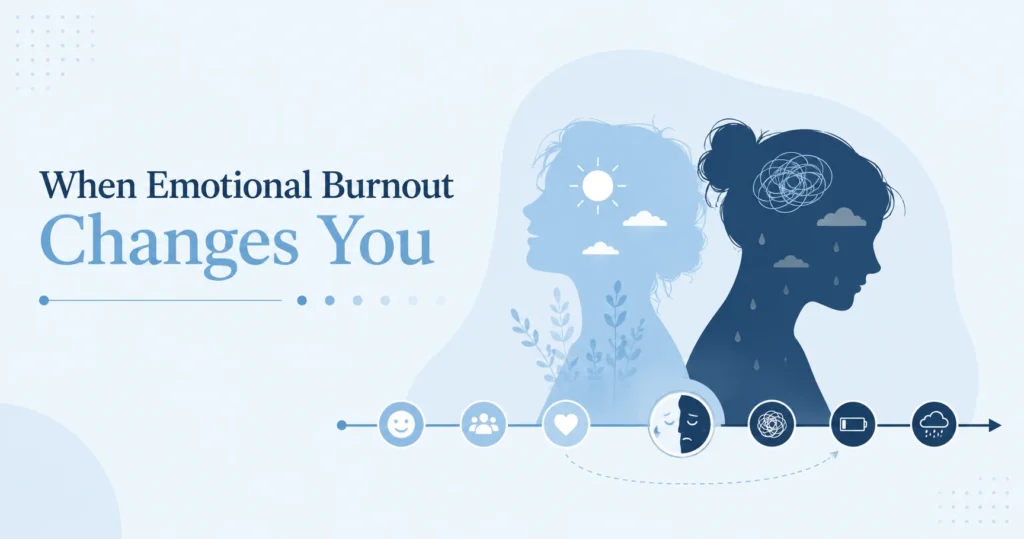
If you recognize yourself in that, you have not simply become a worse person. What you may be living through is one of the least talked about parts of emotional exhaustion: a slow, quiet shift in your personality that almost no one sees coming, least of all you. This guide explains how and why emotional burnout changes the way you think, feel, and show up, and where to begin finding your way back.
What Are the Symptoms of Emotional Exhaustion?
Emotional exhaustion symptoms include irritability over small things, emotional numbness, growing cynicism, pulling away from people you love, and feeling like a stranger to yourself. It is the core dimension of burnout and often shows up first, before tiredness reads as a real problem. It builds over months, not one bad day.
Emotional exhaustion is what happens when your emotional reserves run dry. Not from one hard day, but from months or years of carrying too much at once: stress, grief, pressure, worry, caregiving, conflict, the kind of load that never gets called a crisis because you are still functioning. Still showing up. Still getting things done.
The Maslach Burnout Inventory, one of the most widely used tools in burnout research, treats emotional exhaustion as the central piece of burnout, the part that several researchers describe as the essential component, with the other dimensions theoretically related but distinct. That is part of what makes mental exhaustion symptoms so easy to miss, and why they so often show up in the body before you name them. You do not feel like you are falling apart. You just feel like you have quietly become someone else.
Can Emotional Exhaustion Change Your Personality?
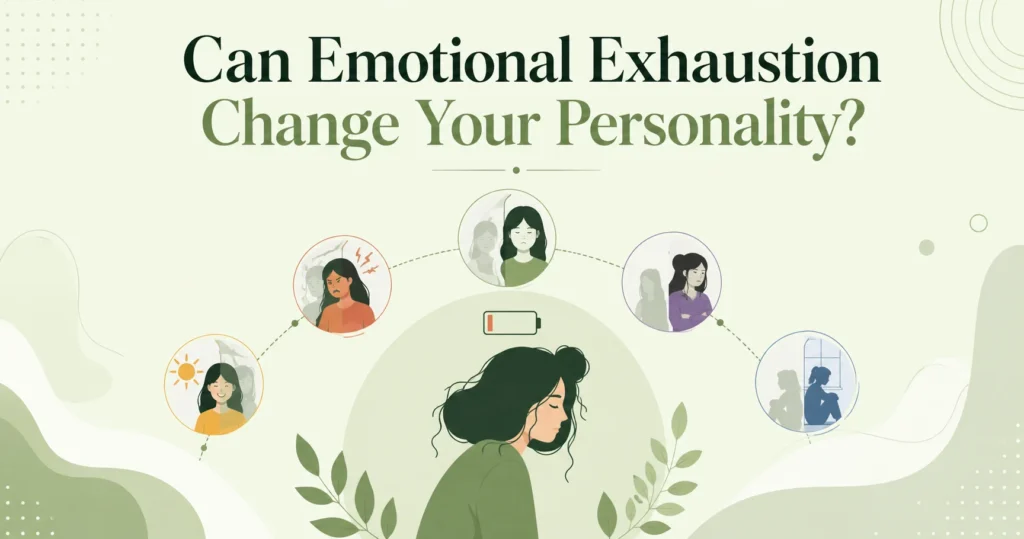
Yes. When emotional reserves stay low for a long time, the traits that make you you, your warmth, drive, humour, and patience, go quiet because they need energy you no longer have. Research on burnout documents irritability, numbness, cynicism, and withdrawal. These are recognized features of exhaustion, not character flaws, and they reverse.
Here are the five shifts people describe most often. If you have been searching how emotional exhaustion affects personality, or wondering whether stress is changing your personality, you may meet yourself in more than one of them.
1. You Become Irritable in Ways That Confuse You
If you are trying to understand why your mood has shifted, the signs of emotional burnout often start with your fuse. You lose your temper over something small. You feel a flare of resentment toward people you genuinely love. A low, simmering frustration that does not lift, even on good days.
This is not a character flaw. There is a body reason for it. Chronic stress is associated with weakened connections in the prefrontal cortex, the part of the brain that handles emotional regulation and impulse control, as a 2021 research review by Woo, Sansing, Arnsten, and Datta describes. In plain terms, the prefrontal cortex is the brain’s calm-it-down centre. When it is worn down, the gap between feeling irritated and acting on it shrinks. The same overload can show up as burnout brain fog, where focus and clear thinking get harder to hold.
The part that hurts most is that this emotional exhaustion and irritability tends to land first in your safest relationships. Your partner. Your kids. Your closest friends. It surfaces at home long before it ever surfaces at work. You are not becoming a mean person. Your nervous system is signalling that it has been stretched past its limit.
2. You Stop Caring About Things That Used to Matter
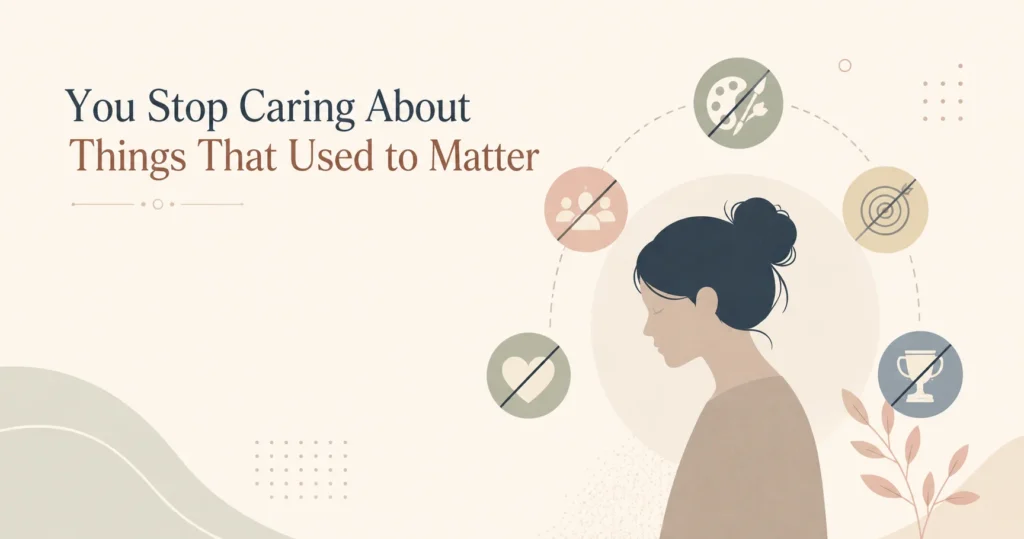
This one is quiet and deeply unsettling. A hobby you loved starts to feel pointless. A friendship you valued starts to feel like effort. Goals that once pulled you forward feel hollow. This is emotional numbness, and it is one of the most misunderstood emotional burnout symptoms.
Under long stretches of stress, the brain can start muting emotional signals as a form of self-protection. You keep operating, but you feel oddly disconnected from your own life. Researchers who study this describe a state called hypoemotionality, a muted kind of feeling where you can still express emotions but experience them as strangely faint. You recognize joy without quite feeling it. You know you love someone, but the love is not arriving in the moment.
This is why people living with emotional numbness symptoms so often say the same thing. “I feel like I am watching my life from a distance.” Or, “I know I should care about this, and I just do not.” It is not indifference. It is your mind trying to protect you from a load it cannot keep processing. This is the heart of emotional numbness and personality change: the warmth is not gone, it has gone quiet.
3. You Become Cynical When You Were Once Hopeful
There is a specific personality shift that comes with longer burnout: the slow slide into cynicism. Where you once gave people the benefit of the doubt, you now expect to be let down. Where you once felt hopeful, you now feel tired at the very thought of trying.
Cynicism is one of the recognized dimensions of burnout. The World Health Organization classifies burnout as an occupational phenomenon with three parts: exhaustion, increased mental distance or cynicism toward your work, and a reduced sense of getting things done. When hope costs energy you no longer have, cynicism becomes the cheaper option. Expecting less means being drained less.
But it changes how you relate to the world and to yourself, and for people who were once warm, open, or idealistic, that can feel like losing a part of who they are. One thing worth holding onto: cynicism born from exhaustion is not who you are. It is a coping strategy your mind adopted without asking you first. This is one of the clearest examples of personality changes due to stress.
4. You Withdraw From People, Even the Ones You Want to Be Close To
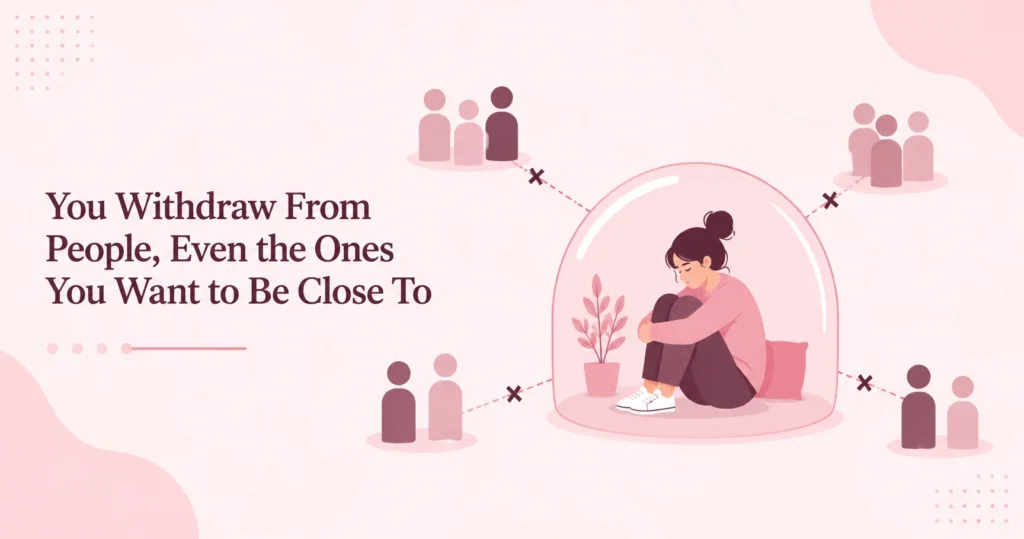
Chronic stress and personality changes often show up most painfully in relationships. You stop reaching out. You cancel plans and feel relief instead of guilt. You are physically in the room but mentally somewhere else. You still love the people around you, but being social feels like spending money from an account that is already empty.
This kind of social withdrawal is well documented in burnout research, and it is rarely about caring less. Emotional availability takes resources, and emotional exhaustion is the slow draining of exactly those resources. For Canadians raised to “stay strong” and keep it together, this pulling away can go unnoticed for a long time, by others and by you. It is one of the quieter forms of emotional burnout and behavior changes.
5. You Feel Like a Stranger in Your Own Life
Maybe the most disorienting of all the emotional exhaustion effects is this: the creeping sense that you no longer recognize yourself. You think back to who you were two or three years ago and it genuinely feels like a different person. You find yourself at 1 a.m. typing things into a search bar like “why do I feel like I changed as a person” or “feeling like I’m not myself anymore,” wondering if something is seriously wrong.
Nothing is seriously wrong in the way you might fear. But something real is happening. Our sense of self leans heavily on emotional continuity, on motivation, and on staying connected to what we value. When emotional resources run chronically low, that sense of self starts to feel fractured. The qualities that defined you, your warmth, your drive, your humour, your hope, go quiet, because they all run on energy you can no longer reach. This is the experience behind feeling like a stranger in your own life. It is not permanent. But it takes more than willpower to come back from.
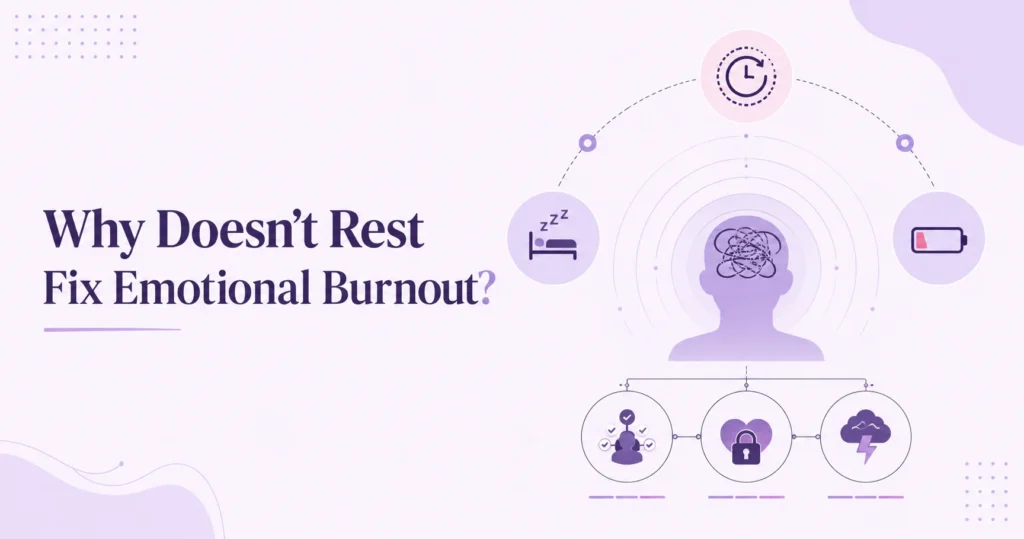
Why Doesn’t Rest Fix Emotional Burnout?
Emotional exhaustion is not a fuel tank that refills with a weekend off. It is a nervous system recalibrated toward survival mode over a long time. Real recovery means addressing the patterns underneath: overcommitment, emotional suppression, and unresolved stress. Rest helps, but it is not enough on its own, which is why people come back from a break still feeling flat.
This is one of the most frustrating parts of burnout. A two-week vacation can end with you still irritable, still numb, still not quite yourself. As CAMH explains, burnout tends to show up as disengagement, helplessness, and a loss of motivation and hope, which is not something a few quiet days simply reset. When the exhaustion is knotted up with older wounds, it can help to read how trauma, stress, and burnout feed one another, and how support untangles them.
This is where structured support starts to matter. Cognitive behavioural therapy, or CBT, a practical talk therapy that helps you notice and shift the thought patterns keeping your nervous system stuck in overdrive, is one of the most studied approaches for stress-related struggles. CBT for burnout works on the loops that keep the overload running, and helps rebuild the link between what you think, what you feel, and how you act, which is exactly what emotional exhaustion pulls apart. If you want to understand how CBT works before anything else, you can start there with no commitment.
If you need help right now
Saalvio is not a crisis service. If you are in immediate danger, please call 911. If you are in mental health crisis, please call 988 (the Suicide Crisis Helpline of Canada) or visit your nearest emergency department. You can also find more crisis resources any time.
How to Recover From Emotional Exhaustion
Recovery from emotional exhaustion is possible, and it asks for more than rest. It means lowering the load that created the overload, reconnecting in small ways without forcing yourself to feel better on cue, and getting support rather than waiting it out alone. Change does not happen overnight, but the personality shifts that came with burnout do reverse over time.
If you have been reading this and nodding, here are some gentle starting points.
Name What Is Happening
There is real power in naming the experience. “I am emotionally exhausted, and it is affecting my personality” lands very differently than quietly deciding you have become a worse version of yourself. The first is something you can work with. The second is just shame.
Reduce the Load, Not Only the Symptoms
Treating irritability or numbness on their own rarely holds. Look at what is creating the overload in the first place: the overcommitment, the unspoken pressure, the resentment you keep swallowing. The symptoms ease when the underlying weight does. If work is the biggest source, our guide on how to stop feeling emotionally exhausted after work has practical places to begin.
Reconnect With Small Things
You do not need to summon passion or joy on demand. Start with small acts of engagement: a walk, one honest conversation, something you make with your hands. There is no pressure for any of it to feel meaningful right away. With burnout, small is not a compromise. Small is how it works.
Seek Support
Emotional exhaustion rarely resolves through solo willpower. Talking with our clinical team of registered psychotherapists and registered social workers, using CBT tools, or simply having a safe place to say how you actually feel can make a real difference. If you are not sure where to begin, this guide on how to find a therapist walks through it gently.
Be Patient With Yourself
Personality changes from burnout do not happen overnight, and they do not reverse overnight either. But they do reverse. How long does emotional exhaustion last is rarely a fixed number. It depends on how long the load has been building, and on the support you reach for now.
You Can Find Your Way Back to Yourself
The version of you that felt warmer, more hopeful, more present has not disappeared. That person is buried under a great deal of unprocessed stress and emotional fatigue, not erased by it.
Coming back takes the right kind of support, not just more sleep. And it begins with seeing what is happening for what it actually is: not a personal failing, but a very human response to carrying too much for too long. If you recognized yourself here, you do not have to figure out the next step tonight, and you do not have to take it alone.
How Saalvio Can Support You
Saalvio is a Canadian mental health platform built around practical, CBT-informed tools and real human care. Whether you are living with burnout and chronic stress, emotional exhaustion, or that unsettling sense that you lost yourself somewhere along the way, there is a place here to start rebuilding.
In Ontario, our clinical team of registered psychotherapists and registered social workers offers virtual therapy that fits into your actual life. If burnout has been sitting alongside depression or anxiety, the same clinical work can hold all of it at once, since these so often arrive together.
Not ready to book? You can message a registered psychotherapist before you book and ask whatever you need to ask: whether they have worked with someone like you, whether their approach fits, whether they will understand the life you come from. There is no cost and no commitment, and messaging is for questions, not therapy by text. Every Canadian’s first therapy session with a Saalvio clinician is free, so deciding to try is not a financial gamble on whether the fit is right.
- Download the Saalvio app for the full self-help experience, available across Canada and North America.
- Book a therapy session through the Saalvio web client portal, offered in Ontario today.
Frequently Asked Questions
Can emotional exhaustion actually change your personality?
Yes. Research on burnout consistently documents personality shifts: more irritability, emotional numbness, growing cynicism, and pulling away from people. These are recognized features of emotional exhaustion, not character flaws. They come from running on emotional reserves that have been empty for too long, and they ease as those reserves are rebuilt.
Why do I feel like I’m not myself anymore?
When your emotional resources are chronically depleted, the traits that make you you, your warmth, motivation, humour, and empathy, all need energy you no longer have. So they go quiet. That creates a real and disorienting shift in how you experience yourself. Nothing is seriously wrong in the way you might fear, but something real is happening, and it responds to support.
Can stress change your personality permanently?
The changes are real, but the evidence says they are not fixed. Cynicism, numbness, and a short fuse are coping patterns your mind adopted under overload, not your permanent character. As the load lowers and you get the right support, the warmth, patience, and drive that went quiet tend to return. Recovery is rarely a straight line, but it is possible.
Is emotional burnout the same as depression?
They overlap but are not the same. Burnout is mainly tied to prolonged external stress and overload. Depression has a broader set of causes and can show up without an obvious stressor. Both deserve support. If you are not sure which fits you, speaking with a registered psychotherapist or registered social worker is the most helpful next step.
How long does it take to recover from emotional exhaustion?
There is no fixed timeline. It depends on how long the exhaustion has been building and what support you reach for. With real changes to workload and stress, plus the right tools, many people notice shifts within weeks to months. Deeper recovery often takes longer and is supported by professional guidance. Gentle, steady progress matters more than speed.
Can CBT help with emotional burnout?
Yes. CBT, a practical talk therapy that targets the thought patterns feeding emotional overload, is one of the most evidence-based approaches for burnout and stress-related struggles. Because those patterns are a core driver of the personality changes that come with burnout, working on them directly is one of the most useful places to start.
Clinically reviewed
Usman Khan, Registered Psychotherapist
Usman Khan is the Clinical Director of Saalvio and a Registered Psychotherapist with the College of Registered Psychotherapists of Ontario (CRPO #13456). He holds an MD, an MPH from Western University, and an MA in Counselling Psychology from Yorkville University. He reviews all clinical content on saalvio.com before publish.
See also across Saalvio
Topics mentioned in this post that have their own page on the site.
Talk to our clinical team
Saalvio offers a free 30-minute consultation with any therapist on the team. There is no card on file. If we are not the right fit, we will say so and help you find one.