
How to practice IFS self-therapy at home
Book a Free 30-Minute Consultation
You do not have to understand every part of yourself to start. You just have to be willing to sit down and listen to one part first.
Doing IFS self therapy at home means learning to notice the different parts of your mind. It means talking to them with kindness instead of pushing them away. Many people use gentle, guided steps to try self therapy IFS on their own, between sessions or as a way to reflect. This is not the same as full clinical IFS therapy with a trained clinician, and it is not a way to diagnose or treat trauma on your own. It is a starting point for noticing what is already inside you.
If you already know what IFS therapy is, you may just want the steps. If not, we will walk through it slowly, the way Saalvio walks through everything.
Saalvio offers online therapy in Ontario with Registered Psychotherapists and Registered Social Workers trained in IFS, delivered through secure virtual sessions. This kind of digital therapy means you do not have to leave your kitchen table to talk with someone who understands parts work and can go deeper than a worksheet ever could.
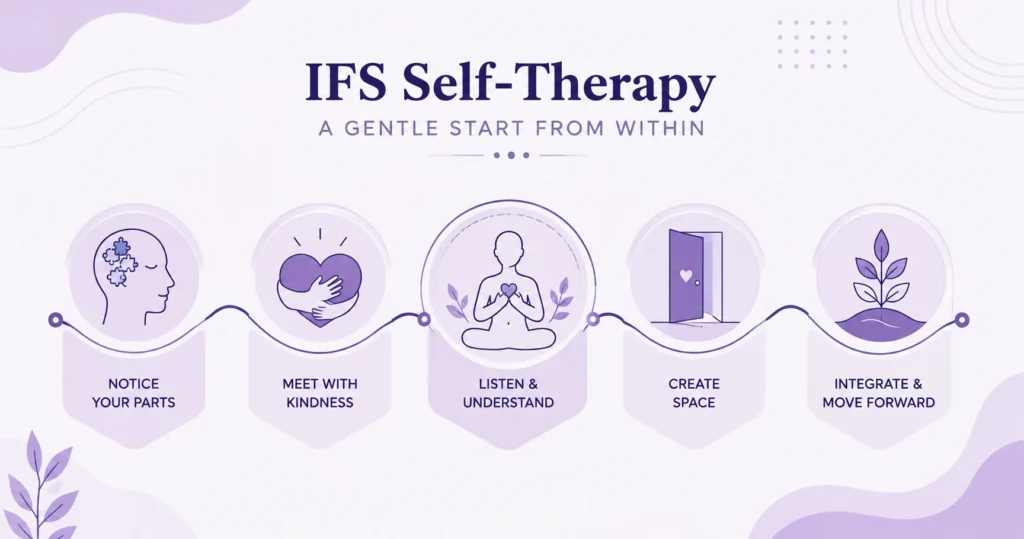
Why people try doing IFS yourself
Doing IFS yourself at home is appealing because it costs nothing and it can happen at 11 p.m., when the noisy part of your mind will not let you sleep. A lot of people search for how to do IFS therapy on themselves after a hard day, hoping for a way to quiet the part that will not stop talking.
Home practice can help you build a habit of noticing your parts. It is not a replacement for working with a Registered Psychotherapist or Registered Social Worker, especially if your parts are carrying trauma, grief, or anything that feels too big to sit with alone. If your parts hold trauma, IFS therapy for trauma explains why that work usually goes better with a trained guide beside you.
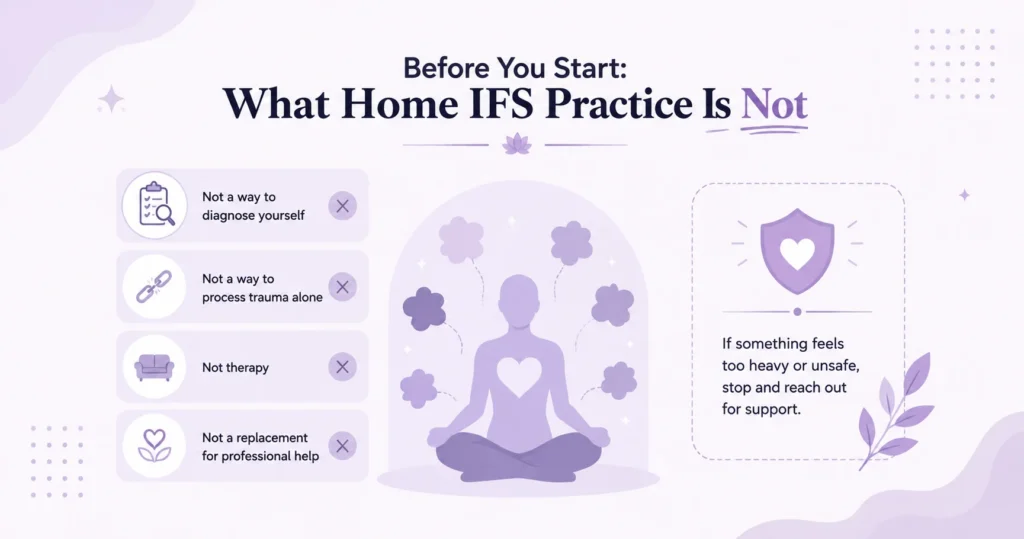
Before you start: What home IFS practice is not
Home IFS practice is not a way to diagnose yourself. It is not a way to process trauma alone. It is not therapy. It is a quiet, low-pressure way to get curious about your inner world, the same way journaling or a walk outside is a way to get curious about your day.
If a part you meet during home practice is carrying something painful, like abuse, loss, or a memory that feels unsafe to sit with, stop the exercise and reach out to a therapist. This is one of the clearest limits of self-guided work, and it protects you.
A simple self-therapy IFS process you can try at home
This is a gentle version of self-therapy IFS, built for a quiet ten or fifteen minutes. Go slowly. If anything feels too heavy, stop and be kind to yourself about stopping.
Step 1: Find a quiet spot
Sit somewhere you will not be interrupted. Put your phone face down. Take three slow breaths.
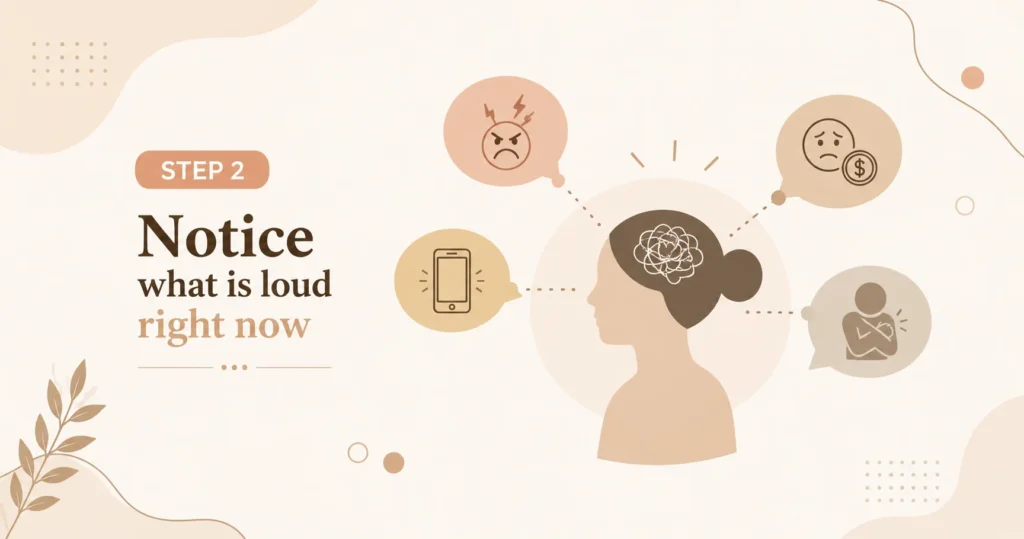
Step 2: Notice what is loud right now
Ask yourself, “What part of me is loudest today?” Maybe it is the part that is angry at a coworker. Maybe it is the part that keeps checking your phone. Name it in a few words. “The part that is scared about money.” “The part that wants to hide.”
Step 3: Get curious, not critical
Instead of judging the part, ask it questions. “What are you afraid would happen if you stopped doing your job?” “How long have you been carrying this?” Many people find this easier with a self-therapy workbook IFS process, a simple written guide with prompts, so they are not starting from a blank page.
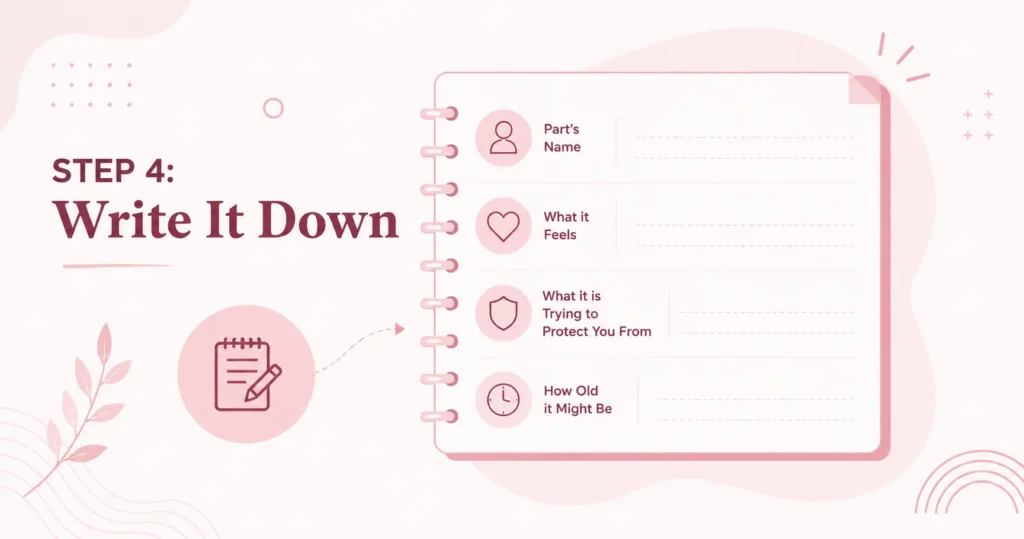
Step 4: Write it down
An IFS therapy worksheet or an IFS parts mapping worksheet can hold what you notice. On paper, write the part’s name, what it feels, what it is trying to protect you from, and how old it might be. This is a small version of internal family systems mapping, drawing out your inner world so it is easier to see.
Step 5: Thank the part
Every part, even the ones that feel unhelpful, is trying to protect you in some way. Thank you before you close the exercise. You do not have to fix it today. You only have to see it.
If you want to go deeper into the language IFS uses for this, 6 F’s of IFS lays out the steps clinicians follow when they sit with a client’s part, and 8 C’s of IFS describes the calm, steady qualities of Self that this whole process is working toward.
Where to find IFS therapy worksheets PDF guides
Many clients ask their therapist for IFS therapy worksheets PDF downloads to use between sessions. A printed worksheet can make home practice feel less abstract. It gives your hands something to do while your mind does the harder work. If you are working with a Saalvio therapist trained in IFS, you can ask for a worksheet built around what you are working on together, rather than a generic one pulled from the internet.

When home practice is not enough
Parts that carry old pain, sometimes called exiles in IFS language, often need a trained person in the room. Not because you are doing something wrong on your own. Because some parts have been protecting you for so long that stepping toward them safely takes real clinical skill. Knowing how to find a therapist who works well with parts language can make the difference between a search that stalls and one that leads somewhere good.
IFS therapy techniques walk through what that looks like in a real session, including how a therapist helps you approach a hard part without being overwhelmed by it.
IFS is also used to understand the parts that show up in our closest relationships, the part that shuts down during an argument, the part that needs constant reassurance. IFS therapy for relationships looks at how this work can change the way you show up with the people you love.
If you are not sure whether IFS is the right fit compared to other approaches, IFS vs. CBT vs. EMDR lays out the difference in plain language, so you can make an informed choice.
You can message a therapist trained in IFS with your questions first, then book a free 30-minute consultation to meet them and decide together if it feels right. It is not a full therapy session, just a chance to talk before you commit to anything. There is no cost and no obligation either way.
Frequently Asked Questions
Is it safe to do IFS on my own?
Light, reflective home practice, like noticing a part and writing about it, is generally low risk for most people. If a part is connected to trauma, abuse, or a memory that feels too big, stop and bring it to a trained therapist instead of working through it alone.
Do I need an IFS worksheet to start?
No. A worksheet or workbook can help you stay organized, but the practice itself only needs a quiet ten minutes and a willingness to listen to yourself without judgment.
Can home IFS practice replace therapy?
No. Self-guided practice can build awareness between sessions, but it does not replace working with a Registered Psychotherapist or Registered Social Worker, especially for trauma, grief, or anything that feels unsafe to sit with alone.
How do I know if a part needs professional support?
If a part brings up a memory, image, or feeling that overwhelms you, or if you feel unsafe, panicked, or unable to calm down after the exercise, that is a sign to pause and reach out to a clinician rather than continuing alone.
Clinically reviewed
Usman Khan, Registered Psychotherapist
Usman Khan is the Clinical Director of Saalvio and a Registered Psychotherapist with the College of Registered Psychotherapists of Ontario (CRPO #13456). He holds an MD, an MPH from Western University, and an MA in Counselling Psychology from Yorkville University. He reviews all clinical content on saalvio.com before publish.
See also across Saalvio
Topics mentioned in this post that have their own page on the site.
Talk to our clinical team
Saalvio offers a free 30-minute consultation with any therapist on the team. There is no card on file. If we are not the right fit, we will say so and help you find one.