
CBT Exercises: Simple Techniques to Change Your Thoughts and Feel Better
Book a Free 30-Minute Consultation
There is a particular kind of tired that has nothing to do with sleep. It is the mind that will not slow down. The replay of a conversation from this afternoon. The worry about tomorrow that arrives the moment your head hits the pillow. The quiet voice that has been telling you, for longer than you have told anyone, that something is wrong with you. If that is the place you are reading this from, you are not alone, and you are not broken.
You do not have to fix all of it tonight. There is a small set of practical CBT exercises you can start on your own, with nothing more than a notebook and a few honest minutes. This guide explains what they are, how to do them, and how to know when it is worth bringing in a real person to help. We will go gently, and we will go one step at a time.
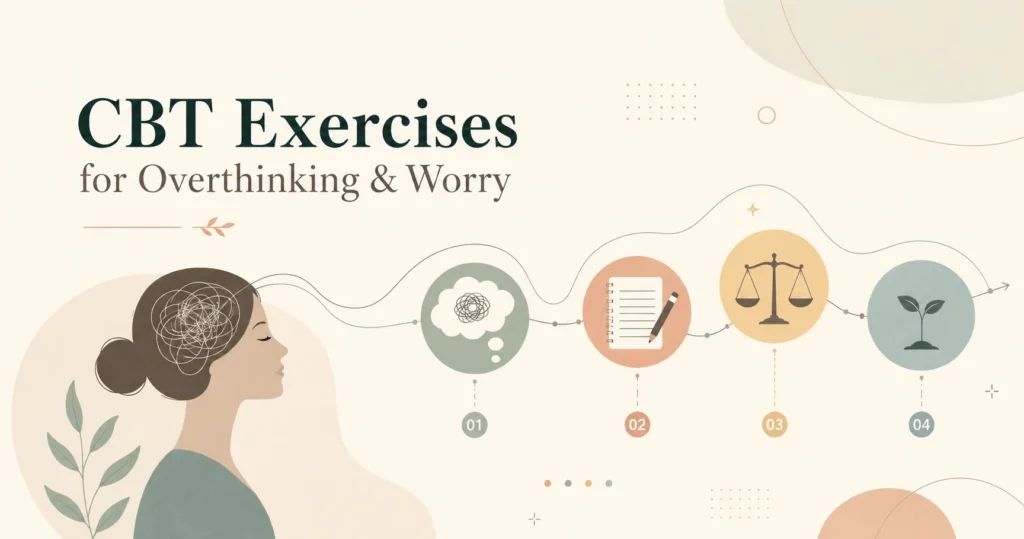
What Are CBT Exercises?
CBT exercises are simple, structured mental practices from cognitive behavioural therapy, a well-studied talk therapy that focuses on the link between thoughts, feelings, and actions. They help you notice unhelpful automatic thoughts (the fast, gut-level thoughts that feel like facts), test those thoughts against the evidence, and choose more balanced ones. Common exercises include thought records, cognitive restructuring, and behavioural activation. You can start most of them on your own today.
These are not academic theories or busywork. They are things you do in the moment a spiral begins, so that a hard thought does not get to write the whole rest of your day. If you want the bigger picture of the method behind them, our plain guide to CBT techniques lays out how the approach fits together.
Why CBT Exercises Work
CBT rests on one plain idea: your thoughts shape your feelings, and your feelings shape what you do. When your thoughts get stuck in a negative groove, your mood, your energy, and even your relationships tend to follow. Simple CBT exercises are designed to interrupt that loop before it pulls you under, by giving you a method you can repeat rather than a feeling you have to wait for.
What CBT does not do is make life’s problems vanish. We wish it did. What it changes is the way you stand in front of them. That is a smaller promise than a cure, and it is also a more honest one.
CBT is one of the most studied talk therapies we have. The Centre for Addiction and Mental Health (CAMH) describes it as a practical, evidence-based form of psychotherapy that helps people identify, question, and change the thoughts and beliefs behind the reactions that cause them difficulty.
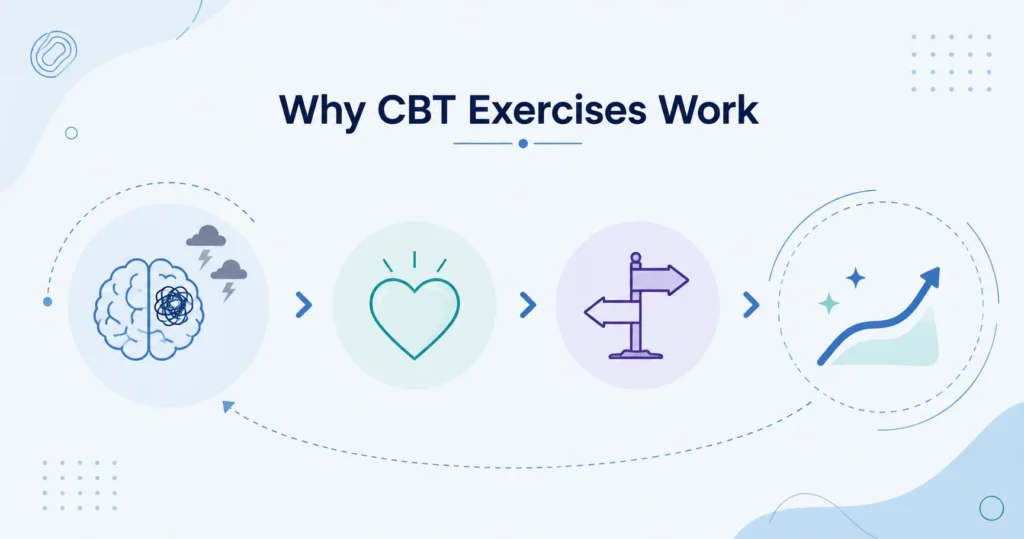
How Do You Challenge Negative Thoughts With CBT?
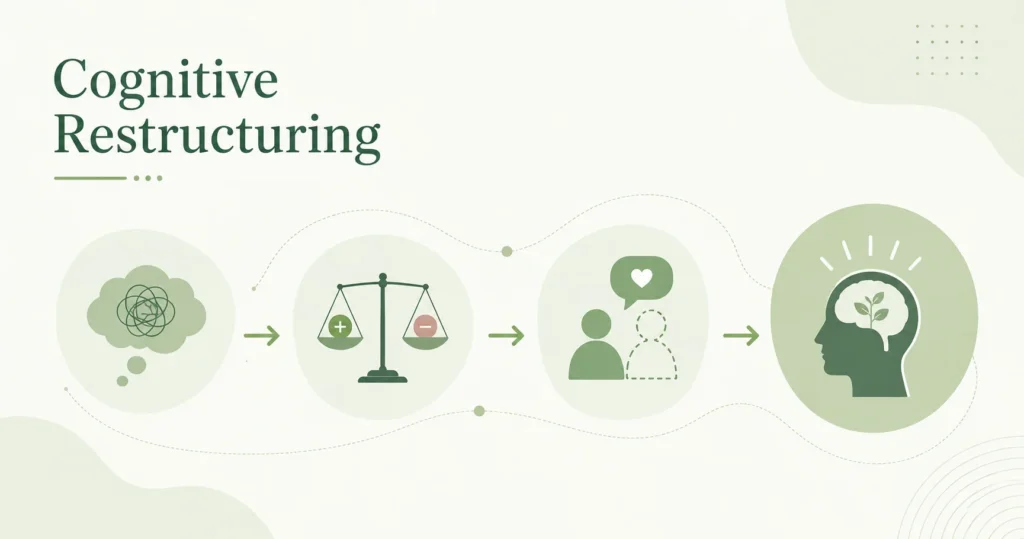
Put the thought on trial. Ask yourself three questions: Is this thought 100 percent true, and what is the actual evidence for it? What is the evidence against it? If a friend I love had this exact thought, what would I say to them? This is called cognitive restructuring, and over time it teaches your brain that it does not have to believe everything it thinks.
The goal is not forced positivity. You are not trying to talk yourself into “everything is fine.” You are looking for the thought that is more accurate, which is almost always kinder than the one fear handed you first. This is the heart of CBT for negative thinking, and it gets easier with practice.
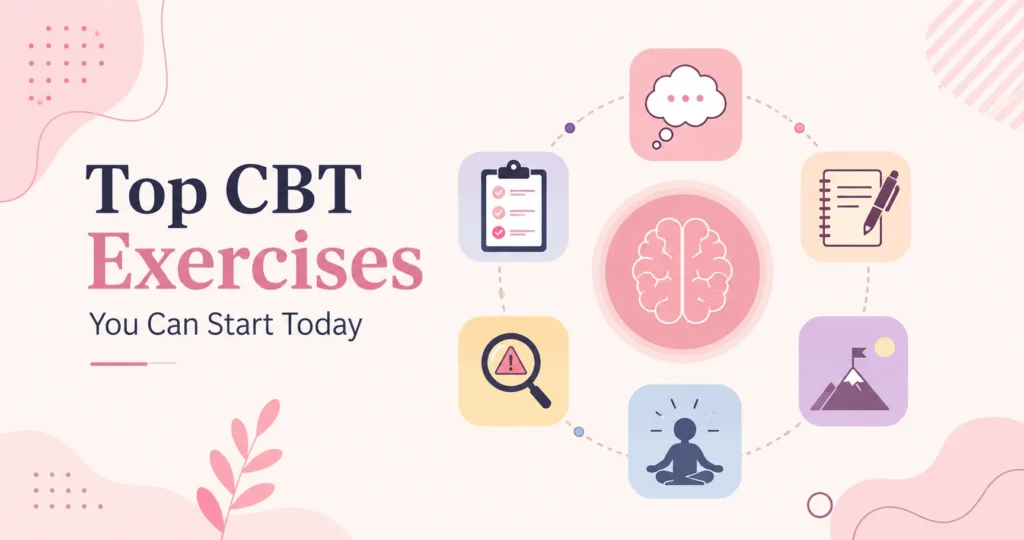
Top CBT Exercises You Can Start Today
These are common CBT techniques that trained therapists use, and they double as CBT exercises to do at home between sessions. They are simple enough to do with a cup of coffee in your hand, and they are free. You do not need anything except a few quiet minutes and a place to write.
1. The Thought Record Exercise
The thought record exercise is one of the most-used CBT techniques. When a wave of a hard feeling hits, grab a notebook or your phone and write down four things:
- The situation: what actually happened. For example, “I walked past a coworker and they did not say hi.”
- The automatic thought: what your brain said in the same second. For example, “They are upset with me, I must have done something wrong.”
- The feeling: what came up. For example, anxious, rejected, small.
- A more balanced thought: another explanation that also fits the facts. For example, “Maybe they were lost in thought or having a hard morning of their own.”
Writing it down moves you from being inside the thought to looking at it. That small distance is where the change starts.
2. Cognitive Restructuring
Cognitive restructuring is the longer name for putting a thought on trial, described in the section above. When a harsh thought arrives, you weigh the evidence for and against it, and you ask what you would tell someone you care about who said the same thing. Done a few times, it slowly loosens the thought’s grip. Your mind learns that a thought is a thing it produced, not a verdict it has to obey.
3. Behavioural Activation
Behavioural activation is the core CBT exercise for low mood, and its rule is the opposite of what depression tells you to do. When you feel low, the instinct is to retreat: stop answering texts, stay on the couch, let the world shrink. Behavioural activation flips this. The rule is that action comes first and motivation follows, not the other way around.
Start tiny. A five-minute walk. One phone call. Three dishes washed. Doing the small thing, even when you do not feel like it, is often the spark that brings a little of your mood back. With low mood, a little is a lot.
4. Graded Exposure (For Anxiety)
We tend to believe that avoiding what scares us keeps us safe. In truth, avoidance quietly feeds the fear and makes it bigger. Graded exposure means facing a feared situation in small, manageable steps instead of all at once. Afraid of busy social settings? You might start by sitting in a coffee shop for ten minutes without having to talk to anyone. Just being there, and noticing that you got through it, is the work. Each small step teaches your nervous system that the feared outcome rarely arrives.

5. The Journaling Brain Dump
Sometimes your head is simply too full to think straight. CBT journaling at its simplest is a brain dump: take a blank page and write everything down. No filter, no proper grammar, no judgment. The point is to get the heavy stuff out of your body and onto the paper, where it tends to feel smaller and more manageable than it did while it was circling inside.
6. The Positive Data Log
Our brains hold onto bad news and let good news slide right off. A positive data log gently corrects that. Each evening, write down a few small things you did well that day and one moment that felt okay. It feels almost too simple. Over time, though, it nudges a mind that has learned to scan for what is wrong toward also noticing what is steady and good.
What Are the Best CBT Exercises for Anxiety?
For anxiety, the most useful CBT exercises are thought records to catch catastrophic thinking, cognitive restructuring to weigh the evidence, and graded exposure to face feared situations in small steps. A slow out-breath and simple grounding help settle the body in the moment. Together these lower the brain’s sense of threat and build tolerance for discomfort over time.
The pattern under most anxiety is the same: the mind overestimates danger, and avoidance keeps you from ever finding out that you could cope. CBT works on both ends of that pattern at once. These are practical CBT exercises for anxiety you can begin today, and they pair well with the kind of support a therapist provides.
What Are the Best CBT Exercises for Depression?
For low mood, behavioural activation is the central CBT exercise: take a small action first and let motivation catch up, such as a five-minute walk or one short phone call. A positive data log, where you note a few things that went okay each day, slowly retrains a brain that tends to hold onto the negative and dismiss the good.
CBT for depression works by interrupting the “nothing matters” loop, getting your body moving in small ways, and rebuilding a sense that your actions still count. These CBT exercises for depression are a real place to start, and you do not have to do them perfectly for them to help. Our fuller guide to CBT for depression walks through how the approach is used in a course of therapy.
Because anxiety and low mood so often travel together, CBT exercises for anxiety and depression overlap a great deal. Thought records, cognitive restructuring, and behavioural activation all work on both. The same skills also help when a racing mind keeps you up at night, which is why there is a dedicated version of the approach in our guide to CBT for insomnia. You can read more about depression and how it tends to show up.
A Real-Life Example: The Unanswered Text
Here is a moment most of us know. You send a message to a friend, and hours pass with no reply.
- The old thought: “They are ignoring me. I am annoying. This friendship is over.”
- The feeling: anxiety, a pit in your stomach, a quiet sadness.
- The CBT thought: “They might be at work, or their phone is on silent. I have gone hours without replying too.”
- The new feeling: calmer, more neutral, or at least more patient.
It is a small shift. It is also the difference between an afternoon lost to worry and one you get to keep.
How Do You Challenge Negative Thoughts With CBT in Daily Life in Ontario?
Life in Ontario moves fast, whether you are commuting through the GTA or holding together a busy family week. CBT exercises are built to fit into the cracks of an ordinary day:
- Work stress? Use thought-challenging in the few minutes before a big meeting.
- Social nerves? Use a small graded exposure step when you meet new people.
- Low mood on the weekend? Use behavioural activation to take one small action.
Whether you are just starting to look into virtual counselling in Toronto or searching for a therapist in Waterloo, these exercises stay the core of the work. The same skills carry from a self-help notebook into a session with a registered therapist; a clinician simply helps you use them on the parts of your life that are hardest to face alone.
Do CBT Exercises Actually Work?
Yes. CBT is one of the most studied talk therapies in the world, and CAMH describes it as an evidence-based psychotherapy. The Canadian Network for Mood and Anxiety Treatments (CANMAT) lists cognitive behavioural therapy and behavioural activation among the first-line psychological treatments for major depressive disorder in adults. The exercises work best with steady practice, including on the good days, and many people find them more effective alongside a registered therapist.
That last point matters. Reading about CBT is not the same as doing it, and doing it alone is not the same as doing it with someone who can help you spot the thought you keep missing.
When Is It Time to Reach Out for More Than Self-Help?
You can use these exercises any time you feel stuck. But if your symptoms are so heavy that daily life feels out of reach, if the negative self-talk barely stops, or if self-help has not been enough after a few weeks, that is a sign to bring in support. Reaching out is not a failure of the exercises. It is what the exercises are meant to lead toward when you need more.
In Ontario, more than one door is open. Ontario residents aged 18 and older can self-refer to the free, publicly funded Ontario Structured Psychotherapy (OSP) Program, which offers CBT for mild to moderate anxiety and depression, including BounceBack phone coaching, internet-based CBT, and individual and group sessions. You do not need a referral or a health card to start.
How Saalvio Supports CBT in Ontario
If you are looking for online CBT therapy in Ontario, Saalvio offers online therapy in Ontario delivered by our clinical team of registered psychotherapists and registered social workers who use evidence-based cognitive behavioural therapy. You can learn more about how we work with this approach on our CBT page. The work is collaborative: a clinician helps you apply thought records, cognitive restructuring, and behavioural activation to your own life, at a pace that fits what you are actually carrying.
Before you book anything, you can message a registered psychotherapist before you book and ask whatever you need to ask: whether they have worked with someone like you, whether their approach fits, whether they will understand the life you come from. There is no cost and no commitment. Messaging is for questions and brief clarifications, not therapy by text, and the therapy itself happens in your booked sessions. Every Canadian’s first therapy session with a Saalvio clinician is free, so deciding to try therapy is not a gamble on whether the fit will be right.
Across Canada and North America, the Saalvio app gives you self-help tools you can carry in your pocket. You can practise thought-challenging on the GO Train, track your mood to see patterns over time, use guided CBT tools in a hard moment, and play cognitive games built to strengthen clear thinking. When it is late and the mind will not settle, Thrive, the in-app AI companion, can help you work a thought record out loud, though it is a self-help companion, not a clinician and not therapy. The app holds the full self-help library; therapy with a Saalvio clinician is offered in Ontario today. It is available on iPhone and Android, because the moments support is needed most are usually the moments you are already holding your phone.
Common Mistakes When Doing CBT Exercises
Plenty of people try CBT exercises and stop after a week. Usually it comes down to a few honest traps:
- Expecting an instant fix. You are retraining habits your mind has practised for years. That takes more than a few days.
- Practising only on bad days. The exercises work best when you do them on the steady days too, so the skill is there when a hard one arrives.
- Avoiding the uncomfortable part. Challenging a thought or taking a small exposure step can feel awkward. That discomfort is usually where the change lives.
None of these mean CBT is not for you. They are just the parts a good clinician helps you get through.
Can CBT Exercises Really Change Things?
CBT exercises do not only help you feel a bit better in the moment. With practice, they help you think more clearly, respond more calmly, and carry a steadier sense of control through ordinary days. You can start right now, with one thought record or one five-minute walk. Small steps. One thought at a time. We will be here when you are ready for the next one.
Frequently Asked Questions
What are CBT exercises?
CBT exercises are simple, structured practices from cognitive behavioural therapy, a well-studied talk therapy. They help you notice unhelpful automatic thoughts, test those thoughts against the evidence, and choose more balanced ones. Common examples include thought records, cognitive restructuring, and behavioural activation, and you can start most of them on your own.
Can I do CBT exercises on my own?
Yes. Many people begin CBT exercises like thought records and behavioural activation on their own, and they are free to try. Working with a registered psychotherapist or registered social worker usually makes the same exercises more effective, because a clinician helps you apply them to your own life and notice the patterns you tend to miss.
How long do CBT exercises take to work?
Many people notice a shift in perspective within a few weeks of steady practice. Deeper, lasting change takes longer, because you are retraining habits your mind has held for years. CBT works best when you do the exercises regularly, including on the days you feel fine, not only on the hard ones.
Are CBT exercises good for anxiety?
Yes. CBT is recommended as a first-line approach for anxiety, and CAMH describes it as evidence-based. Useful exercises include thought records to catch catastrophic thinking, cognitive restructuring to weigh the evidence, and graded exposure to face feared situations in small steps, which lowers the brain’s sense of threat over time.
Do CBT exercises help with depression?
Yes. CANMAT lists cognitive behavioural therapy and behavioural activation among the first-line psychological treatments for depression in adults. Behavioural activation, taking a small action and letting motivation follow, helps break the “nothing matters” loop, and a positive data log slowly retrains a mind that holds onto the negative.
What if self-help is not enough?
If self-help has not been enough after a few weeks, or your symptoms feel too heavy to manage alone, it is worth talking to a registered therapist. In Ontario you can self-refer to the free OSP Program, or you can message a Saalvio therapist with your questions first. If you are in crisis, please use the resources below right away.
If you need help right now
Saalvio is not a crisis service. If you are in immediate danger, please call 911. If you are in mental health crisis, please call 988 (the Suicide Crisis Helpline of Canada) or visit your nearest emergency department. You can also find more crisis resources here.
Clinically reviewed
Usman Khan, Registered Psychotherapist
Usman Khan is the Clinical Director of Saalvio and a Registered Psychotherapist with the College of Registered Psychotherapists of Ontario (CRPO #13456). He holds an MD, an MPH from Western University, and an MA in Counselling Psychology from Yorkville University. He reviews all clinical content on saalvio.com before publish.
See also across Saalvio
Topics mentioned in this post that have their own page on the site.
Talk to our clinical team
Saalvio offers a free 30-minute consultation with any therapist on the team. There is no card on file. If we are not the right fit, we will say so and help you find one.