
CBT for Insomnia: How CBT-I Works and How to Access It in Ontario
There is a particular kind of tired that sleep does not fix. You lie down already doing the math: if I fall asleep right now, I get five hours. Then four. Then the math itself is what keeps you up, and the bed that used to feel like rest starts to feel like a place you fight. The rest of the house is quiet. The clock keeps moving. You are the only one awake, again.
If that is you tonight, here is the one thing worth holding onto: your sleep system is not broken beyond repair. Sleep is a natural biological process, and like any natural process it can be thrown off by stress, worry, and habits that made sense at the time. Sleeping pills can quiet a few bad nights, but they do not touch the patterns underneath. There is an approach that does, and it has held up in research for decades. This guide walks through what insomnia cbt therapy is, how it works, whether it actually works, and how to find cbt for insomnia ontario residents can reach today.
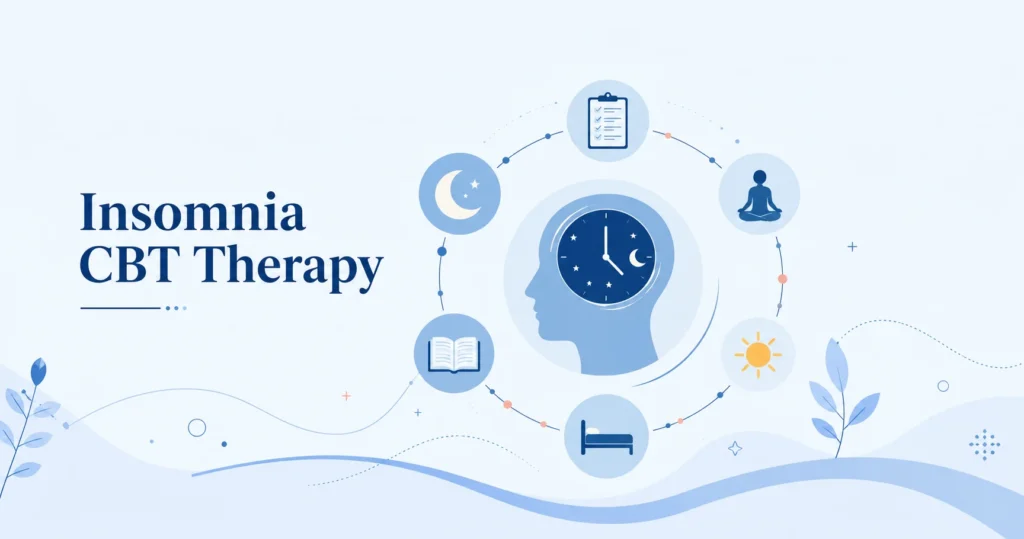
What Is CBT for Insomnia?
CBT for insomnia, or CBT-I, is a short, structured talk therapy for chronic sleeplessness. Over about four to eight sessions it targets the thoughts, habits, and tension that keep you awake, and replaces them with healthy sleep cues. The Canadian Psychological Association lists cognitive behavioural therapy for insomnia as the first-line treatment for chronic insomnia in adults.
Unlike open-ended counselling, cbt therapy for insomnia is brief and focused. It does not ask you to relive your whole past. It works on the specific thoughts, behaviours, and feelings that disrupt your rest right now. If you want the bigger picture of the method first, our CBT page explains how these same principles apply across many goals.
The idea at the centre of this approach is simple. Your sleep is shaped by the relationship between your mind, your body, and the place you sleep. After a few rough nights, you start making quiet adjustments: sleeping in on weekends to catch up, taking long naps, lying in bed for hours reading or worrying. Every one of those is a reasonable response to exhaustion. The trouble is that they confuse your body clock and teach your body to stay alert in the one place you want it to let go. A structured cbt for insomnia treatment finds those hidden disruptors and replaces them, one at a time, with cues that actually invite sleep.
What Is CBT-I in One Sentence?
CBT-I is cognitive behavioural therapy adapted for sleep: a brief, evidence-based program that retrains your body and quiets your mind so your bed becomes a place of rest again, rather than a place you brace yourself against.
How Does CBT Help Insomnia?
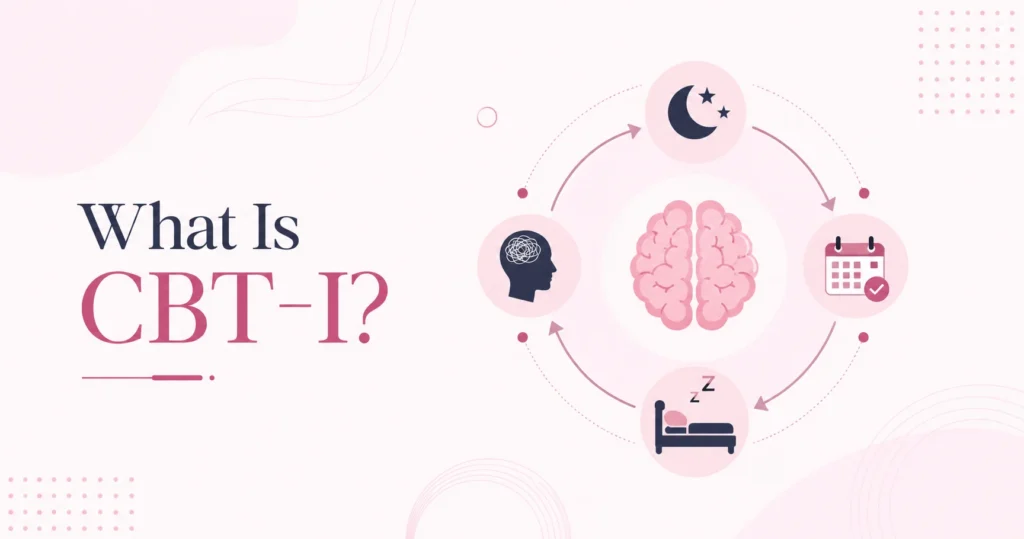
CBT-I works on the two systems that run sleep, your sleep drive and your body clock, and calms a third one that chronic insomnia adds: hyperarousal, a wired, on-alert feeling at bedtime. Behavioural steps rebuild your sleep drive, while cognitive steps quiet the anxious thoughts that keep your brain switched on at night.
To understand how does cbt help insomnia, it helps to name the parts. Your sleep drive is your built-in need for sleep, which grows the longer you stay awake. Your circadian rhythm is your internal 24-hour body clock. When chronic sleeplessness sets in, it adds hyperarousal, a state of raised physical and mental alertness driven by stress and sleep worry. Your body can be deeply tired while your brain reads the bed as a threat and keeps you switched on.
CBT insomnia training works by treating two connected parts at once.
The Behavioural Part
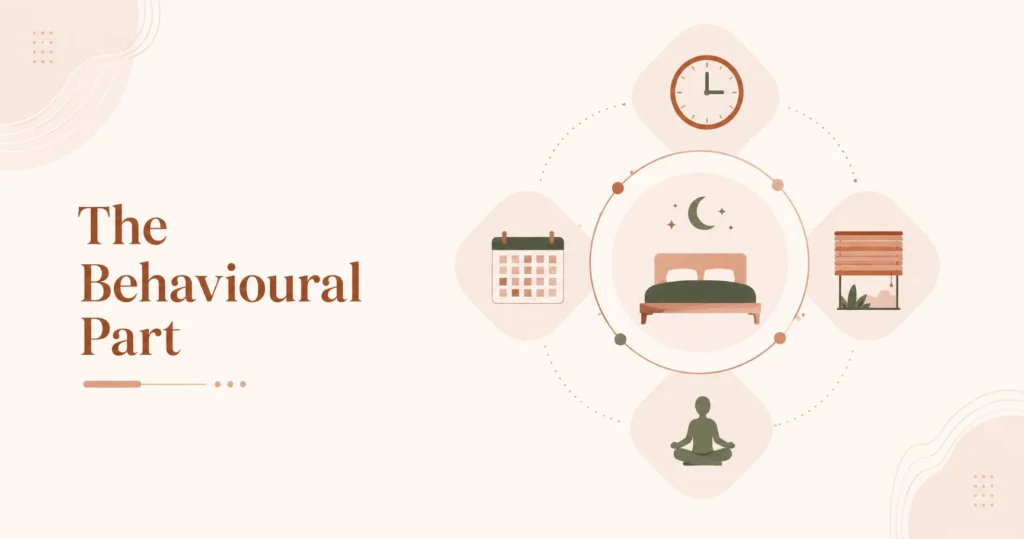
This part is about what you do and where you do it. By adjusting your daily schedule and your bedroom habits, you lower that wired, on-alert feeling and strengthen your natural sleep drive. The goal is to teach your body to link the bed with one thing only: deep, real rest.
The Cognitive Part
This part is about the story running in your head at 2:00 in the morning. When you cannot sleep, the mind reaches for worst cases: “If I do not sleep tonight, tomorrow is ruined,” or “My health is falling apart because of this.” Cognitive restructuring means noticing those thoughts, checking them against what is actually true, and softening them. Lowering the distress lowers the alertness, and a calmer brain can finally let go. These are the same thought-testing skills at the heart of our wider guide to CBT exercises, applied here to the night.
Does CBT Really Work for Insomnia?
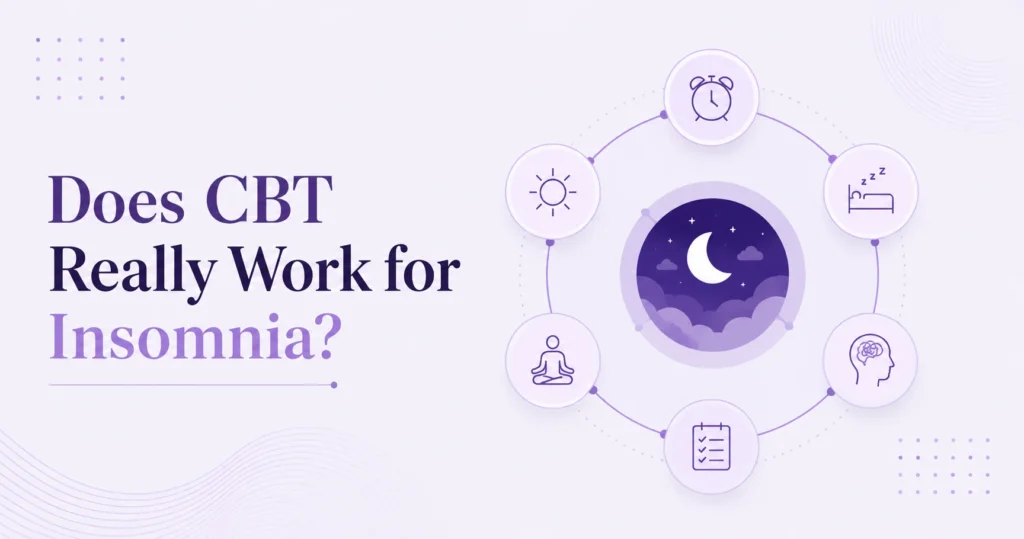
Yes. CBT-I is recommended as the first-line treatment for chronic insomnia by the Canadian Psychological Association and the American College of Physicians. Research shows most people improve, and unlike sleeping pills, the skills keep working after treatment ends because they fix the patterns that cause sleeplessness rather than masking them.
It is fair to feel skeptical. When you are this tired, you have probably already tried blackout curtains, herbal tea, white noise, and putting the phone down early, and still ended up staring at the ceiling. So people ask, honestly, can cbt help with insomnia when nothing else has, does cbt work for insomnia at all, and does cbt really work for insomnia over the long term. The research keeps answering the same way. The American College of Physicians names CBT-I the first treatment to try for chronic insomnia in adults, ahead of medication, partly because it carries fewer risks than sleep drugs and partly because the gains tend to last.
How Effective Is CBT for Insomnia?
When you look at how effective is cbt for insomnia, and at how effective cognitive behavioural therapy is more broadly, the pattern is steady: a structured method produces measurable, lasting change. According to the Canadian Psychological Association, about 70 to 80 percent of people with insomnia benefit significantly from four to six sessions of CBT-I. The same fact sheet notes that roughly 20 to 25 percent of the population are dissatisfied with their sleep, so if you are in this, you are far from alone.
People who do the work often describe:
- Falling asleep faster, with less time spent lying awake.
- Waking less often in the middle of the night.
- Higher sleep efficiency, which is the share of time in bed actually spent asleep.
- For many, a real and lasting easing of long-standing sleep problems.
The part worth underlining is durability. A sleeping pill stops working the night you stop taking it. The skills you build through cbt insomnia work stay with you, so the next stressful stretch of life is far less likely to drag you back into chronic sleeplessness. CBT-I does not promise a cure, and no honest approach should. What it offers is a method you can keep using.
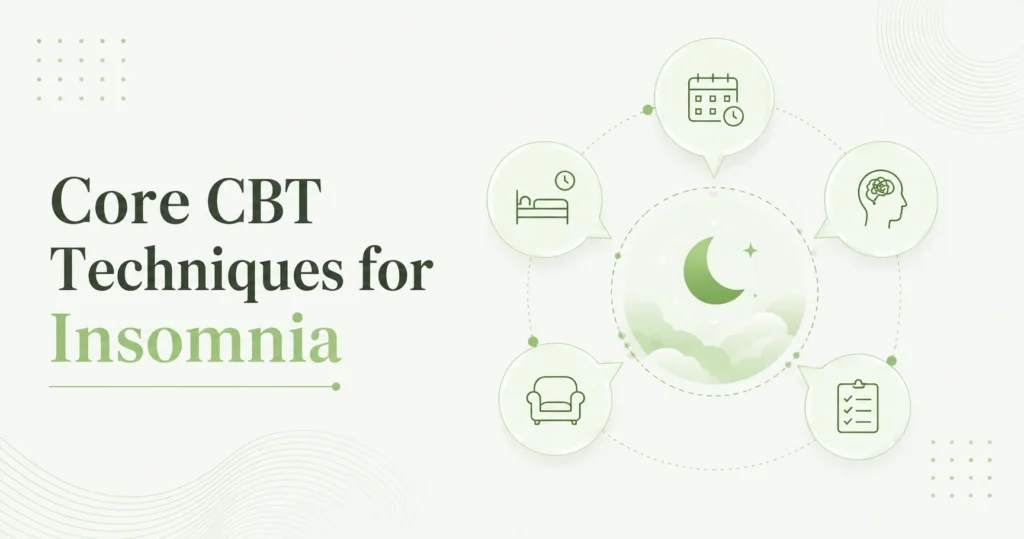
Core CBT Techniques for Insomnia
If you want to know how to do cbt for insomnia, it helps to see the actual tools clinicians use. These are not generic sleep-hygiene tips. They are specific cbt techniques insomnia programs use to change your biology. A trained therapist tailors them to your own sleep pattern; the short version is below so you know what the work looks like.
1. Stimulus Control Therapy
Stimulus control therapy breaks the learned link between your bed and frustration. After months of poor sleep, your brain quietly files the bedroom under “stay awake.” This technique reverses that with a few firm rules:
- Use your bed for sleep and intimacy only. No television, no laptop, no eating in bed.
- Go to bed only when you are genuinely sleepy, not just tired or bored.
- If you have been awake for about 15 to 20 minutes, get up. Go to a dimly lit room, do something calm and dull like reading a paper book, and return only when sleep feels close.
- Get up at the same time every morning, no matter how the night went.
2. Sleep Restriction Therapy
When sleep will not come, the instinct is to spend more hours in bed hoping to catch a little. That usually makes sleep more broken, not less. Sleep restriction therapy temporarily matches your time in bed to the amount you are actually sleeping. If you spend eight hours in bed but sleep only five, a clinician might set your time in bed at five or five and a half hours to start. It is demanding at first, but it builds your sleep drive quickly. Within a week or two, sleep usually comes faster and runs deeper, and your time in bed is widened back up as your sleep efficiency improves. This is done with a professional, not alone, especially because of the daytime tiredness in the first stretch.
3. Cognitive Restructuring
Here you track your automatic thoughts about sleep, often with a sleep diary. Once you can see the worry patterns on paper, you learn to meet them with reality. Instead of “I will fail completely tomorrow if I do not sleep,” you practise something truer: “I have gotten through hard days on poor sleep before, and I can get through tomorrow safely too.” Smaller distress, calmer body, easier sleep.
4. Relaxation Training
Physical tension keeps the body braced for action. CBT-I teaches evidence-based ways to settle the nervous system before bed, including:
- Progressive muscle relaxation, which means tensing and releasing muscle groups one by one to drain physical strain.
- Autogenic training, which uses gentle imagery and breathing to bring a feeling of warmth and heaviness to the limbs.
- Mindfulness, which means letting racing thoughts come and go without grabbing onto them.
How to Access CBT for Insomnia in Toronto and Across Ontario
If you are looking for cbt for insomnia toronto clinics or support elsewhere in the province, there are a few real paths, and the right one depends on your budget, your schedule, and how much guidance you want. CBT-I in Ontario broadly comes from registered psychotherapists, registered social workers, and psychologists; what follows is how to find each path, and where Saalvio fits.
Free, Publicly Funded Care Through OSP
Ontario funds a free option called the Ontario Structured Psychotherapy (OSP) Program. It provides publicly funded cognitive behavioural therapy to Ontario residents aged 18 and older who are living with depression, anxiety, and related sleep distress. If you have searched for free cbt for insomnia ontario offers, this is the honest first stop. OSP includes guided self-help with a coach, group sessions, and individual virtual sessions, and you can self-refer without a family doctor. You can read the details and start a referral through CAMH. Public programs sometimes carry a wait, so it is worth knowing your other options too.
Private Care With Registered Clinicians
If you want care sooner, or care shaped tightly around your own sleep pattern, working with a private clinician is a strong choice. Many cbt insomnia therapists across Ontario focus specifically on sleep, and a specialist can design an accurate sleep-restriction window and work through the lifestyle pieces with you.
Saalvio offers online cbt i ontario care delivered by registered psychotherapists and registered social workers who use evidence-based cognitive behavioural therapy for insomnia. You meet from your own home, which removes the commute, the waiting room, and a good deal of the dread of a first visit. If you are weighing it, you do not have to decide tonight, and you do not have to decide alone. You can message a registered psychotherapist before you book and ask whatever you need: whether they have worked with sleep like yours, whether their approach fits, whether they will understand the life you come from. There is no cost and no commitment. Every Canadian’s first session with a Saalvio clinician is free, so deciding to try therapy is not a gamble on whether the fit will be right. You can also read more about online therapy in Ontario or therapy in Toronto.
A note on cost: Saalvio does not bill insurers directly. Sessions with registered psychotherapists and registered social workers are typically reimbursable under most Canadian extended health benefit plans, and every client receives a detailed receipt to submit. Coverage varies by plan, so it is worth confirming yours.
Self-Guided Tools, Apps, and Workbooks
If you would rather start on your own, or begin tonight while you wait for an appointment, self-guided resources are a real entry point.
- CBT for insomnia online free articles. Plain-language, evidence-based guides like this one can teach you the rules of stimulus control at no cost.
- CBT for insomnia pdf workbooks and sleep diaries. Many Canadian health networks offer downloadable sleep-diary templates and worksheets so you can track your sleep efficiency by hand. A sleep diary, where you note your bed and wake times and how the night went, is one of the most useful tools in the whole approach.
- CBT insomnia apps. The Saalvio mobile app, on the Apple App Store and Google Play, carries self-help sleep tools, guided practices, mood tracking, a private journal, and structured self-assessments you can use any time. These tools support better sleep; they are not therapy, and the app’s Thrive companion is an AI built to keep you company, not a clinician. Therapy itself happens in booked sessions with the clinical team. The Saalvio app is available across Canada and North America. Saalvio therapy is offered in Ontario today.
Self-Guided or Therapist-Led? Choosing Your Path
You may be wondering whether to try the tools on your own or book a professional. Both paths help, and for many people a mix works best: start with an app or workbook to learn stimulus control and sleep restriction, and bring in a registered clinician for deeper guidance if you stall or hit a wall. There is no wrong order. There is only the next small step.
What the First Few Weeks of CBT-I Feel Like
It helps to know the honest version. Because changing long-standing habits is hard, the first week or two of sleep restriction can leave you sleepier and more tired during the day than usual. That is expected. It is the sign your body is rebuilding its sleep drive, the way a new schedule or a new training routine takes a short adjustment before it settles.
A few things make that stretch easier:
- Tell someone. Let a friend, your family, or your therapist know what you are doing, so they understand why you are up at the same time even on a Saturday.
- Protect your safety. If you feel foggy or very tired during the early adjustment, avoid long drives and heavy machinery until your sleep steadies. This matters more than getting the schedule perfect.
- Be kind to yourself. One bad night is not a failure. It is a single line in your sleep diary. Healing is not a straight line, and your body will keep correcting itself over time.
Sleep problems often travel with anxiety and low mood, and the worry about not sleeping can feed both. If your sleeplessness comes alongside anxiety or depression, that is common, and it is worth telling a clinician so the whole picture gets care, not just the nights. When low mood is the bigger part of the picture, our guide to CBT for depression covers how the same approach is used there. If at any point the distress feels like more than you can hold, please reach for the crisis support below right away.
If you need help right now
Saalvio is not a crisis service. If you are in immediate danger, please call 911. If you are in mental health crisis, please call 988 (the Suicide Crisis Helpline of Canada) or visit your nearest emergency department.
You Do Not Have to Do This Alone
Sleeplessness has a way of shrinking your world down to the size of the dark bedroom and the moving clock. It does not have to stay that small. By working on the habits and the anxious thought loops that keep your mind running at night, you can teach your body clock to find its rhythm again and let rest come back.
Whether you start tonight with a sleep diary and the Saalvio app, or sit down with a registered clinician who does this every day, the first step is the whole point. You can take it tired. You can take it unsure. We will be here. You can find crisis resources any time you need them.
Frequently Asked Questions
What is CBT-I?
CBT for insomnia, or CBT-I, is a short, structured talk therapy for chronic sleeplessness. Over about four to eight sessions it targets the thoughts, habits, and tension that keep you awake, and replaces them with healthy sleep cues. The Canadian Psychological Association lists it as the first-line treatment for chronic insomnia in adults.
Does CBT-I really work?
Yes. The Canadian Psychological Association reports that about 70 to 80 percent of people with insomnia benefit significantly from four to six sessions of CBT-I, and both the CPA and the American College of Physicians recommend it as the first-line treatment. Unlike sleeping pills, the skills keep working after treatment ends.
How long does CBT for insomnia take?
Most CBT-I programs run four to eight sessions. Many people fall asleep faster and wake less within the first week or two of sleep-drive work, while the fuller benefit builds over the course. CBT-I is designed to be time-limited and goal-focused, not open-ended, so you learn the skills and carry them forward.
Is CBT better than sleeping pills for insomnia?
Major guidelines, including the Canadian Psychological Association and the American College of Physicians, recommend CBT-I before medication for long-term chronic insomnia. Pills can help in the short term, but their effect stops when you stop taking them. CBT-I targets the root patterns, so the improvement tends to last.
Can I do CBT for insomnia online or for free?
Yes. The Ontario Structured Psychotherapy (OSP) Program offers free, publicly funded CBT to Ontario residents aged 18 and older living with depression, anxiety, and related sleep distress, and you can self-refer through CAMH. Saalvio also offers online care, and every Canadian’s first session with a Saalvio clinician is free.
Are there CBT for insomnia apps or workbooks?
Yes. Many Canadian health networks offer free downloadable sleep diaries and cbt for insomnia pdf worksheets to track your sleep efficiency by hand. The Saalvio mobile app carries self-help sleep tools, guided practices, and a sleep journal. These tools support better sleep but are not therapy; therapy happens in booked sessions with a registered clinician.
How do I find a CBT-I therapist in Ontario or Toronto?
CBT-I in Ontario is offered by registered psychotherapists, registered social workers, and psychologists. Saalvio provides online cbt for insomnia ontario care through registered psychotherapists and registered social workers, including for residents looking in Toronto. You can message a clinician with your questions before you book, at no cost and no commitment.
Is CBT-I safe if I have anxiety or depression too?
Yes, and it is common for sleep problems to come with anxiety or low mood. CBT-I can be paired with care for both, and telling your clinician about your mood helps them treat the whole picture. If your distress ever feels like more than you can hold, please use the crisis resources below right away.
Clinically reviewed
Usman Khan, Registered Psychotherapist
Usman Khan is the Clinical Director of Saalvio and a Registered Psychotherapist with the College of Registered Psychotherapists of Ontario (CRPO #13456). He holds an MD, an MPH from Western University, and an MA in Counselling Psychology from Yorkville University. He reviews all clinical content on saalvio.com before publish.
See also across Saalvio
Topics mentioned in this post that have their own page on the site.
Talk to our clinical team
Saalvio offers a free 30-minute consultation with any therapist on the team. There is no card on file. If we are not the right fit, we will say so and help you find one.