
Is REBT Effective for Anxiety and Depression? A Complete Guide for Ontario Residents
Book a Free 30-Minute Consultation
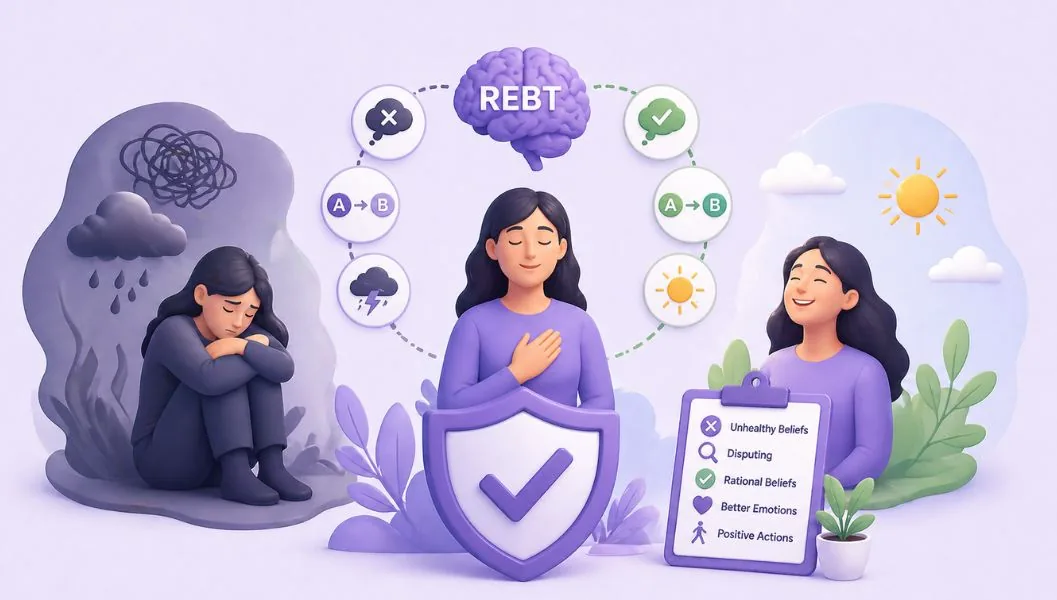
There is a particular kind of tired that does not come from the body. It comes from your own thoughts working against you all day. You try to stay calm, and your mind jumps straight to the worst thing that could happen. You try to feel a little lighter, and the same heavy thought loops back, like a song you cannot turn off.
If that is familiar, you are not alone in it. Across Ontario, from the noise of the big cities to the quiet of the smaller towns, people are turning to structured talk therapies to find their footing again. One of them is REBT. This guide explains what it is, how it works, whether it actually helps with anxiety and depression, and how to find real support in Ontario. We will go slowly, and in plain language.
Is REBT Effective for Anxiety and Depression?
Yes, REBT is effective for many people with anxiety and depression. Rational Emotive Behaviour Therapy is a structured talk therapy that targets the rigid, negative beliefs that feed worry and low mood. CMHA Ontario lists evidence-based cognitive therapies among the first-line psychological treatments for anxiety, and clinicians use REBT for both conditions.
It helps because it does not only sit with the symptom. It goes after the thinking patterns underneath: the constant overthinking, the worry that follows you from room to room, the low mood that flattens everything, and the self-doubt that talks you out of trying. That is why so many therapists now use REBT for anxiety and REBT for depression in their online therapy in Ontario sessions.
This is honest information, not a promise. No therapy works the same way for every person, and REBT does not “cure” anyone. What it offers is a method you can learn and repeat.
What Is REBT?
REBT, or Rational Emotive Behaviour Therapy, is a form of talk therapy that links what you think to how you feel and act. Instead of blaming the situation alone, it helps you find and change the rigid beliefs behind your distress, so your emotional response can shift too. It was first developed in the 1950s and is one of the oldest cognitive therapies.
REBT was created by psychologist Albert Ellis in 1955, and the Albert Ellis Institute describes it as the original cognitive behavioural therapy, the approach that later treatments grew from. So when you use REBT today, you are using a method that has been studied and refined for almost seventy years.
REBT focuses on three things:
- The deep-seated beliefs you hold about a situation.
- How those beliefs shape your daily emotions.
- The practical ways you can change those beliefs.
A Simple, Real-Life Example
Say you miss a deadline at work or school.
- The automatic thought: “I am a total failure.”
- The feeling: heavy anxiety and deep sadness.
- The behaviour: you start avoiding your desk and replaying every small mistake.
REBT helps you replace that crushing thought with something more honest: “I made a mistake this time, and I have the skills to fix it and move forward.” The situation has not changed. Your grip on it has.
How Does REBT Work? The ABC Model
REBT works through the ABC model. A is the activating event, something that happens. B is the belief you hold about it. C is the consequence, how you feel and act. The key idea is this: it is the belief (B), not the event (A), that drives the emotion (C). When you change the belief, the feeling changes with it.
Here is how it looks with a real moment:
- A, the activating event: a disagreement with your partner.
- B, the belief: “They do not love me anymore.”
- C, the consequence: you feel rejected and pull away.
The event did not create the rejection you felt. The belief did. Once you learn to notice the belief and question it, your emotional world starts to move.
An irrational belief, in plain terms, is a thought that feels like a hard fact but is actually rigid, extreme, and not fully true (“I must never fail,” “everyone has to approve of me”). REBT is built to find these and loosen them.
Why REBT Helps with Anxiety
Anxiety is a thief. It steals your peace by feeding you fears that sound urgent and certain: “Something terrible is about to happen.” “I am not strong enough to handle this.” “Everyone is judging me and waiting for me to fail.”
Managing anxiety with REBT means learning to put those thoughts on trial instead of obeying them. You do not just cope with the fear; you start to take it apart. You learn to:
- Notice the “musts” and “shoulds” running quietly in your head.
- Check them against the actual evidence in front of you.
- Replace them with grounded, realistic perspectives.
That last shift is the one people describe most: the sense of being back in the driver’s seat of their own day. As CMHA Ontario notes, cognitive therapies of this kind are among the most-researched and most-recommended ways to work with persistent anxiety.
How REBT Helps Lift Depression
Depression often arrives as a heavy fog, full of quiet, flat statements: “Nothing is ever going to get better.” “I am not good enough for this life.” “What is even the point of trying?”
Rational emotive therapy for depression is not about forced positivity or pretending everything is fine. It is about gently questioning those heavy beliefs and learning to accept a hard reality without letting it decide your whole worth. CAMH names cognitive behavioural therapy as a first-line treatment for depression, and REBT belongs to that family.
Instead of demanding that you feel better, it helps you think more clearly, and clearer thinking tends to make room for the feeling to ease on its own time. If you want a broader, day-to-day approach as well, our guide to depression walks through small, gentle steps.
REBT Techniques That Work in Real Life
At the heart of Rational Emotive Behaviour Therapy techniques is a small set of practical tools. For a fuller walk-through, our guide to REBT techniques covers each one in plain steps. These are common REBT techniques a therapist might teach, and many double as thought challenging techniques for anxiety and depression you can practise between sessions:
- Direct challenging: ask yourself, “Is this thought one hundred percent true? Where is the actual evidence for it right now?”
- Reframing: instead of “I cannot handle this,” try “This is really hard right now, and I have gotten through hard things before.”
- Radical acceptance: learning to accept that you are a flawed, ordinary human. Mistakes are part of being alive; they do not erase your value.
- Behavioural practice: taking small, brave actions, like speaking up in a meeting or trying something new, even while you feel nervous. It slowly builds confidence the way exercise builds muscle.
When you question the evidence for a fear, you quietly take its power back. This is also how REBT helps with overthinking and with negative self-talk: it interrupts the loop before it convinces you it is telling the truth.
REBT for Overthinking and Negative Self-Talk
If your mind runs the same worried script on repeat, REBT for overthinking gives you a way to step outside the loop and ask whether the thought is fact or habit. And if your inner voice is mostly harsh, REBT for negative self-talk helps you notice the cruelty, name it as a belief rather than a verdict, and answer it with something fairer. Both come down to the same skill: catching the thought, then checking it.
REBT vs CBT: What Is the Difference?
REBT is part of the CBT family. CBT, or cognitive behavioural therapy, broadly looks at how thoughts and behaviours interact. REBT zooms in on the core, often rigid beliefs (the musts and shoulds) behind distress, and challenges them directly. Both are evidence-based, and neither is simply better. Many therapists blend the two. If you want the two set side by side, our guide on the difference between CBT and REBT breaks it down.
- REBT: focuses closely on changing the underlying beliefs that cause distress. Very direct.
- CBT: a broader look at how thoughts, feelings, and behaviours work together.
- Open talk therapy: more about expressing emotion and exploring your history.
Many people are drawn to REBT because it is action-oriented. It gives you something to practise the moment your session ends, not only something to talk about, and our look at the benefits of REBT daily practice shows how small, repeated reps add up.
Signs REBT Might Fit You
REBT may be worth exploring if you notice yourself:
- Overthinking even the smallest details.
- Feeling dread or anxiety without a clear reason.
- Running mostly negative self-talk in your head.
- Stuck in the same emotional cycles year after year.
- Wanting practical, doable tools rather than only a place to vent.
Whether you are in Toronto, Ottawa, Waterloo, or a smaller community in Northern Ontario, this structured approach offers a clear path to follow. You do not have to wait for a crisis to begin. Even mild, quiet symptoms deserve attention.
Is REBT Enough on Its Own?
For many people, REBT is genuinely helpful on its own. For others, it works best as part of a fuller picture: mindfulness to stay in the present, gentle lifestyle steps like time outdoors and steadier sleep, and connection with people you trust. There is no single right combination, only the one that fits your life. A therapist can help you sort out what that looks like for you.
How REBT Therapy Works in Ontario
Mental health is finally getting more of the attention it deserves in Ontario. The hard reality is still here too: wait times can be long, and in smaller towns, finding the right clinician can be difficult. That is part of why online care matters. REBT therapy in Ontario, delivered online, lets you reach support from your own home, on a schedule that fits a real Canadian life.
Ontario also has free, publicly funded options. The Ontario Structured Psychotherapy Program, described by CAMH, offers short-term cognitive behavioural therapies for anxiety and depression to Ontario residents, and you can self-refer. It is worth knowing your options before you choose.
How Saalvio Can Support You
Saalvio offers online rebt therapy in Ontario, delivered by the registered psychotherapists and registered social workers on our clinical team who use REBT and related cognitive approaches. When you work with us, you get personalized care matched to your actual life, and a clinician who treats you like a person, not a case file.
Before you book anything, you can message a registered psychotherapist before you book and ask whatever you need to ask: whether they have worked with someone like you, whether their approach fits, whether they will understand the life you come from. There is no cost and no commitment. Messaging is for questions and brief clarifications, not therapy by text; the real work happens in a booked session. Every Canadian’s first session with a Saalvio clinician is free, so deciding to try therapy is not a financial gamble on whether the fit will be right.
The Saalvio app self-help tools, on iPhone and Android, add support you can use any day between sessions: mood tracking to see your patterns over time, a private journal, guided practices, and cognitive games. These are self-help tools, not therapy, and what you write stays private to you. Saalvio virtual therapy is offered in Ontario today. The Saalvio self-help app is available across Canada and the rest of North America.
Frequently Asked Questions
Is REBT effective for anxiety and depression?
Yes, REBT is effective for many people. It directly challenges the rigid, negative beliefs that feed both anxiety and low mood, which can lead to steadier thinking over time. CMHA Ontario lists cognitive therapies of this kind among first-line treatments for anxiety, and clinicians use REBT for depression too. Results vary from person to person.
How long does REBT take to work?
Many people notice a shift in how they think within a few weeks of regular practice. Longer-held beliefs often take a few months to rewire. REBT is built to be practical and goal-focused, giving you skills to use between sessions, so progress tends to build with steady effort rather than arriving all at once.
What is the ABC model in REBT?
The ABC model is the core of REBT. A is the activating event, something that happens. B is the belief you hold about it. C is the consequence, how you feel and act. The main idea is that the belief (B), not the event (A), drives the emotion (C). Change the belief and the feeling shifts.
Is REBT better than CBT?
Neither is simply better. REBT is part of the CBT family. CBT looks broadly at how thoughts and behaviours interact, while REBT focuses more directly on the rigid core beliefs behind distress. Both are evidence-based. Many people choose REBT because it is direct and action-oriented, but the right fit depends on you.
Can I do REBT therapy online?
Yes. Online therapy platforms like Saalvio deliver structured REBT sessions across Ontario, by video, from your own home. For many people, online care removes real barriers: the commute, the waiting room, and a good deal of the dread of a first visit. You can also message a therapist with questions before you book anything.
Who is a good fit for REBT?
REBT often suits people who overthink, run a lot of negative self-talk, get stuck on “musts” and “shoulds,” or feel caught in the same emotional cycles. It also fits people who want practical tools to use right away rather than only a space to talk. A therapist can help you decide if it is the right approach for you.
If you need help right now
Saalvio is not a crisis service. If you are in immediate danger, please call 911. If you are in mental health crisis, please call 988 (the Suicide Crisis Helpline of Canada) or visit your nearest emergency department. You can also find more support on our crisis resources page.
Clinically reviewed
Usman Khan, Registered Psychotherapist
Usman Khan is the Clinical Director of Saalvio and a Registered Psychotherapist with the College of Registered Psychotherapists of Ontario (CRPO #13456). He holds an MD, an MPH from Western University, and an MA in Counselling Psychology from Yorkville University. He reviews all clinical content on saalvio.com before publish.
See also across Saalvio
Topics mentioned in this post that have their own page on the site.
Talk to our clinical team
Saalvio offers a free 30-minute consultation with any therapist on the team. There is no card on file. If we are not the right fit, we will say so and help you find one.