
REBT Techniques: A Complete Guide to Managing Your Thoughts and Emotions
Book a Free 30-Minute Consultation
There is a thought that shows up on the hard days, usually somewhere between brushing your teeth and answering the first message of the morning. It sounds like, “Why do I keep reacting this way, even when I know it is not helping me?” If you have ever caught yourself there, you are not broken and you are not alone. You are tired of being at the mercy of your own mind, and that is a fair thing to be tired of.
REBT techniques are a set of practical tools for that exact feeling. They are not academic theory you have to be a doctor to understand. They are small, repeatable skills that help you notice a heavy thought, ask whether it is actually true, and choose a fairer one before it runs away with the rest of your day. This guide explains what REBT techniques are, how the ABC model works, the techniques you can start using on your own, and how to find REBT therapy in Ontario when you are ready for that.
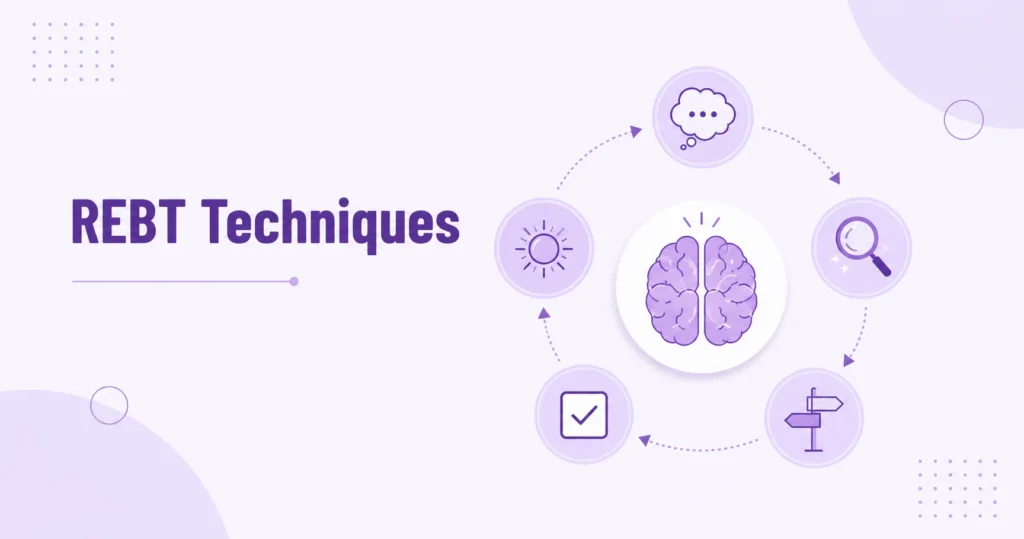
What Are REBT Techniques?
REBT techniques are practical mental skills from Rational Emotive Behaviour Therapy, a type of talk therapy. They help you spot the strict beliefs behind a hard feeling, question whether those beliefs are true and useful, then swap them for fairer ones. Common techniques include disputing irrational beliefs, reframing, and the ABC model. You can practise many of them on your own.
REBT looks at the direct line between what you think, how you feel, and what you do. We tend to assume our feelings are caused by the world around us. REBT suggests something slightly different, and once you see it, it is hard to unsee: it is often not the situation itself that hurts, it is the story you tell yourself about it.
That single idea has a long history. REBT was developed by the psychologist Albert Ellis in the 1950s, and it is widely considered the first of the cognitive behavioural therapies, the approach that helped shape the CBT so many people use today. So when you practise these techniques, you are not chasing a trend. You are using one of the oldest, most-tested ideas in modern therapy.
Using REBT therapy techniques, you learn to do three things:
- Notice the negative thoughts before they spiral.
- Challenge the irrational beliefs (the rigid musts and shoulds you hold about yourself and the world) that keep you feeling stuck.
- Replace those old scripts with kinder, more realistic thinking.
This is why rational emotive behaviour therapy techniques travel so well into online therapy in Ontario. They do not stay inside the therapist’s office. They work in the messy, ordinary moments of a real Ontario week.
Why REBT Resonates With So Many People
Many therapies spend their time on the feelings themselves, and feelings matter. Rational emotive therapy techniques go one level underneath them, to the rigid “musts” and “shoulds” that quietly run the show.
Here is a small, familiar example.
- The situation: a friend or a colleague does not answer your text.
- The automatic thought: “They are upset with me,” or “I am not worth their time.”
- The emotional consequence: a heavy mix of sadness and worry that sits with you for hours.

When you start using REBT techniques, you learn to press pause right in the middle of that and ask one honest question: “Is this thought actually true, or am I filling in the blanks with my own fears?” That one small pause can change how the whole evening feels.
What Is the ABC Model in REBT?
The ABC model maps how feelings really form. A is the activating event, B is the belief you hold about it, and C is the emotional consequence. REBT adds D, disputing the belief, and E, the new effect once a fairer belief replaces the old one. The event does not cause the feeling; the belief in the middle does.
The ABC model is the heart of every technique here, because it gives a chaotic moment a shape you can actually work with. REBT extends it into a full ABCDE process:
- A, Activating event: what happened. The unanswered text. The hard feedback at work.
- B, Belief: the thought you attached to it. “One mistake means I am a failure.”
- C, Consequence: how you felt and what you did next.
- D, Disputing: where you put the belief on trial. “Where is the evidence that one mistake makes me a total failure?”
- E, Effect: the steadier thought that takes its place. “I am learning, and this feedback will actually make me better.”
Once you can name A, B, and C, the feeling stops being a wall and starts being a sequence. And a sequence has a place where you can step in.
The Most Effective REBT Techniques You Can Start Today
You do not need a clinician beside you to begin. Here are some of the most-used techniques in rational emotive behaviour therapy, the kind people practise in everyday life and in sessions, including online therapy in Ontario.
1. Disputing Irrational Beliefs
Disputing irrational beliefs means putting a painful thought on trial. When a thought makes you feel miserable, you ask: is it logical? Is it actually helping me? Is it the whole truth? Most of the time we discover we have been exaggerating the “awfulness” of a situation, and the thought loses some of its grip the moment we question it out loud. This is the heavy hitter among thought challenging techniques.
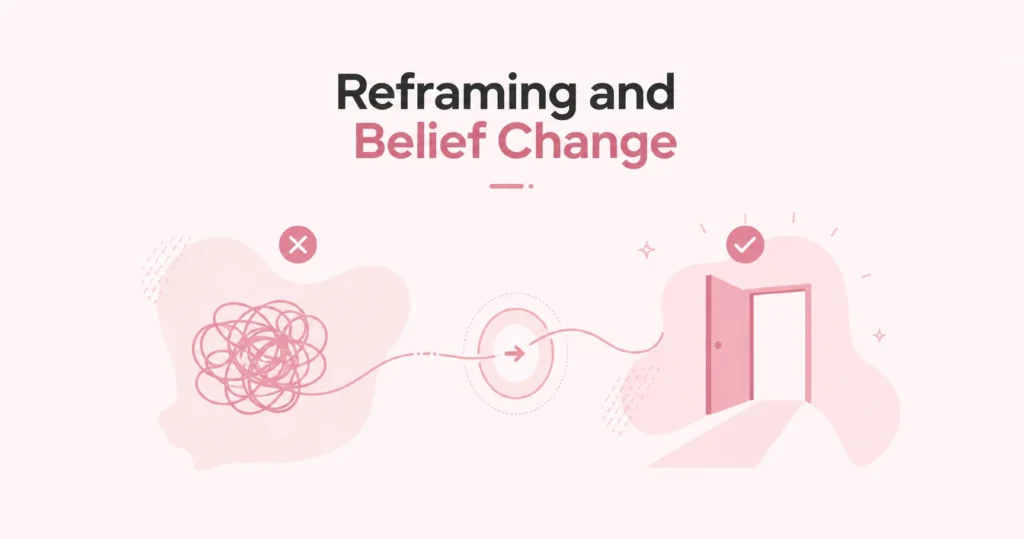
2. Reframing and Belief Change
Belief change techniques move you off the rigid script. Instead of “I always fail,” you reach for something true but fairer: “I did not get the result I wanted this time, and I have the skills to try again.” Reframing is not forced positivity. It is being accurate about a situation instead of cruel about it.
3. Emotional Awareness
This one is about letting a feeling exist without punishing yourself for having it. Emotions are a bit like weather. They move through if you do not anchor them down with harsh self-talk. Sitting with a feeling, naming it, and letting it pass is a skill in its own right, and it is one of the techniques that carries over well into REBT group therapy techniques, where people learn it alongside others.
4. Behavioural Practice
Sometimes you have to act your way into a new way of thinking. You take a small, brave step even while you are nervous, and your brain collects the evidence it needs to believe that you can cope. The thought “I cannot handle this” gets quietly disproven by the fact that you did.

5. Acceptance Techniques
Life in Canada, and everywhere else, is not going to be perfect. REBT teaches that you can dislike a situation and still accept the reality of it, which stops the second layer of pain known as “double suffering,” feeling bad about feeling bad. Acceptance does not mean approval. It means you stop spending energy fighting what already happened.
Techniques like these work best when they become part of an everyday routine, not a one-off. If you want to see how that adds up, our guide to the daily practice benefits of REBT shows what steady, small repetition can do over time.
REBT Therapy Examples: How It Looks in Real Life
Imagine you are getting ready for a presentation in front of your team.
- The old script: “I am going to stumble, look foolish, and everyone will judge me.”
- Disputing it: “Have I actually ever been called foolish at work? No. Am I prepared? Yes.”
- The new script: “I might feel some nerves, and that is okay. I can handle a few stumbles and still do this well.”
That is a complete ABC to E example. The activating event is the presentation, the belief is the old script, the consequence is the dread, the disputing is the question you asked, and the effect is the steadier thought you walked in with. The shift does not erase the nerves. It just stops them from running the room.
REBT vs CBT: Is REBT Better Than CBT?
Neither is better; they are close relatives. REBT is one of the approaches that shaped cognitive behavioural therapy, and both work on the link between thoughts and feelings. REBT leans harder into the strict core beliefs (the rigid musts and shoulds) you hold about yourself and the world. Many therapists blend the two. If you want them laid out side by side, we compare CBT and REBT in plain terms.
If REBT and CBT feel like cousins, that is because they nearly are. The techniques of rational emotive behaviour therapy tend to be direct, and they spend extra time on the deep philosophical beliefs underneath a feeling, not only the surface thought. Because the work is so action-oriented, some people find it a good fit when they want practical tools they can use right away. There is no single right answer between them, only the approach that fits the person and what they are carrying.
How REBT Techniques Help With Everyday Struggles
These tools are not only for the big, defining problems. They are for the ordinary weight of being human, the stuff that builds up across a week. The Canadian Psychological Association lists cognitive and behavioural therapies among the evidence-based talk therapies for anxiety and mood concerns; you can read their plain-language Psychology Works fact sheets for the broader clinical background.
REBT Techniques for Anxiety
REBT techniques for anxiety work by interrupting the “what if” spiral. You learn to demand evidence from a fearful thought instead of accepting it as fact, which shrinks catastrophic thinking back down to a realistic size. It pairs well with everyday practice and with professional support for anxiety when the worry is more than self-help can hold. If you are weighing whether this approach fits heavier days, our look at whether REBT is effective for anxiety and depression goes deeper.
REBT for Depression
REBT for depression helps interrupt the cycle of self-blame, the inner voice that has gone flat and unkind. By disputing the harsh belief (“I am a burden,” “nothing will change”) and reaching for a fairer one, you slowly build a more compassionate internal voice. It is not a switch you flip. It is a muscle you rebuild. For many people, REBT works best alongside other support for depression.
REBT for Anger
REBT for anger rests on one idea that takes the heat out of a lot of conflict: other people’s actions do not “make” you angry. Your interpretation of those actions does. That sounds simple, and it is also one of the harder things to practise, because it hands the responsibility back to you. It also hands back the choice.
REBT for Stress
For everyday stress, REBT teaches you to separate what you can control from what you cannot, and to stop treating every setback as a catastrophe. It does not promise a stress-free life. It gives you a way to carry the pressure without letting it crush your spirit.
If you need help right now
Saalvio is not a crisis service. If you are in immediate danger, please call 911. If you are in mental health crisis, please call 988 (the Suicide Crisis Helpline of Canada) or visit your nearest emergency department. You can also find more crisis resources here.
A Simple Daily REBT Routine for Daily Life
If you want to start tonight, here is a five-minute habit that puts REBT techniques for daily life into practice:
- Notice: catch a thought that makes you feel low.
- Record: write it down, in your own words.
- Question: use thought-challenging techniques. Is this 100 percent true?
- Balance: rewrite it so it is fair, not just “positive.”
- Act: do one small thing that proves the fairer thought is the more honest one.
Five minutes, repeated, does more than one long burst of effort you cannot keep up. With this kind of work, a little done often beats a lot done once. The Saalvio app self-help tools, including mood tracking and journaling, give this small habit somewhere to live so it is easier to keep.
Healthy vs Unhealthy Thinking: A Quick Comparison
REBT is not about forcing cheerfulness. It is about moving from rigid, harsh thinking to flexible, fair thinking. The difference usually sounds like this:
- “I must never fail” becomes “I would prefer to do well, and I can cope when I do not.”
- “Everyone has to approve of me” becomes “I would like people to approve, and I can live with it when some do not.”
- “This is unbearable” becomes “This is hard, and I have handled hard things before.”
- “I am a failure” becomes “I did something that did not work, which is not the same as being a failure.”
The healthier version is not softer or less honest. If anything it is more honest, because it stops pretending that a preference is a law.
Signs You Might Be Ready for Support
Self-help carries many people a long way. It is also okay for it to run out. It might be worth talking to someone if you:
- Feel like you are overthinking every small detail.
- Are emotionally exhausted by the end of most workdays.
- Live with a loud inner critic that will not give you a break.
- React much more strongly to small setbacks than you want to.
These are common experiences, not character flaws, and they are workable with the right support. The Mental Health Commission of Canada publishes national context on how the country is working to improve access to care, if you want to understand the bigger picture you are part of.
How Saalvio Supports REBT Therapy in Ontario
Finding help should not feel like a second job. Saalvio is a Canadian mental health platform, and our clinical team of registered psychotherapists and registered social workers includes clinicians who work with REBT and other CBT-family approaches. When you connect with online therapy in Ontario through Saalvio, you get:
- Sessions from your own safe space, with no commute and no waiting room.
- Practical, evidence-based work on the beliefs underneath the feelings.
- A clinical relationship that can help you spot the blind spots you cannot see in your own thinking.
If you are looking for an REBT therapist in Toronto or anywhere across Ontario, you do not have to decide everything tonight. Before you book, you can message a registered psychotherapist before you book and ask whatever you need to ask: whether they have worked with someone like you, whether their approach fits, whether they will understand the life you come from. There is no cost and no commitment, and it is not therapy by text; it is just a conversation to help you choose. Therapy itself happens in booked sessions.
Every Canadian’s first therapy session with a Saalvio clinician is free, so deciding to try is never a financial gamble on whether the fit will be right. Saalvio does not bill insurers directly, but sessions with our registered psychotherapists and registered social workers are typically reimbursable under most extended health benefit plans, and you receive a detailed receipt to submit to your insurer.
Saalvio virtual therapy is offered in Ontario today. Across the rest of Canada and North America, the Saalvio mobile app, available for iPhone and Android, carries mood tracking, journaling, guided practices, and tools you can use to practise these techniques between moments, wherever you are.
Frequently Asked Questions
What are REBT techniques?
REBT techniques are practical mental skills from Rational Emotive Behaviour Therapy. They help you identify, challenge, and change the strict, irrational beliefs that drive emotional distress and self-defeating behaviour. Common ones include disputing irrational beliefs, reframing, emotional awareness, and the ABC model. Many can be practised on your own.
What is the ABC model in REBT?
The ABC model maps how a feeling forms. A is the activating event, B is the belief you hold about it, and C is the emotional consequence. REBT adds D, disputing the belief, and E, the new effect once a fairer belief replaces it. The event does not cause the feeling; the belief in the middle does.
How does REBT help with anxiety?
REBT helps with anxiety by interrupting the “what if” spiral. You learn to ask one question of a fearful thought: where is the actual evidence? Demanding proof shrinks catastrophic thinking down to size and replaces it with a balanced view, so the body’s alarm has less to react to. It pairs well with everyday practice.
Is REBT better than CBT?
Neither is better; they are close relatives. REBT is one of the approaches that shaped cognitive behavioural therapy, and both work on the link between thoughts and feelings. REBT leans harder into the strict core beliefs, the rigid musts and shoulds, you hold about yourself and the world. Many therapists blend the two.
Can I practise REBT on my own?
Yes. Many people use REBT techniques for daily life on their own with a simple five-step habit: notice a low thought, write it down, question whether it is fully true, rewrite it fairly, then act on the new version. A therapist helps you catch the blind spots you cannot see in your own thinking.
How long does REBT take to work?
Everyone is different, but many people notice a shift in how they react within a few weeks of steady practice. REBT is practical and skills-based, so progress tends to track how often you use the techniques, not just how many sessions you attend. Deeper, long-standing beliefs usually take longer.
Where can I find REBT therapy in Ontario?
You can access REBT therapy in Ontario through licensed clinics or through a platform like Saalvio, which offers online therapy in Ontario with a clinical team of registered psychotherapists and registered social workers. You can message a therapist with your questions before you book, and every Canadian’s first session is free.
Clinically reviewed
Usman Khan, Registered Psychotherapist
Usman Khan is the Clinical Director of Saalvio and a Registered Psychotherapist with the College of Registered Psychotherapists of Ontario (CRPO #13456). He holds an MD, an MPH from Western University, and an MA in Counselling Psychology from Yorkville University. He reviews all clinical content on saalvio.com before publish.
See also across Saalvio
Topics mentioned in this post that have their own page on the site.
Talk to our clinical team
Saalvio offers a free 30-minute consultation with any therapist on the team. There is no card on file. If we are not the right fit, we will say so and help you find one.