
Why Do I Feel Mentally Exhausted Even After Doing Nothing?
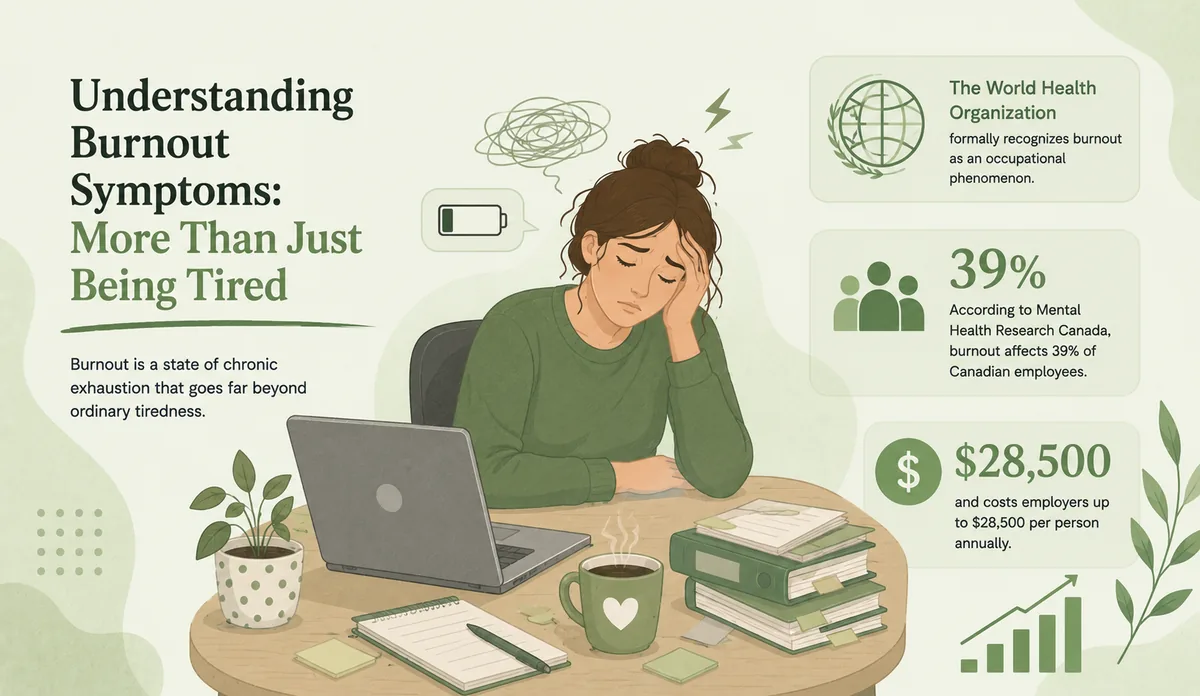
You slept in. The weekend was quiet. You did not do much of anything. And still, somehow, Monday found you just as empty as before, maybe emptier. The tiredness is not in your arms or your legs. It sits somewhere deeper, in a place rest does not seem to reach.
If you have been quietly asking why do I feel mentally exhausted when I have barely done anything, you are not broken and you are not lazy. This is what mental exhaustion feels like, and it is far more common in Canada right now than most people realize. Mental exhaustion is not a weakness. It is what happens when your mind has been running on stress for a long time, without enough real recovery to refill what it has spent.
This guide explains what mental exhaustion is, why a quiet day can still leave you drained, the 7 warning signs to watch for, what causes it, and how to genuinely recover. We will go in small, honest steps.
What Is Mental Exhaustion?
Mental exhaustion is deep mental and emotional depletion. It builds when your mind has been handling stress, worry, and problem-solving for longer than it can keep up. It is sometimes called mental fatigue, and the feeling is the same: your thinking goes slow and heavy, and even small tasks feel like too much.
As CAMH explains in its career burnout resource, burnout is a state of emotional, physical and mental exhaustion caused by excessive and prolonged stress. It can leave you feeling emotionally drained and unable to function well at work and in other parts of life.
Here is the part that confuses people most. Mental exhaustion is different from ordinary physical tiredness. Physical tiredness usually answers to sleep. Mental exhaustion often does not. You can sleep ten hours and wake up still drained. That is because the strain is not on your muscles. It is the ongoing toll of long stress on your nervous system, your emotional reserves, and your brain’s capacity to focus and stay steady. This is also why so many people describe feeling mentally and physically exhausted at the same time, even after a full night of rest.
Why Do I Feel Mentally Exhausted Even After Doing Nothing?
Because your nervous system keeps working even when your body rests. Passive worry, holding feelings in, staying on alert, and making many small decisions all drain mental energy without any movement at all. The brain does not refill through inactivity alone, so a quiet day can still leave you feeling completely empty.
If you have ever wondered why you feel so drained doing nothing, or why am I always mentally tired no matter how much I slow down, the answer is usually one or more of these:
- Passive worry. Your mind keeps turning over the future, the past, or things you cannot control, even while you sit still. The body is at rest, but the mind is sprinting.
- Emotional suppression (holding feelings in). Pushing difficult feelings down takes real mental energy. The more you bottle up, the more depleted you feel.
- Decision fatigue. Every choice you make through the day draws on the same mental fuel. By evening, even small decisions like what to eat can feel impossible.
- Hypervigilance (staying on high alert). After long stress, your nervous system can get stuck in threat-detection mode. That constant scanning is exhausting, even during calm moments.
- Poor-quality rest. Lying on the sofa scrolling your phone is not real recovery for the brain. Neither is passive TV watching. True mental rest looks different, and we will come to it below.
7 Warning Signs You Are Mentally Exhausted
These are the most common signs of mental exhaustion. If several of them sound like you, your mind is asking for real recovery, not just another early night. This is a gentle self-check, not a diagnosis. If you have been asking am I mentally exhausted, reading this list slowly is a fair place to start.
| Warning sign | What it can look like |
|---|---|
| 1. Tiredness that rest does not fix | You sleep, you rest, and you still wake up drained. Energy does not come back the way it used to. |
| 2. Feeling overwhelmed by small things | A short email or a simple errand feels like a mountain. Ordinary tasks cost more than they should. |
| 3. Trouble concentrating or deciding | Your focus slips, you reread the same line, and even minor decisions feel heavy. This is brain fog. |
| 4. Emotional numbness or detachment | You feel flat, far away, or strangely nothing, even about things that used to matter to you. |
| 5. More irritability | Your patience runs short. Small annoyances set you off in a way they normally would not. |
| 6. Pulling away from people | You cancel plans, leave messages unanswered, and withdraw, even from people you love. |
| 7. Physical symptoms | Headaches, muscle tension, a churning stomach, or getting sick more often. The mind and body are not separate. |
If you recognize the picture, you are not failing. This is what does mental exhaustion look like for a great many people, and naming it is the first foothold. Our closer look at the signs of mental exhaustion shows how the body often speaks up when the mind is done.
What Causes Mental Exhaustion? Common Triggers
Mental exhaustion rarely comes from one big event. It piles up from steady pressure over weeks or months. Understanding the common mental exhaustion causes can help you see what has actually been draining you.
- Workplace overload. Heavy workloads, unclear expectations, and little control are leading drivers. Statistics Canada reports that a heavy workload is the most common cause of work-related stress in Canada, followed by trouble balancing work and personal life. If the drain is mostly job-related, our guide on how to stop feeling emotionally exhausted after work offers practical steps.
- Emotional labour. Caring for others, as a parent, a healthcare worker, a teacher, a social worker, or a family caregiver, draws hard on your emotional reserves. Over time this can become compassion fatigue, the particular drain of caring for others.
- Financial stress. Constant worry about money, housing, and the cost of living is cognitively draining. It is a real and heavy weight for many people right now.
- Chronic anxiety. Ongoing anxiety keeps the nervous system on alert, which is metabolically expensive. Over time it wears mental resources thin.
- Perfectionism. Very high standards create relentless inner pressure. When the brain never feels allowed to relax, it burns out faster.
- Unresolved trauma. Unprocessed difficult experiences can keep the nervous system dysregulated, which is exhausting even with no new demands added on top.
- Digital overload. Constant notifications, news, and information keep the brain stimulated and prevent the quiet it needs to recover.
The thread running through all of these is the same. Burnout, the workplace form of mental exhaustion, now affects a large share of working Canadians. The Canadian Psychological Association describes burnout as a state of mental and emotional exhaustion from prolonged stress, and reports it affecting roughly one in three working-age Canadians. If this is where you have landed, our page on burnout support explains what care can look like. You are part of a very large group of people carrying this quietly.
Burnout vs Mental Exhaustion: What Is the Difference?
They overlap, and people often use the words together, but they are not exactly the same. Mental exhaustion is the broad state of being mentally and emotionally drained, from any source. Burnout is a specific form of it, tied to long, unrelieved stress, most often from work or caregiving, and usually paired with cynicism and a sense of getting nothing done. All burnout involves mental exhaustion. Not all mental exhaustion is burnout. If it has been going on long enough that you no longer feel like yourself, our piece on whether emotional exhaustion can change who you are sits with that worry honestly.
How to Recover from Mental Exhaustion: What Actually Helps
Recovery is more than doing less. It is about genuinely restoring your nervous system, your emotional reserves, and your capacity to think clearly. There is no instant cure, and anyone who promises one is not being honest with you. But there is a real path, and mental exhaustion recovery is possible. Here is what tends to help most.
- Reduce the demands that are draining you. Look honestly at what is taking the most out of you, and lower the load where you can, even a little. You cannot pour from an empty cup.
- Do truly restful things. Real rest for the brain is active, not passive. Time in nature, a creative activity you enjoy, gentle movement, or real conversation with someone you trust restores more than scrolling does.
- Protect your sleep. Hold a steady schedule, keep screens out of the last hour before bed, and let your body learn that night means rest again.
- Move gently. A short walk outdoors can settle a stirred-up nervous system. You do not need a hard workout. A little is a lot.
- Reconnect with people. Withdrawal feels safer when you are depleted, but quiet connection with one trusted person eases the load rather than adding to it.
- Address the root cause. If anxiety, perfectionism, or unprocessed stress is underneath the exhaustion, treating the root is what makes recovery last. This is where talking to a professional helps.
If anxiety or burnout is driving your exhaustion, structured talk therapy like CBT can speed recovery by helping you change the thought and stress patterns keeping you depleted. Therapy does not just help you cope. It helps you understand what has been running you down.
When to Seek Professional Help for Mental Exhaustion
Self-help strategies are enough for mild mental exhaustion. But professional support matters when:
- The exhaustion has lasted more than a few weeks and does not improve with rest.
- You notice signs of depression, such as persistent low mood, loss of interest, or hopelessness.
- Anxiety is chronic and getting in the way of daily life.
- You are leaning on alcohol or other substances to cope.
- Your work, your relationships, or your physical health are starting to slip.
Reaching out is a sign of strength, not failure. In Ontario, Saalvio’s clinical team of registered psychotherapists and registered social workers offers online therapy in Ontario, including support for burnout and the chronic stress underneath mental exhaustion. If you are not sure where to begin, our guide on how to find a therapist walks you through it.
If you are not ready to book, you can message a therapist before you book and ask whatever you need to ask, with no cost and no commitment. Messaging is a no-pressure way to start a conversation, not therapy by text and not crisis support. Every Canadian’s first session with a Saalvio clinician is free, so taking the first step is not a financial gamble.
Therapy sessions with a Saalvio clinician are offered in Ontario today, as the team continues expanding across Canada. The Saalvio app, with mood tracking, journaling, guided practices, and self-assessments, is available across Canada and North America for support you can use any time.
Frequently Asked Questions
Why do I feel mentally exhausted even after doing nothing?
Because your nervous system keeps working even when your body rests. Passive worry, holding feelings in, staying on alert, and making many small decisions all drain mental energy without any movement. The brain does not refill through inactivity alone, so a quiet day can still leave you feeling completely drained and empty.
What are the signs that I am mentally exhausted?
The seven common signs are tiredness that rest does not fix, feeling overwhelmed by small things, trouble concentrating or deciding, emotional numbness, more irritability, pulling away from people, and physical symptoms like headaches or tension. These build slowly. If several sound like you, see the warning-signs section above and consider reaching out for support.
What is the fastest way to recover from mental exhaustion?
There is no instant cure. The fastest path is to lower the demands draining you, do genuinely restful things like time in nature and real connection, and treat the root cause. If anxiety or burnout is underneath, structured therapy like CBT can speed recovery by changing the stress patterns keeping you depleted.
Is mental exhaustion the same as depression?
They share symptoms but are not the same. Mental exhaustion is usually tied to specific demands and eases when those demands drop. Depression is more constant, affects every part of life regardless of context, and needs professional treatment. Long-running mental exhaustion can turn into depression, so check in with a professional if you are unsure.
How long does it take to recover from mental exhaustion?
There is no fixed timeline. Mild cases can lift in days to weeks with rest and fewer demands. Moderate to severe exhaustion, especially with burnout or untreated anxiety, often takes weeks to months and more than rest alone. Working with a therapist trained in CBT or burnout recovery can help shorten it.
When should I see a professional about mental exhaustion?
Reach out when exhaustion lasts more than a few weeks and rest does not help, when you notice signs of depression or chronic anxiety, when you are leaning on alcohol or substances to cope, or when work, relationships, or health are slipping. In Ontario, Saalvio’s clinical team can help, and your first session is free.
If you need help right now
Saalvio is not a crisis service. If you are in immediate danger, please call 911. If you are in mental health crisis, please call 988 (the Suicide Crisis Helpline of Canada) or visit your nearest emergency department.
Clinically reviewed by Usman Khan, RP (CRPO #13456)
Clinically reviewed
Usman Khan, Registered Psychotherapist
Usman Khan is the Clinical Director of Saalvio and a Registered Psychotherapist with the College of Registered Psychotherapists of Ontario (CRPO #13456). He holds an MD, an MPH from Western University, and an MA in Counselling Psychology from Yorkville University. He reviews all clinical content on saalvio.com before publish.
See also across Saalvio
Topics mentioned in this post that have their own page on the site.
Talk to our clinical team
Saalvio offers a free first session with any therapist on the team. There is no card on file. If we are not the right fit, we will say so and help you find one.