
What happens in an IFS therapy session? IFS therapy techniques explained
Book a Free 30-Minute Consultation
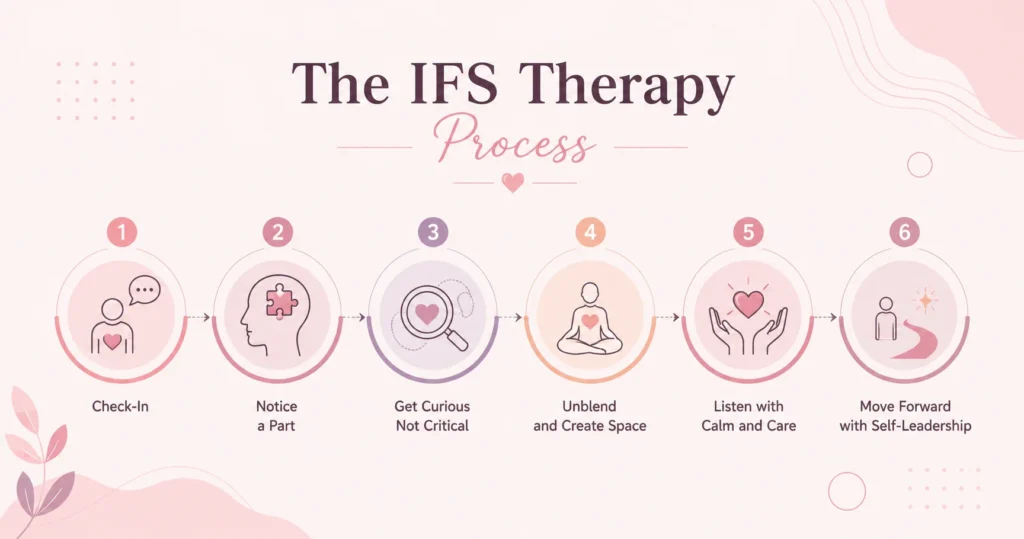
An IFS therapy session usually starts with a short check-in. Then your therapist helps you notice one part of you, like worry or anger. Together, you get curious about that part instead of pushing it away. This is called unblending. Common IFS therapy techniques help you listen to your parts with calm and care, at your own pace.
There is a man who snaps at his kids after work and hates himself for it every single time. There is a woman who checks her phone forty times a night because being alone with her own mind feels too loud. There is a teenager who smiles through dinner and cries in the shower, so no one has to worry about her.
None of them are broken. They are carrying parts of themselves that learned, a long time ago, how to keep them safe. IFS therapy is built for exactly this. It does not ask you to fight those parts or push them away. It asks you to get curious about them instead. This page walks through the IFS therapy process from start to finish.
What is IFS therapy?
IFS stands for Internal Family Systems. What is IFS therapy, in plain terms? It is a kind of parts work therapy built on one idea: your mind is not one single voice. It is made up of many parts, like an inner family. Some parts protect you. Some parts carry old pain. And underneath all of them is your Self, a calm, steady core that is still there even on your hardest days.
IFS is one of several evidence-based approaches Saalvio’s clinical team draws on. It works differently from CBT (cognitive behavioural therapy) and from EMDR (eye movement desensitization and reprocessing). None of these is better than the others in every case. If you are weighing your options, IFS vs CBT vs EMDR breaks down when each tends to help most.
How does IFS therapy work?
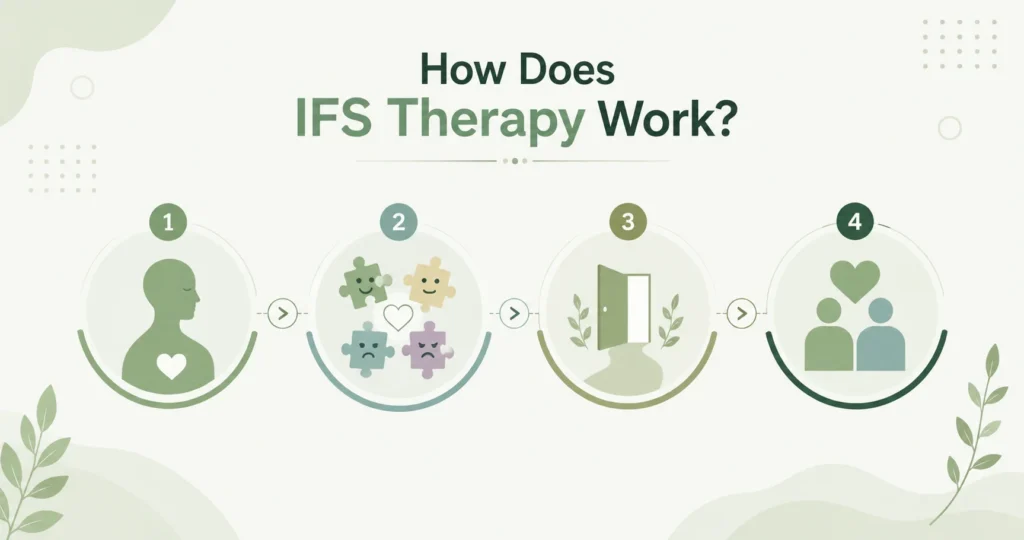
IFS therapy works by helping you build a relationship with your own parts instead of being run by them. Every part has a reason for what it does, even when that reason is hard to see at first. A part that picks fights might be trying to protect you from feeling small. A part that shuts down might be trying to protect you from being hurt again.
Your therapist is not the one doing the healing work directly on your parts. Their job is to help you, from your own calm and curious Self, get to know your parts and lead the way. That is the heart of parts work therapy, and it is why IFS feels different from therapies that focus mainly on changing thoughts or behaviours.
This same process works whether you are getting to know your own parts alone or exploring the parts that show up between you and someone you love. IFS therapy for couples uses that same curiosity on the parts that get triggered in an argument, not just the parts inside one person.
What happens step by step in an Internal Family Systems session?
The IFS therapy steps are gentle and go at your speed. No two sessions look exactly the same, but most follow a similar shape.
- Check-in. Your therapist asks how you are doing and what feels present today.
- Finding a part. You notice a feeling, a thought, or a body sensation, like a tight chest or a heavy sadness, and your therapist helps you name it as a part.
- Unblending. You get a little space from that part, so you can look at it instead of being fully inside it. More on this below.
- Getting curious. With your therapist’s help, you ask the part questions. What is it afraid would happen if it stopped doing its job? How old does it feel? What does it need you to know?
- Listening and witnessing. The part shares its story, often a memory or a moment where it first stepped in to protect you.
- Unburdening, when the part is ready. Some sessions end here. Others reach a point where the part is ready to let go of an old belief or feeling it has carried for years.
This is the Internal Family Systems process in a nutshell. It is slow by design. Rushing a part rarely works, and Internal Family Systems therapy techniques are built around trust, not pressure.
What are the main IFS therapy techniques and interventions?
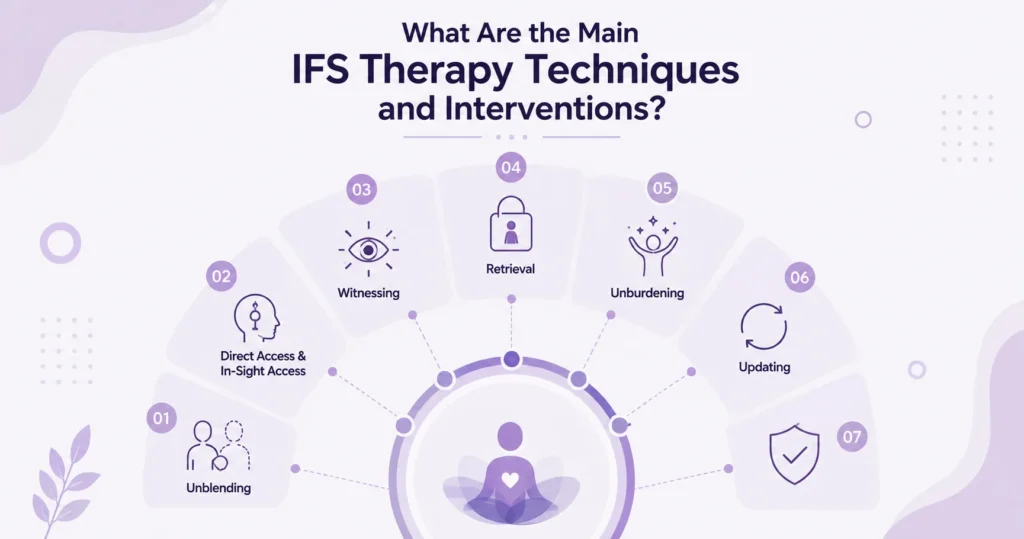
A few IFS therapy interventions come up again and again in sessions.
- Unblending. Helping you step back from a part so you can observe it rather than become it.
- Direct access and in-sight access. Two ways of talking with a part, either through your own inner awareness or, less often, through the therapist speaking to the part more directly.
- Witnessing. Letting a part fully tell its story, sometimes for the first time, without being rushed or corrected.
- Retrieval. Gently helping a younger, wounded part (often called an exile) leave the moment it got stuck in.
- Unburdening. A part releasing an old belief, feeling, or role it no longer needs to carry.
- Updating. Helping a part learn that the danger it has been guarding against is not present in the same way anymore.
Therapists often use a framework known as the 6 F’s of IFS to guide the unblending process step by step, and they look for the qualities described in the 8 C’s of IFS, like calm, curiosity, and compassion, as signs that you are speaking from your Self rather than from a part.
What is IFS unblending?
IFS unblending is the moment you go from being angry to noticing the anger. From being the fear to being someone who can sit beside the fear and ask it questions. That small shift in distance is where the real work happens.
Unblending does not mean pushing a part away or telling it to be quiet. It means finding just enough space to be curious instead of consumed. A therapist might ask, “Can you find where that anger is in your body right now?” or “If that worry could speak, what would it want you to know?” These small, plain questions are some of the most common IFS self therapy techniques in the room.
What does an IFS therapy session example look like?
Here is an illustrative example, not a real client, to show how a session might unfold.
A client we will call Daniyal comes in saying he feels stuck. Every time he tries to rest, a part of him pushes him to keep working. His therapist asks him to notice that pushing part and where he feels it. He says it feels like pressure behind his eyes.
Instead of trying to make the pressure go away, his therapist invites him to get curious about it. Daniyal learns that this part started working overtime when he was a teenager, watching his parents struggle with money. It decided that if he never stopped, nothing bad would happen again.
By the end of the session, Daniyal is not “cured” of the pushing part. He understands it. He can feel where it lives in his body, and he can thank it for trying to protect his family all these years, even as he starts to imagine what it might feel like to let it rest a little.
Sessions like this often surface when someone is carrying anxiety, old trauma, or symptoms of PTSD, since those experiences are frequently held by parts that took on a protective job early in life. IFS therapy for trauma, anxiety, and PTSD looks at this in more depth. Early studies suggest IFS therapy may support people managing PTSD, depression, and difficult emotions, alongside gains in self-compassion, though the overall body of research is still small and growing, according to the IFS Institute.

How do I find IFS therapy techniques near me?
If you are searching for IFS part works techniques near you in Ontario, Saalvio’s clinical team includes Registered Psychotherapists and Registered Social Workers trained in IFS and other evidence-based therapy approaches. Therapy is offered virtually across Ontario today, with expansion across Canada underway.
You do not have to decide anything tonight. You can message a Saalvio therapist trained in IFS with your questions before you book anything, or start with a free 30-minute consultation to meet a registered clinician and see if it feels right. There is no cost and no pressure either way.
Frequently Asked Questions
Is IFS therapy the same as talking to yourself?
No. IFS therapy is a structured approach guided by a trained therapist. It helps you build a real relationship with different parts of your mind, rather than simply thinking things through on your own.
How long does it take to see change with IFS therapy?
This varies from person to person and depends on what a client is working through. Some people notice a shift in how they understand a part after just one or two sessions. Deeper unburdening work often unfolds over a longer stretch of time.
Do I need to believe in “parts” for IFS therapy to work?
No. Many clients feel unsure at first. Parts language is simply a way of describing feelings, urges, and reactions that most people already notice inside themselves, like the part that gets defensive or the part that wants to disappear.
Does insurance cover IFS therapy in Canada?
Saalvio does not bill insurance providers directly. However, sessions with a Registered Psychotherapist or Registered Social Worker are typically eligible for reimbursement through most Canadian extended health benefit plans. Each client receives a detailed receipt that can be submitted to their insurance provider for reimbursement.
Can I ask a therapist about IFS before booking a session?
Yes. You can message any Saalvio therapist who practices IFS with your questions about their approach, fit, or experience, at no cost and with no commitment.
Clinically reviewed
Usman Khan, Registered Psychotherapist
Usman Khan is the Clinical Director of Saalvio and a Registered Psychotherapist with the College of Registered Psychotherapists of Ontario (CRPO #13456). He holds an MD, an MPH from Western University, and an MA in Counselling Psychology from Yorkville University. He reviews all clinical content on saalvio.com before publish.
See also across Saalvio
Topics mentioned in this post that have their own page on the site.
Talk to our clinical team
Saalvio offers a free 30-minute consultation with any therapist on the team. There is no card on file. If we are not the right fit, we will say so and help you find one.