
Positive Affirmations for Mental Health: A Full Guide That Actually Helps
Some days, the voice inside your head is not kind. It tells you that you are not good enough. That you messed up again. That things are never going to get better. That everyone else has it figured out, and you are the only one who does not.
Most of us know that voice well. Most of us have lived with it so long we have stopped noticing it is even there. And most of us were never taught a real, practical way to answer it back.
That is what positive affirmations for mental health can offer. Not the toxic-positivity kind that tells you to smile through a hard day and pretend you are fine. Something quieter and more honest than that, grounded in how the brain actually works. This guide covers the science behind affirmations, how they connect to CBT, how to use them so they genuinely land, and more than 80 ready-to-use mental health affirmations sorted by what you are going through right now.
Do Positive Affirmations Really Work for Mental Health?
Yes, with honest nuance. Self-affirmation activates the brain’s reward centres and helps build new neural pathways, and a 2025 meta-analysis of 129 studies found real gains in self-perception and well-being. Affirmations work best when practised daily, chosen so they feel reachable, and paired with other support when you need it.
This is a fair question to ask, and a skeptical one is healthy. Affirmations have been sold as a cure-all so often that it is reasonable to wonder whether they do anything at all. The honest answer is that they are not magic, and they are not nothing. They are a small, repeatable practice with a real evidence base, and they are most useful as one tool among several, not as the whole toolbox.
What Are Positive Affirmations? (And What They Are Not)
A positive affirmation is a short, intentional statement you repeat to yourself to build a healthier relationship with your own thoughts. The idea underneath it is simple: the things we say to ourselves, over and over, shape how we feel and how we act.
Affirmations are not magic words. They are not about denying reality or pretending everything is perfect. They are not toxic positivity. You are not trying to convince yourself that a painful situation is secretly fine.
What positive self-affirmations actually do is interrupt a harsh automatic thought and offer something more balanced and true in its place. Something that admits the difficulty while still holding space for your worth, your capacity, and your ability to cope.
Here is the difference in practice. If your mind says “I am terrible at handling stress” every time life gets hard, an affirmation does not pretend the stress is gone. It offers another statement that is also true: “I have handled hard things before, and I can handle this too.”
This is why affirmations and mindfulness fit so naturally together, and why both sit in the CAMH positive thinking resource library. Mindfulness teaches you to notice a thought without being swept away by it. Affirmations give you a steadier thought to return to once you have noticed.
How Affirmations Improve Mental Health: What the Science Says
Affirmations are not just a self-help trend. The research behind them has been building for years, across both neuroscience (how the brain works) and psychology (how the mind and behaviour work).
Your Brain on Affirmations
When you practise self-affirmation, the reward part of your brain responds. A 2016 brain-imaging study found that self-affirmation activates the ventral striatum and the ventromedial prefrontal cortex, the same reward-processing centres that light up during other positive experiences. In plain terms, the brain treats the practice as genuinely rewarding. You can read the original research on PubMed (Cascio and colleagues, 2016).
Repeating these statements also helps build new neural pathways, the patterns of thought and response that grow more automatic the more you practise them. The brain is neuroplastic, which means it changes in response to repeated experience. What we rehearse, we strengthen.
CAMH points to this same mechanism. Their helpful-practices page states that repeating daily affirmations in the mirror has been shown to activate the brain’s reward centres and create new neural pathways.
What the Research Adds Up To
The largest review to date pulled the numbers together. A 2025 meta-analysis published in the journal American Psychologist, drawing on 129 studies and more than 17,700 participants, found that self-affirmation produced significant gains in self-perception, general and social well-being, and measurable reductions in things like anxiety and negative mood. The effects were not only in the moment. Follow-up testing showed that some of the longer-term benefits, especially the easing of psychological barriers, were sometimes even stronger than the immediate ones. The American Psychological Association summarized the findings in its report on the meta-analysis.
This is the part worth holding onto. Affirmations are not a quick lift that fades by lunchtime. Practised consistently, the benefits build. Over time they become part of how you see yourself.
Affirmations and Stress
There is also evidence that a brief affirmation exercise can help when you are stretched thin. Research on the stress-buffering effects of self-affirmation suggests that a short practice can support clearer problem-solving under pressure. When you are overwhelmed and your thinking feels foggy, a few minutes of intentional, kind self-talk is not a small thing.
This covers the real benefits of positive affirmations: they are accessible, free, supported by named research, and they ask very little of you to begin.
How Do Affirmations Connect to CBT?
CBT, or cognitive behavioural therapy, is a structured talk therapy built on a simple idea: your thoughts, feelings, and behaviours are linked. CBT affirmations replace cognitive distortions, the unhelpful automatic thoughts like all-or-nothing thinking and catastrophizing, with balanced and accurate alternatives. They are not wishful thinking. They are a practical, everyday way to apply core CBT skills on your own.
If you have heard of CBT before, you already understand the ground that affirmations stand on. Change the way you think about something, and you change how you feel about it. Feel differently, and you tend to act differently.
CBT practitioners call those unhelpful automatic thoughts cognitive distortions. A cognitive distortion is simply a thought that feels true but is bent out of shape. Common ones include:
- All-or-nothing thinking: “I did not do it perfectly, so I completely failed.”
- Catastrophizing: “This one thing going wrong means everything will fall apart.”
- Mind reading: “Everyone must think I am a mess.”
- Personalization: “It is all my fault.”
CBT thought-challenging is the practice of catching one of those thoughts and checking it: Is it fully true? What is the more realistic version? Affirmation therapy techniques are a gentle, repeatable form of that same work. A related approach called REBT works directly on the rigid beliefs underneath those distortions, and our guide on whether REBT is effective for anxiety and depression explains how. CBT affirmations swap the distorted thought for one that is both more accurate and more compassionate. They are not about thinking positively for its own sake. They are about thinking more correctly.
This overlaps directly with CMHA Ontario’s mental wellness framework, which emphasizes the link between how we think about ourselves and our overall mental health. Recognizing your strengths, questioning self-critical patterns, and slowly building a steadier sense of self are all part of how positive thinking affirmations and affirmations for mental wellness do their work.
The Saalvio app self-help tools are built on CBT principles and include guided affirmation and thought-challenging exercises you can use anywhere in Canada and across North America.
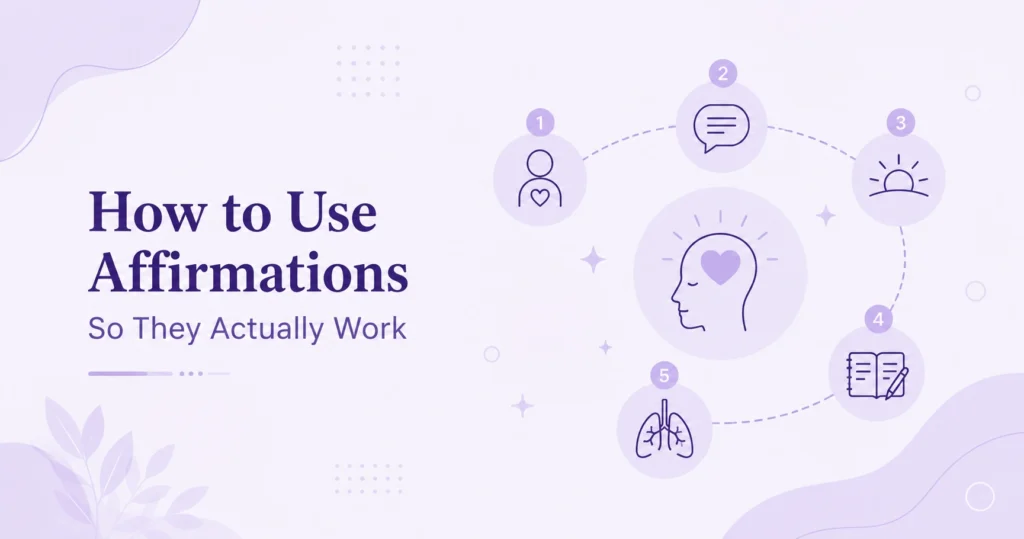
How to Use Affirmations So They Actually Work
Choose ones that feel reachable, say them in the present tense, repeat them daily, say them out loud or write them down, and pair them with slow breathing. Consistency matters more than length. A few minutes every day does more than one long session once a week. Reading a list and hoping something sticks is not enough; the practice is what makes the difference.
Here is how to use affirmations in a way the brain can actually register:
- Choose ones that resonate with you. Generic lines can feel hollow. The more an affirmation connects to something you genuinely value, the more your brain treats it as meaningful. You do not need to believe it fully yet. You just need to pick something that feels reachable.
- Say them in the present tense. “I am learning to trust myself” lands differently than “I will eventually trust myself.” The present tense feels more real and more immediate, and the brain responds to that.
- Repeat them consistently, mornings especially. Morning affirmations for positive energy are widely recommended because the mind is receptive early and you are setting the tone for the day. Morning affirmations to start the day are a good anchor, but consistency matters more than the exact time.
- Say them out loud or write them down. Spoken or written affirmations are more powerful than ones you only think. Saying an affirmation aloud while looking in the mirror is often described as especially effective, and the research agrees: a multi-sensory experience deepens how the brain encodes it.
- Pair them with slow breathing. Slow, relaxed breathing while you say an affirmation activates the parasympathetic nervous system, the calming side of your nervous system, so the words are more likely to be felt than just thought. This matters most for affirmations for panic attacks and sleep affirmations for anxiety.
80+ Affirmations Sorted by What You Are Going Through
Pick the section that matches where you are today. You do not have to use all of them. Three that feel reachable are plenty.
Daily Affirmations for Anxiety and Stress Relief
These are for the moments anxiety is present. They acknowledge the feeling without feeding it, and gently turn the nervous system back toward calm. They double as positive affirmations for stress and anxiety, and as affirmations for stress relief on a hard day.
- I am safe in this moment.
- This feeling is uncomfortable, and it will pass.
- My thoughts are not facts.
- I can be anxious and still do what matters to me.
- I have gotten through every hard day so far.
- I am allowed to slow down.
- One breath at a time is enough.
- I do not have to solve everything right now.
Affirmations for Panic Attacks
When panic hits, your nervous system believes it is in danger even though you are safe. These are short on purpose, easy to remember in the moment. Pair them with slow, steady breathing.
- This is a panic attack, not danger.
- My body is doing too much, and it will settle.
- I have felt this before, and it ended.
- I can ride this wave.
- Nothing about this is permanent.
- I am here, and I am okay.
Affirmations for Depression
Depression often whispers that things will never change, that you do not deserve to feel better, that reaching out is pointless. These affirmations are gentle and realistic. They do not demand positivity. They offer a quieter truth.
- I am doing the best I can with what I have today.
- Getting through today is enough.
- This heaviness is the depression talking, not the truth about me.
- I am worth the small kindness of trying.
- I do not have to feel good to be worthy of care.
- One small thing is still something.
- Asking for help is allowed, and it is brave.
Affirmations for Intrusive Thoughts and Overthinking
Intrusive thoughts and overthinking are exhausting. These affirmations for intrusive thoughts and affirmations for overthinking help create a little distance, reminding you that having a thought is not the same as it being true or dangerous.
- A thought is just a thought. It does not control me.
- I can notice this thought and let it pass, like a cloud.
- I am not my worst-case scenario.
- Having a thought does not make it true.
- I do not have to act on every thought I have.
- My mind is busy, and I am still safe.
Self-Love Affirmations and Affirmations for Self-Worth
These are some of the most powerful affirmations to build into a daily practice. Self-love affirmations and affirmations for self worth challenge the deep belief that you are not enough, not lovable, or not worthy of care.
- I am worthy of love exactly as I am.
- My worth does not depend on what I produce.
- I am allowed to take up space.
- I deserve the same kindness I give others.
- I am enough, even on my hardest days.
- I do not have to earn my own care.
Affirmations for Self-Doubt
When self-doubt is loud, these gentler lines help you keep moving without waiting to feel certain first.
- I can do hard things while feeling unsure.
- Doubt is a feeling, not a verdict.
- I have been right about more than I give myself credit for.
- I am allowed to try before I feel ready.
Affirmations for Self-Confidence
Whether it is at work, in a social setting, or facing something new, affirmations for self confidence help build the quiet, steady kind that grows from the inside.
- I trust myself to handle what comes.
- I belong in the rooms I am in.
- My voice is worth hearing.
- I can be nervous and capable at the same time.
- I have prepared, and I am ready enough.
Affirmations for Inner Peace and Emotional Healing
These are for the longer stretch. Healing happens slowly, over weeks and months, in grief, in recovery, in the work of learning to feel whole again. Use these healing affirmations and affirmations for emotional healing when you need them, and use them for affirmations for inner peace on the quieter days too.
- I am allowed to heal at my own pace.
- Peace is something I can return to, again and again.
- I can hold sadness and still find calm.
- Letting go is not the same as giving up.
- I am gentle with the parts of me that are still hurting.
- Healing is not a straight line, and that is okay.
Sleep Affirmations for Anxiety
At night, anxiety can feel like the loudest it ever gets. These sleep affirmations for anxiety are for settling in. Say them slowly, paired with slow breathing, to help your nervous system shift out of alert mode.
- The day is done, and I have done enough.
- It is safe to let go tonight.
- My mind can rest now.
- I do not have to solve anything before sleep.
- Tomorrow will keep until tomorrow.
- My body knows how to rest.
If anxiety at night is a regular struggle, you may also find it worth reading about the symptoms of anxiety, and about anxiety more broadly.
Affirmations for Workplace Stress
Work stress is one of the biggest mental health pressures Canadians carry. These affirmations for workplace stress are for the moment before a hard meeting, after a draining day, or when the pressure will not let up.
- I can do my job without carrying it home in my chest.
- My worth is not my output.
- I am allowed to set a boundary.
- A hard day at work is not a verdict on me.
- I can ask for what I need.
Affirmations for Burnout
Burnout is its own kind of exhaustion, the slow erosion of running on empty for too long. These are for when rest itself feels out of reach.
- Resting is not failing.
- I cannot pour from an empty cup, and refilling it is allowed.
- I am a person, not a task list.
- Slowing down is how I keep going.
Affirmations for Confidence at Work
For the specific moment you need to walk in steadier, these affirmations for confidence at work pull from both lists above.
- I have earned my place here.
- I can speak up calmly.
- My contribution matters.
Affirmations for Women’s Mental Health
Women in Canada carry particular pressures: higher rates of anxiety and depression, the weight of caregiving, and constant messaging about how they should look, feel, and perform. These positive affirmations for women, sometimes searched as affirmations for women mental health, name that reality while affirming real worth and strength.
- My needs matter as much as everyone else’s.
- I am allowed to rest without earning it.
- I do not have to be everything to everyone.
- My body is not a project.
- I can say no and still be loving.
- I am more than the care I give to others.
Affirmations for Men’s Mental Health
Men in Canada face real barriers to expressing emotion and asking for help. A 2025 national survey by the Canadian Men’s Health Foundation found that 67 percent of Canadian men have never sought out a professional mental health service. These affirmations for men mental health speak to the pressure many men carry to perform strength without feeling it.
- Asking for help is wisdom, not weakness.
- I am allowed to feel without having to fix it right away.
- Real strength includes being honest about hard days.
- My worth is not measured only by my work.
- I can carry less and still be a good man.
- It is okay to not be okay.
Mindfulness Affirmations: Coming Back to the Present
Mindfulness and affirmations are a natural pair. As CMHA National explains in its mindfulness resource, mindfulness can help us build a different relationship with our experiences and look at problems from a wider view, without getting tangled in difficult thoughts or feelings. If a steadier practice appeals to you, our guide to meditation for mental health is a good companion. These mindfulness affirmations are made to be used during or after a mindfulness or mindfulness-based therapy practice.
- I am here, in this moment, and this moment is enough.
- I can notice my thoughts without following them.
- I return to my breath, gently, as many times as I need.
- I do not have to fix this feeling, only feel it.
- Right now, in this breath, I am okay.
Guided Affirmations for Anxiety: A 5-Minute Practice
Here is a simple, complete practice you can do anywhere in Canada, any time. It takes about five minutes and combines slow breathing with intentional self-talk. This is one of the most accessible guided affirmations for anxiety you can build into a day.
- Find a comfortable position. Sit or lie down. Close your eyes if that feels safe.
- Take three slow breaths. Breathe in for four counts, hold for two, breathe out for six. Notice your body beginning to settle.
- Choose three affirmations. Pick ones from this guide that feel reachable today. Do not worry about believing them fully. Choose ones that point in the direction you want to go.
- Say each one three times, slowly. Out loud if you can. Feel the words as you say them. Notice whatever comes up, without judgment.
- Close with one small gratitude. Think of one thing you are grateful for, even something tiny: a warm cup of tea, a quiet minute, a person who cares about you.
You can also find guided affirmation exercises and CBT-informed thought-challenging tools in the Saalvio app, available across North America.
When Affirmations Are Not Enough
Affirmations are a valuable daily practice, and they are not a substitute for professional support when you need it. If you are noticing that your thoughts and feelings are reaching beyond what affirmations and self-help can hold, it may be time to consider talking to someone. Our guide to the signs you may need therapy walks through what to look for, without any pressure.
If you are looking for online therapy in Ontario, Saalvio’s clinical team of registered psychotherapists and registered social workers offers support that fits into your actual life. They use evidence-based approaches, including CBT, to help you work with anxious or self-critical thought patterns rather than against them. If you are new to therapy, our plain overview of how sessions with Saalvio work lays out the steps. Therapy with a Saalvio clinician is offered in Ontario today. The Saalvio self-help app, with its affirmation and thought-challenging tools, is available across Canada and North America.
Not sure where to start? Before you book anything, you can message a registered psychotherapist before you book and ask whatever you need to ask: whether they have worked with someone like you, whether their approach fits, whether they will understand the life you come from. There is no cost and no commitment, and it is not therapy by text; it is just a conversation to help you decide. Every Canadian’s first therapy session with a Saalvio clinician is free, so deciding to try is never a gamble on whether the fit is right.
Sessions with a registered psychotherapist or registered social worker are typically reimbursable under most extended health benefit plans, and every client receives a detailed receipt to submit to their insurer.
Frequently Asked Questions
Do positive affirmations really work for mental health?
Yes, with nuance. Affirmations are backed by neuroscience and psychology research. Daily affirmations can activate the brain’s reward centres and help build new neural pathways. They work best when practised consistently, chosen to resonate personally, and combined with other mental health practices or professional support when it is needed.
What are the best daily affirmations for anxiety?
Effective daily affirmations for anxiety acknowledge the feeling without feeding it. Examples include “I am safe in this moment,” “This feeling will pass,” “My thoughts are not facts,” and “I can be anxious and still do the things that matter to me.” Pair them with slow, deep breathing for the strongest effect.
How do affirmations connect to CBT therapy?
CBT, or cognitive behavioural therapy, is built on the idea that our thoughts shape our feelings and behaviour. CBT affirmations challenge cognitive distortions, the unhelpful automatic thoughts like catastrophizing and all-or-nothing thinking, and replace them with balanced alternatives. Affirmation therapy techniques are a practical, accessible way to apply core CBT skills on your own or alongside formal sessions.
Are there affirmations specifically for men’s mental health?
Yes. Men face a lot of pressure to stay strong and hide their feelings. Affirmations for men mental health help interrupt that pattern, reminding men that it is okay to feel overwhelmed, to rest, and to ask for help. Lines like “Asking for help is wisdom, not weakness” and “I am allowed to feel without having to fix it right away” speak directly to those internal barriers.
How do I use sleep affirmations for anxiety?
Use sleep affirmations as part of a bedtime wind-down. Lie down, take three to five slow breaths (in for four counts, hold for two, out for six), then repeat your chosen affirmations slowly, focusing on the words and the feeling of your breath. Lines like “The day is done, I have done enough” help shift the nervous system from alert to calm. Consistency over weeks builds the strongest results.
Can affirmations replace therapy?
For mild stress or general wellness, affirmations can be a meaningful stand-alone practice. For moderate to severe anxiety, depression, trauma, or burnout, they work best alongside professional therapy, not instead of it. If you are unsure whether what you are facing needs professional support, our guide to the signs you may need therapy, linked above, can help.
What affirmations help with intrusive thoughts?
Affirmations for intrusive thoughts work by creating distance between you and the thought. Helpful examples include “A thought is just a thought. It does not control me,” “I can notice this thought and let it go, like a cloud passing,” and “I am not my worst-case scenario.” They calmly acknowledge and release the thought rather than forcing it away, which often only makes it louder.
What is the mindfulness and affirmations connection?
Mindfulness and affirmations work together. Mindfulness teaches you to notice thoughts without being consumed by them. Affirmations give you a healthier thought to return to when the mind pulls toward negativity. Used as a pair, mindfulness affirmations help you both step back from a harsh thought and choose a steadier one in its place.
If you need help right now
Saalvio is not a crisis service. If you are in immediate danger, please call 911. If you are in mental health crisis, please call 988 (the Suicide Crisis Helpline of Canada) or visit your nearest emergency department.
You can also find more crisis resources here.
Clinically reviewed
Usman Khan, Registered Psychotherapist
Usman Khan is the Clinical Director of Saalvio and a Registered Psychotherapist with the College of Registered Psychotherapists of Ontario (CRPO #13456). He holds an MD, an MPH from Western University, and an MA in Counselling Psychology from Yorkville University. He reviews all clinical content on saalvio.com before publish.
See also across Saalvio
Topics mentioned in this post that have their own page on the site.
Talk to our clinical team
Saalvio offers a free 30-minute consultation with any therapist on the team. There is no card on file. If we are not the right fit, we will say so and help you find one.