
What Is the Difference Between Sadness and Depression?
We all have days when the world goes grey. A plan falls through, a relationship ends, grief settles in after a loss, and the heaviness sits on your chest like a coat you cannot take off. Sadness is one of the most human things there is. But sometimes the heaviness does not lift. The days run into each other, and a quiet question starts to form: am I actually depressed, or just sad?
That question deserves a real answer. Not so you can label yourself, but so you can understand what your mind and body might need right now. This guide walks through the difference between sadness and depression, the signs to watch for, what causes each, and when it might be time to reach out. We will go gently.
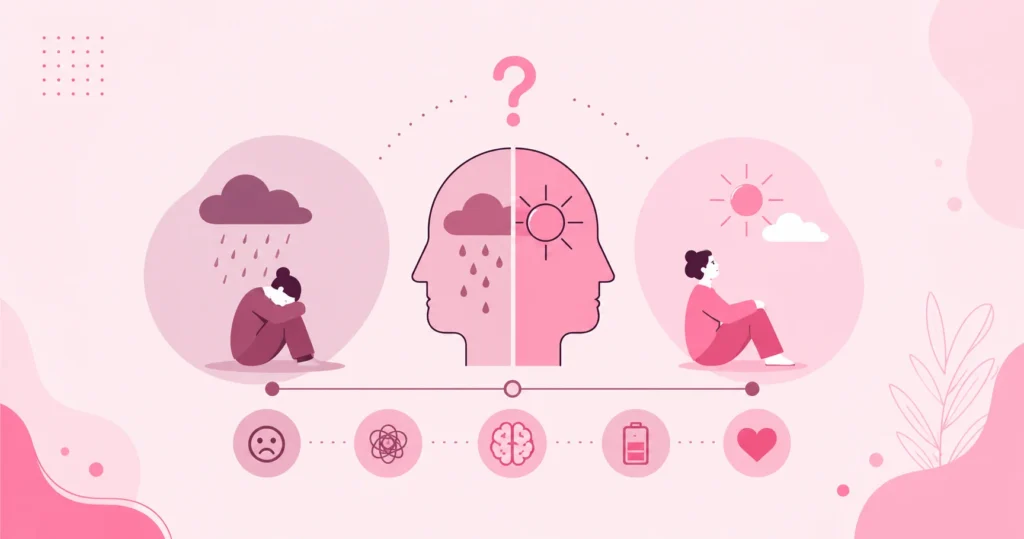
What Is the Difference Between Sadness and Depression?
Sadness is a normal, temporary reaction to a hard event, like loss or disappointment, and it lifts on its own with time and comfort. Depression is a medical condition that lasts most of the day for two weeks or more, and it changes sleep, appetite, energy, and your interest in things you used to enjoy.
Both sadness and depression involve low mood and a wish for things to feel different. But they are not the same, and treating them the same way can mean missing what you actually need. Depression is different from sadness in kind, not just in size. It is not sadness with a louder volume. It is a condition that changes how the brain works day to day, and it often needs real support to manage.
So when people ask about depression vs sadness, the honest short answer is this: sadness is weather, and depression is climate. Weather passes. Climate is the pattern you live inside. According to CAMH, depression is present when symptoms last for most of the day, most days, for more than two weeks, and they get in the way of how a person functions. CAMH also notes that depression can be treated, so people recover and get back to daily life.
Signs of Depression vs Sadness
Knowing the signs of depression vs sadness can help you understand what you are living through. The clearest difference is usually how long the feeling lasts and how much of your life it touches. Sadness tends to come with a reason and ease with time. Depression tends to linger, flatten everything, and stay even on days when nothing went wrong.
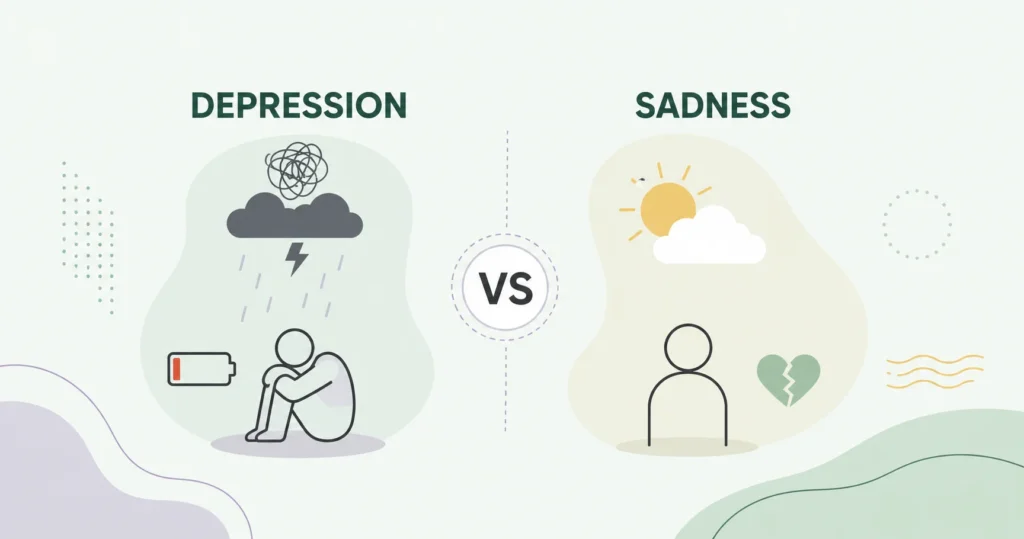
Common Signs of Sadness
- Crying after a hard or emotional event
- Feeling disappointed, hurt, or let down
- Pulling back for a little while, then coming back
- Wanting comfort, rest, or connection
- Slowly feeling better as days pass
Common Signs of Depression
- A low mood that stays, most of the day, most days
- Hopelessness, or a flat, empty feeling
- Anhedonia, which is the loss of interest or pleasure in things you used to enjoy
- Ongoing tiredness or mental exhaustion that rest does not fix
- Anxiety that shows up alongside the low mood
- Little motivation to start or finish things
- Sleeping too little or too much
- Eating much more or much less than usual
- Feeling cut off from the people around you
- Struggling to get through everyday tasks
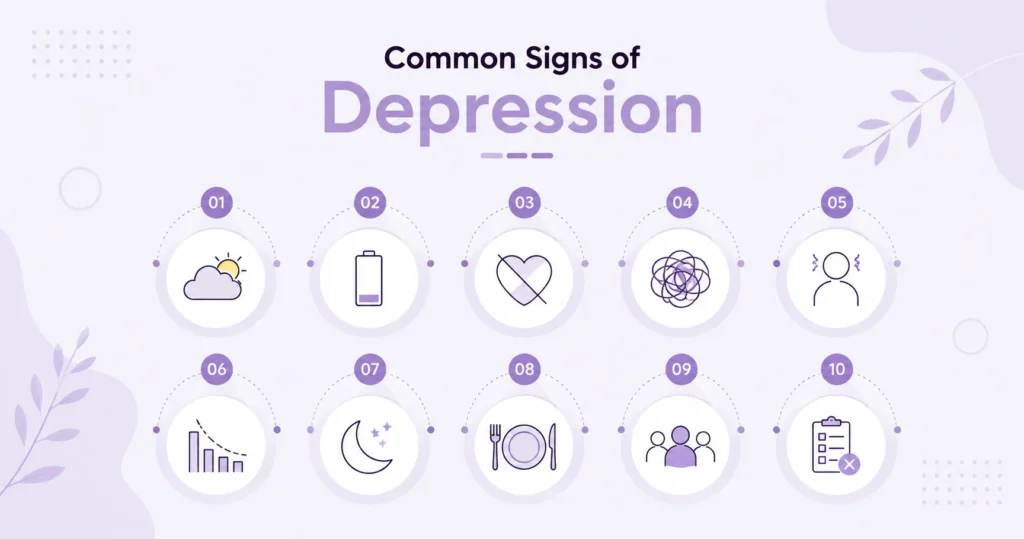
This side-by-side view is meant for self-awareness, not self-diagnosis. If these signs of depression last for weeks and start to affect your well-being, your work, your school, or your relationships, that is a fair reason to talk to someone. You can learn more on our depression page, and because low mood and worry so often travel together, our page on anxiety may help too.
Am I Sad or Depressed? Honest Questions to Ask Yourself
Sadness usually has a clear cause and eases within hours or days. If low mood lasts two weeks or more on most days, takes the joy out of things you once liked, and disrupts your sleep, appetite, or daily tasks, it may be depression. This is reflection, not a diagnosis. A registered therapist can help you tell the difference.
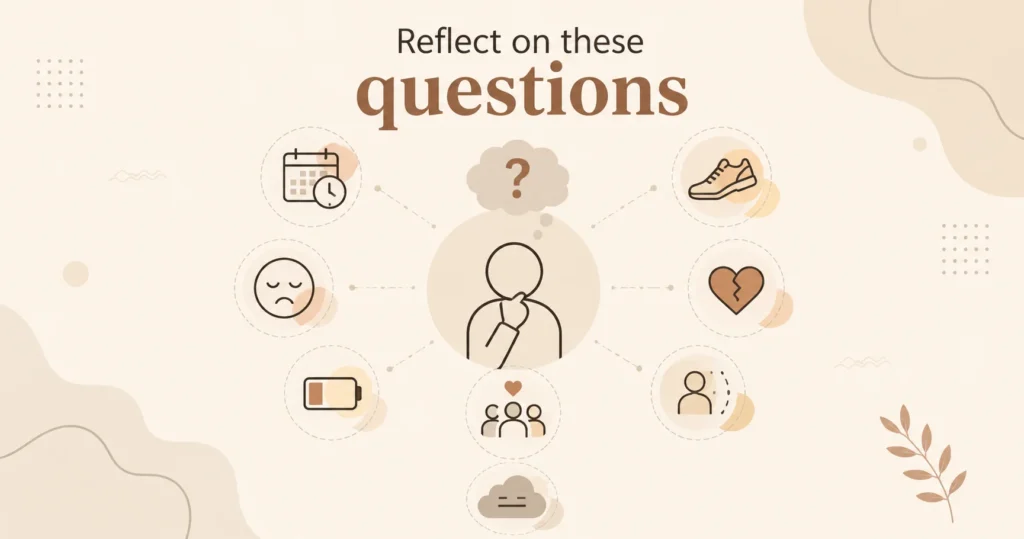
If you have been quietly asking yourself am I actually depressed or just sad, that question is worth honouring. Here are some gentle reflections. There is no score to pass or fail.
Reflect on these questions
- Has this feeling lasted more than two weeks, most days?
- Have I lost interest in things that used to bring me joy?
- Are my sleep, appetite, or energy noticeably different?
- Am I struggling to get through everyday tasks?
- Do I feel hopeless, even on days when nothing bad has happened?
- Have I been pulling away from people I care about?
- Does this feel less like sadness and more like numbness or emptiness?
If you answered yes to several of these, it does not mean something is wrong with you. It means you might benefit from more support than self-care alone can offer. Wanting help is not weakness. It is one of the clearest signs of self-respect there is.
What Causes Sadness and Depression?
Sadness is usually triggered by an outside event, such as loss, rejection, or change. Depression has more layered causes: biology like brain chemistry, genetics, and hormones; psychological factors like long-running negative thinking or unresolved trauma; and social pressures like isolation, money stress, or discrimination. Often several of these combine. Our deeper guide to the causes of depression walks through each of these in turn.
So what causes sadness and depression is rarely one clean thing. Sadness usually points back to something you can name. Depression is more tangled, and it can be hard to trace to a single cause:
- Biological factors, like shifts in brain chemistry, hormonal changes, inflammation, or a family history of mood conditions.
- Psychological factors, like negative thinking patterns, low self-worth, or unresolved trauma that hardens over time. This is one reason CBT helps so many people, because it works directly with the thought patterns that feed the pain.
- Social and environmental factors, like isolation, financial stress, hard relationships, or the weight of discrimination and chronic hardship.
No two people carry depression in exactly the same way. That is why compassionate, personal support matters so much, and why there is no single script that fits everyone.
Can Sadness Turn Into Depression?
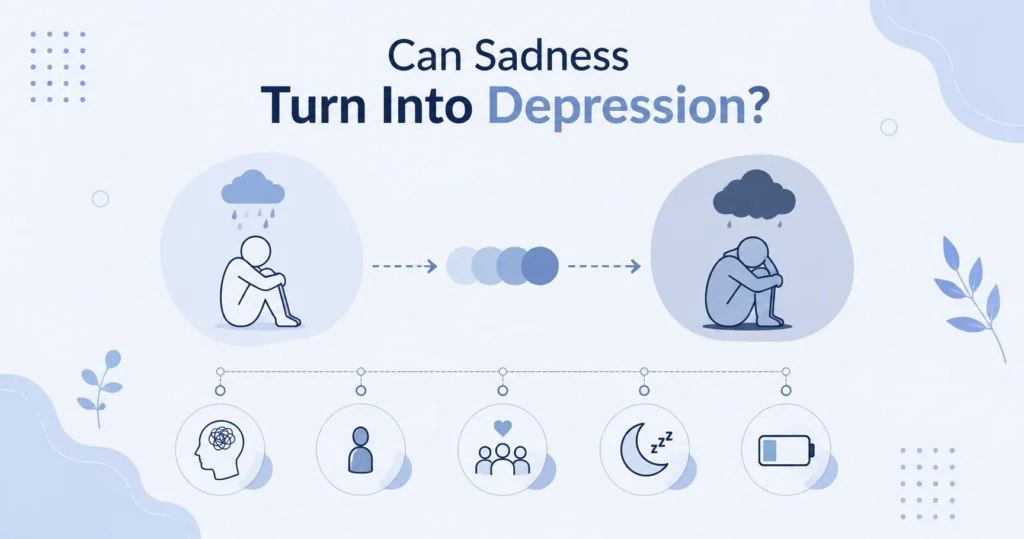
Yes. Sadness that is prolonged, unsupported, or stacked on top of existing strain can develop into depression. Grief after a major loss can sometimes deepen into a depressive episode, especially when support is missing. Chronic stress, isolation, poor sleep, and a family history of mood conditions all raise that risk.
So can sadness turn into depression, and when does sadness become depression? There is no exact line you cross. But certain things make the shift more likely:
- Chronic stress. Long pressure with no relief slowly drains your emotional reserves.
- Isolation. Too little connection lets negative thoughts grow louder.
- Family history. A family history of mood conditions can raise your odds.
- Poor sleep. Broken rest makes it much harder to steady your mood.
Knowing this is not meant to frighten you. It is meant to help you notice early, so you can reach for support before the heaviness settles in for a long stay.
How Long Does Sadness Normally Last?
Sadness usually eases within a few hours to a few days. There is no exact cutoff, but if a consistently low mood lasts two weeks or more on most days, that is a signal worth taking seriously and a good reason to talk to a mental health professional. Duration is one of the clearest dividing lines between sadness and depression.
Grief can last much longer than a few days, and that is normal too. What matters is whether the feeling slowly loosens its grip over time, or whether it stays heavy and flat week after week. If it stays, that is information, not failure.
Is It Normal to Feel Sad for No Clear Reason?
Yes, short stretches of low mood without an obvious cause are common. Depression, though, can also arise with no clear trigger, because it can come from biology like brain chemistry or genetics, not only from life events. If the feeling is heavy, ongoing, or feels more like numbness, it is worth reaching out.
This is part of what depression can feel like that surprises people. You can have a good life on paper and still feel the floor drop out. That does not mean you are ungrateful or broken. It means depression does not always wait for permission or a reason.
Depression and Seasonal Patterns in Ontario
Some low mood follows the calendar. Seasonal affective disorder, often shortened to SAD, is a type of depression tied to the darker months, when shorter daylight hours can pull mood down. In Ontario, where winters are long and the light fades early, this is a real and familiar struggle. If you notice your mood dip as the days shorten, our guide to how cold weather changes your mood unpacks why that happens.
According to the Canadian Psychological Association, about 2 to 3 percent of Canadians will experience serious SAD in their lifetime, while around 15 percent report at least a mild version. You can read a plain overview of the condition at CAMH. If your low mood arrives every fall and lifts in spring, that pattern is worth mentioning to a professional.
One more piece of context worth naming gently: newcomers settling into a new country often carry extra weight, like cultural adjustment, language barriers, and distance from the people who used to hold them up. If that is you, your sadness makes sense, and you are not alone in it.
Should I See a Therapist for Sadness?
You do not have to be clinically depressed to benefit from therapy. It is a space to process feelings and build coping skills, not only for crisis. If sadness feels overwhelming, lasts a long time, or affects your relationships or daily life, reaching out is a wise choice. In Ontario, Saalvio connects you with registered psychotherapists and registered social workers.
Therapy is not only for the breaking point. It can help at any stage, whether you are working through everyday sadness or navigating a deeper depressive episode. Saalvio’s clinical team works in approaches like CBT, which has strong evidence for both low mood and depression. If the heaviness has settled in, our guide on how to overcome depression offers practical, gentle steps. And if you are weighing online therapy in Ontario, you can start small. Not sure where to begin? Here is how to find a therapist that fits.
If cost is on your mind, every Canadian’s first therapy session with a Saalvio clinician is free, so taking the first step is never a financial gamble. Therapy is offered in Ontario today, in English, Urdu, Hindi, Punjabi, and Pashto. The Saalvio self-help app, with mood tracking, journalling, guided practices, and the Thrive AI companion, is available across Canada and North America. Thrive is a supportive companion, not a clinician, and not a replacement for therapy.
You can also message a therapist before you book. It is free, with no commitment and no pressure, just a way to ask your questions and see if the fit feels right. Messaging is a calm on-ramp, not therapy by text and not crisis support. Real sessions happen when you book them.
Coping With Sadness: Practical Steps That Help
When sadness shows up, there are gentle things you can do to move through it with more kindness. These are not a cure, and they are not a replacement for professional care when you need it. They are small footholds.
- Name what you are feeling. Saying “this is grief” or “this is disappointment” can take some of the heat out of a feeling. Putting words to emotion is a core skill in CBT, and many people find it brings the intensity down a notch.
- Let yourself feel it. Pushing sadness away tends to make it stay longer. Giving yourself permission to cry, rest, or simply sit with it can help it move through you.
- Reach out. Connection is one of the strongest answers to both sadness and depression. Telling one person you trust how you really feel can change a whole day.
- Move your body, even a little. A short walk can lift your mood, and gentle movement is widely recommended as part of managing low mood. You do not need a workout. You need a first step out the door.
- Go easy on the numbing. It is natural to want relief, but alcohol, overworking, or endless scrolling tends to deepen the ache over time rather than ease it.
Final Thoughts on Sadness or Depression
Sadness is a normal emotional response. Depression is a deeper condition that can wear down your energy, your thoughts, and your ability to get through the day. When people sit with the question of sadness or depression, what they are really asking is whether they are allowed to need help. You are.
Understanding the difference between sadness and depression lets you respond to yourself with more awareness and more compassion. You do not have to navigate any of this alone, and reaching for support is a real act of care toward the person you are. Wherever you are in your week, whatever the feeling is called, your experience deserves attention and kindness.
Frequently Asked Questions
How long does sadness normally last?
Sadness usually eases within a few hours to a few days. There is no exact cutoff, but if a consistently low mood lasts two weeks or more on most days, that is a signal worth taking seriously and a good reason to talk to a mental health professional. Duration is one of the clearest dividing lines.
Can you have both sadness and depression at the same time?
Yes. People living with depression can still feel specific sadness in response to events. Depression does not erase other emotions. It often makes them harder to process and slower to recover from, so the two can sit side by side in the same week or even the same day.
Is depression always caused by something that happened to you?
Not necessarily. Life events can trigger depression, but it can also arise from biological factors like brain chemistry, genetics, hormonal changes, or chronic physical health conditions. Sometimes there is no clear external cause at all, and that does not make the depression any less real or any less worthy of care.
Can depression happen without a clear reason?
Yes. Depression can develop from a mix of biological, psychological, and social factors, even when no obvious trigger exists. If you feel low for no reason you can name, that is not a sign you are imagining it. It is a sign worth taking seriously and, if it lingers, worth bringing to a professional.
When should I get help for low mood?
Reach out when low mood lasts two weeks or more, takes the joy out of daily life, or affects your sleep, work, or relationships. You do not need to wait for a crisis to ask for support. In Ontario, you can connect with our clinical team, or start with our crisis resources if you need help right now.
Clinically reviewed
Usman Khan, Registered Psychotherapist
Usman Khan is the Clinical Director of Saalvio and a Registered Psychotherapist with the College of Registered Psychotherapists of Ontario (CRPO #13456). He holds an MD, an MPH from Western University, and an MA in Counselling Psychology from Yorkville University. He reviews all clinical content on saalvio.com before publish.
See also across Saalvio
Topics mentioned in this post that have their own page on the site.
Talk to our clinical team
Saalvio offers a free 30-minute consultation with any therapist on the team. There is no card on file. If we are not the right fit, we will say so and help you find one.