
Why Do I Feel Mentally Tired Every Day?
You slept the whole night. You did the things you were supposed to do. And still, from the moment you opened your eyes, your mind felt like it was wading through water. The small tasks feel large. The large ones feel impossible. And somewhere in the quiet of the day you keep asking the same question: why do I feel mentally tired all the time?
If that is you, please hear this first. You are not lazy, and you are not broken. Feeling mentally tired every day is one of the most common things people carry, and one of the least talked about. It does not always look like crying or falling apart. Often it looks like forgetting a word mid-sentence, losing interest in things you used to love, or sitting down to a simple task and feeling your brain hit a wall.
This guide walks through what mental fatigue actually is, why it happens, the signs worth watching for, and how recovery begins. Not a quick fix. A real, honest starting point.
What Is Mental Fatigue?
Mental fatigue is exhaustion that comes from sustained mental or emotional effort rather than physical work. Researchers describe it as a psychobiological state (a tiredness rooted in both mind and body) caused by long periods of demanding thinking or feeling. It makes it harder to focus, manage emotions, and make decisions. Rest and reduced pressure usually help it ease.
Unlike the ache in your legs after a long day of moving, mental fatigue comes from using your mind and your feelings hard, over and over, with no real pause. It can settle on anyone: a student, a parent, a nurse, a caregiver, a new arrival learning a country and a language at the same time. Constant mental fatigue does not ask permission, and it does not check whether you have earned the right to feel it.
Why Do I Feel Mentally Tired Every Day?
Feeling mentally tired every day usually means your mind has been carrying sustained stress, emotional effort, or poor rest for too long. Common drivers are chronic stress, emotional labour, broken sleep, information overload, and unresolved pain. It is a signal to lighten the load, not a personal failing. If it lasts for weeks, it is worth talking to someone.
So if you are asking why am I mentally exhausted, or why is my brain always tired, here are the most common reasons. If a quiet, low-demand day still leaves you empty, our companion guide on why you feel mentally exhausted even after doing nothing looks at that specific puzzle.
1. Chronic Stress
Long-term stress keeps your nervous system on high alert, like a smoke alarm that never stops chirping. Over time, that constant readiness wears the mind down. Work pressure, money worries, a strained relationship, or simply too many responsibilities and not enough hands can all drive constant mental fatigue. When the alarm never switches off, the body can get stuck in what our guide calls survival mode, and that constant readiness is deeply tiring on its own.
2. Emotional Labour
Emotional labour means managing your own feelings to meet the needs of others. It is the steady work of staying calm when you are not, smiling when you are tired, holding it together for a child or a patient or a parent. Healthcare workers, teachers, parents, and service workers carry a lot of it. Quietly regulating your emotions all day is deeply draining, and it leaves many people feeling emotionally and mentally exhausted.
3. Poor Sleep Quality
You can be in bed for eight hours and still wake up empty. Poor sleep quality stops your brain from doing its overnight repair work, when it clears waste and settles memory. Without that, mental exhaustion stacks up night after night.
4. Information Overload
We take in more each day than any generation before us. News, messages, notifications, and an endless scroll create what is often called mental overload. That steady flood of input is a leading cause of mental overload symptoms and the foggy, scattered feeling that comes with cognitive fatigue.
5. Lack of Meaningful Rest
Rest is more than sleep. It is time away from screens, away from obligations, away from problems that need solving. Without that kind of rest, your mental battery never reaches a full charge, no matter how early you go to bed.
6. Unresolved Emotional Pain
Grief, loneliness, an old wound that never closed, a conflict that never settled. These take real mental energy to carry, even when you are not actively thinking about them. If you have been pushing through hard feelings alone, with no place to set them down, your mind can quietly reach the end of what it can hold.
7. Over-Commitment and People-Pleasing
Saying yes to everyone leaves almost nothing for your own recovery. Over time, that pattern builds into mental burnout symptoms and a deep, settled sense of being mentally drained, of giving and giving with nothing coming back.
What Are the Signs of Emotional Burnout and Mental Exhaustion?
Watch for trouble concentrating, forgetfulness, and brain fog; feeling numb, irritable, or overwhelmed by small tasks; headaches, tension, and tiredness sleep does not fix; and pulling away from people or leaning on caffeine and screens to cope. Several of these together, lasting weeks, are worth taking seriously.
Catching the signs of emotional burnout early can help you act before things get heavier. Here are the mental exhaustion symptoms and signs of mental fatigue worth noticing in yourself.
Cognitive signs (how you think):
- Trouble concentrating or making even small decisions
- Forgetting things more than usual
- Feeling foggy, slow, or a step behind
- Less creativity and a harder time solving problems
Emotional signs (how you feel):
- Feeling detached, numb, or flat
- Irritability, mood swings, or a short fuse
- Feeling overwhelmed by tasks that used to be easy
- A sense of hopelessness or that nothing will change
Physical signs (how your body responds):
- Headaches or tight, aching muscles
- Tiredness that sleep does not fix
- Changes in appetite or digestion
- Getting sick more often
Behavioural signs (what you do):
- Pulling away from friends, family, or things you once enjoyed
- Leaning harder on caffeine, screens, or alcohol to cope
- Putting things off or avoiding them
- Struggling to start or finish tasks
If several of these signs you are mentally exhausted ring true, please take them seriously. They are not a character flaw. They are information. Our closer look at the signs of mental exhaustion shows how the body often speaks up when the mind is done.
What Is Mental Overload?
Mental overload is what happens when the steady stream of news, notifications, emails, and decisions outpaces what your mind can process. The signs look like cognitive fatigue: scattered focus, irritability, and feeling foggy or behind. Scheduling intentional, limited screen time, rather than constant passive scrolling, reduces these symptoms noticeably.
Think of your attention as a desk. There is only so much room on it. When the inputs never stop arriving, the desk overflows, and nothing gets the focus it needs. That overflow is mental overload, and it is one of the quiet engines behind feeling mentally drained at the end of a day where, on paper, you did not do all that much.
What Is the Difference Between Mental Fatigue and Depression?
Mental fatigue is usually tied to a stressor or overload and tends to lift with rest and less pressure. Depression is a clinical condition with persistent low mood and loss of interest, and often needs professional support. They overlap, and long-term exhaustion can worsen depression. If symptoms persist or affect daily life, it is worth reaching out.
The two share enough symptoms that they can be hard to tell apart from the inside. Mental fatigue tends to ease when the load lightens. Depression tends to stay, pressing down on mood and interest even when life calms. Chronic mental exhaustion can also tip into or deepen depression over time. There is no shame in not being able to sort it out alone; that is exactly what a clinician is for.
Saalvio connects you with registered psychotherapists and registered social workers in Ontario who work with stress, burnout, anxiety, and low mood. You can book a session through our web portal whenever you are ready.
Mental Burnout Symptoms: When to Take It Seriously
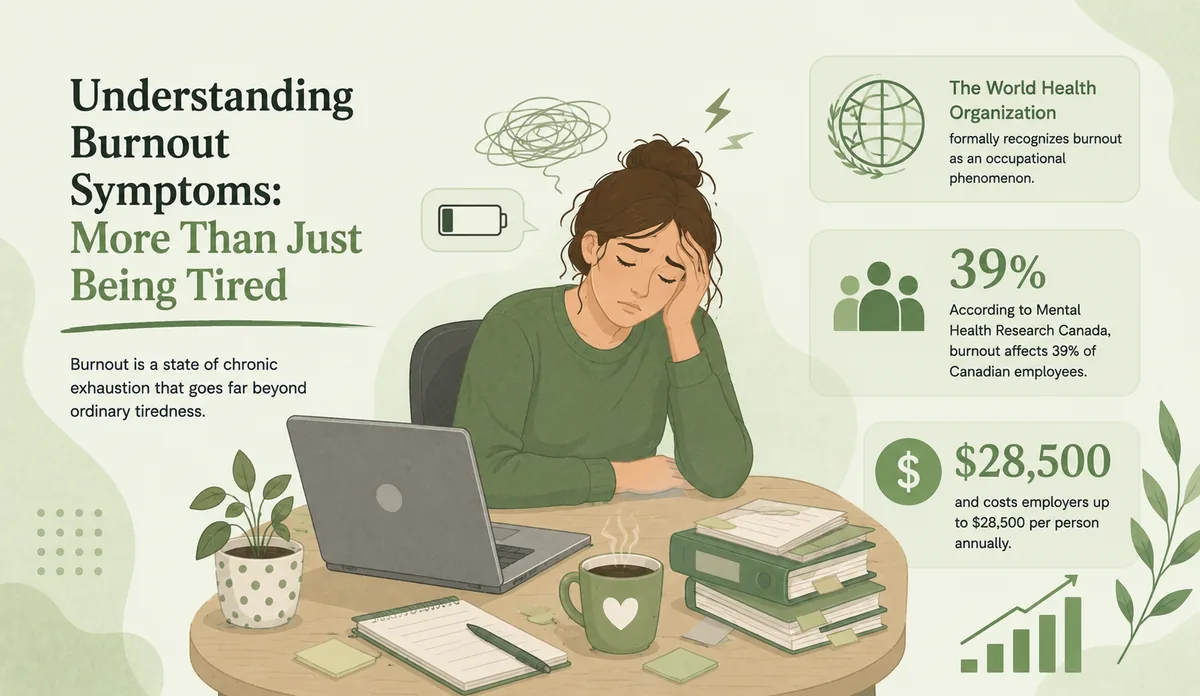
Some mental burnout symptoms go well beyond ordinary tiredness. Burnout is defined by the World Health Organization as a syndrome with three dimensions: feeling drained and exhausted, growing cynical or distant from your work, and a reduced sense of getting anything done (World Health Organization, ICD-11). The term was first named by psychologist Herbert Freudenberger and later studied in depth by Christina Maslach.
Take it seriously if you notice:
- Chronic mental exhaustion that has lasted weeks or months
- Complete disengagement from work or the responsibilities you used to manage
- A steady feeling that nothing matters, or that you cannot keep going
- Physical signs like a tight chest, frequent illness, or disrupted sleep
These are not signs of weakness. They are signs that your mind and body have been carrying too much, for too long, with too little relief. If burnout is what you are facing, our page on burnout support explains what care can look like.
If your low mood has turned darker than tiredness, please do not wait this one out alone.
If you need help right now
Saalvio is not a crisis service. If you are in immediate danger, please call 911. If you are in mental health crisis, please call 988 (the Suicide Crisis Helpline of Canada) or visit your nearest emergency department. You can also find more crisis resources any time.
How Do I Recover From Mental Exhaustion?
Start by naming what you are feeling, then reduce the load where you can. Protect seven to nine hours of sleep, set limits on screens and news, take short daily breaks, and move your body. CBT-based tools help reframe draining thought patterns. If exhaustion is persistent, professional support speeds recovery.
Recovery is possible, but it is rarely instant, and anyone promising you a five-minute cure is selling something. Here is how to recover from mental exhaustion in ways the evidence actually supports, which is also the honest answer to how to stop feeling mentally tired and a steady path toward mental fatigue recovery.
1. Acknowledge What You Are Feeling
Pushing through or talking yourself out of it usually makes it last longer. Simply naming what is going on, whether that is burnout, chronic mental fatigue, or just feeling mentally drained, is a real and meaningful first step.
2. Reduce the Load Where You Can
Look honestly at your commitments and ask what can be paused, shared, or let go. You will not be able to drop everything, and that is fine. Even small reductions in pressure open a little room for recovery to begin.
3. Protect Restorative Sleep
Aim for seven to nine hours of real sleep. Keep a steady schedule, ease off screens before bed, and build a slow wind-down that tells your nervous system it is safe to rest.
4. Use CBT-Based Thought Work
Cognitive behavioural therapy, or CBT, is one of the most evidence-based ways to address mental fatigue and burnout. It helps you spot the draining thought patterns, like harsh self-criticism or always bracing for the worst, and gently shift them toward something steadier and more true. You can read more about how CBT works, and the Saalvio mobile app includes CBT-informed exercises for tracking and reframing your thoughts between days.
5. Set Limits Around Screens and Information
Cutting back on social media and news, especially first thing in the morning and last thing at night, lowers mental overload symptoms a great deal. Chosen, time-boxed screen use is far less draining than open-ended scrolling.
6. Build Small Recovery Habits
Short breaks through the day, even five to ten minutes of stillness, a slow walk, or quiet breathing, give your brain a chance to reset. Working in focused stretches with short breaks between them can help if constant mental fatigue makes long tasks feel impossible.
7. Move Your Body
Movement is one of the fastest ways to shift a tired mind. According to Harvard Health Publishing, regular physical activity can lift mood and ease symptoms of low mood and anxiety. Even a short walk counts; this is not about training for anything.
8. Reach for Support
If the tiredness is persistent, or the signs of burnout keep stacking up, therapy can change things. Approaches like CBT, Acceptance and Commitment Therapy (ACT, which helps you make room for hard feelings while still moving toward what matters), and mindfulness-based therapy work well for chronic mental exhaustion.
In Ontario, reaching a therapist through Saalvio is straightforward. You can explore online therapy in Ontario or read our guide on how to find a therapist and book a session with a registered psychotherapist or registered social worker who understands burnout, stress, and emotional exhaustion.
What Ontario Residents Should Know
Mental health challenges are common across Ontario, and burnout is no exception. According to the Centre for Addiction and Mental Health (CAMH), in any given year one in five Canadians experiences a mental health or addiction problem.
Yet many people wait months before reaching out, often because getting care feels complicated. Saalvio is built to make that first step lighter. Whether you are in Toronto, Ottawa, Hamilton, or anywhere else in Ontario, you can reach a therapist and use evidence-based self-help tools from wherever you are. If you are not sure where to start, you can message a therapist before you book, with no cost and no commitment. Messaging is a no-pressure way to ask your questions first; it is not therapy by text, and it is not crisis support. Therapy happens in a booked session.
Every Canadian’s first therapy session with a Saalvio clinician is free, so trying therapy does not have to be a gamble on whether the fit is right.
A Note on Self-Compassion
If you have been mentally tired for a long time, there is a good chance you have also been hard on yourself for it. Wondering why you cannot just push through. Comparing yourself to people who seem to manage so easily.
Self-compassion is not making excuses. It is treating yourself with the same plain kindness you would offer a friend who was struggling. Research summarized by Dr. Kristin Neff and Self-Compassion.org links greater self-compassion to lower anxiety, depression, and stress. Being gentle with yourself is not a luxury. It is part of how recovery happens.
Frequently Asked Questions
Is feeling mentally tired every day normal?
Occasional mental tiredness is normal, especially after a demanding stretch. But if you feel mentally tired all the time for weeks on end, that is a signal worth listening to. It usually means the load has outpaced your recovery. Lighten what you can, protect rest, and reach out if it does not lift.
Can anxiety cause mental exhaustion?
Yes. Anxiety keeps your mind in a constant state of alertness and threat-scanning, which is very energy-intensive. Many people who live with anxiety feel significant mental fatigue as a result. Calming the nervous system through breathing, steady sleep, and support usually eases both the worry and the tiredness over time.
How long does it take to recover from mental burnout?
There is no fixed timeline. Mild burnout may ease in a few weeks with rest and a lighter load. More severe or chronic mental exhaustion can take months and often benefits from professional support. What matters most is steady, gentle progress and protecting your recovery rather than rushing back.
Can diet affect mental fatigue?
Yes. Poor nutrition, skipped meals, and high sugar intake can worsen cognitive fatigue and energy crashes. Staying hydrated and eating regular, balanced meals supports brain function and steadier energy through the day. Diet alone will not resolve burnout, but it removes one common drain while you work on the bigger picture.
If you have been asking why you feel mentally tired, or why your brain is always tired, this guide was written for you. You deserve rest. You deserve support. And you do not have to figure this out alone.
Saalvio offers CBT-informed self-help tools and guided exercises in the mobile app, and access to registered psychotherapists and registered social workers in Ontario who work with mental burnout, stress, and emotional exhaustion through our web portal. When you are ready to take a first step, we are here.
Clinically reviewed
Usman Khan, Registered Psychotherapist
Usman Khan is the Clinical Director of Saalvio and a Registered Psychotherapist with the College of Registered Psychotherapists of Ontario (CRPO #13456). He holds an MD, an MPH from Western University, and an MA in Counselling Psychology from Yorkville University. He reviews all clinical content on saalvio.com before publish.
See also across Saalvio
Topics mentioned in this post that have their own page on the site.
Talk to our clinical team
Saalvio offers a free 30-minute consultation with any therapist on the team. There is no card on file. If we are not the right fit, we will say so and help you find one.