
What Doomscrolling Does to Mental Health and How to Break the Cycle
You picked up your phone for two minutes. An hour later you are still there, tense, tired, and somehow unable to put it down. You are not weak, and you are not the only one. You are doomscrolling, and your mind is paying for it.
Most of us know the feeling. You open a news app before bed. One headline leads to the next. Before you notice, you have spent an hour reading about crisis, conflict, and things you cannot change. You feel worse than when you started. That loop has a name, and it does real harm to how you feel.
Doomscrolling and mental health are more closely linked than most people think. Understanding that link is the first step toward taking back your attention and your calm.
What Is Doomscrolling, Exactly?
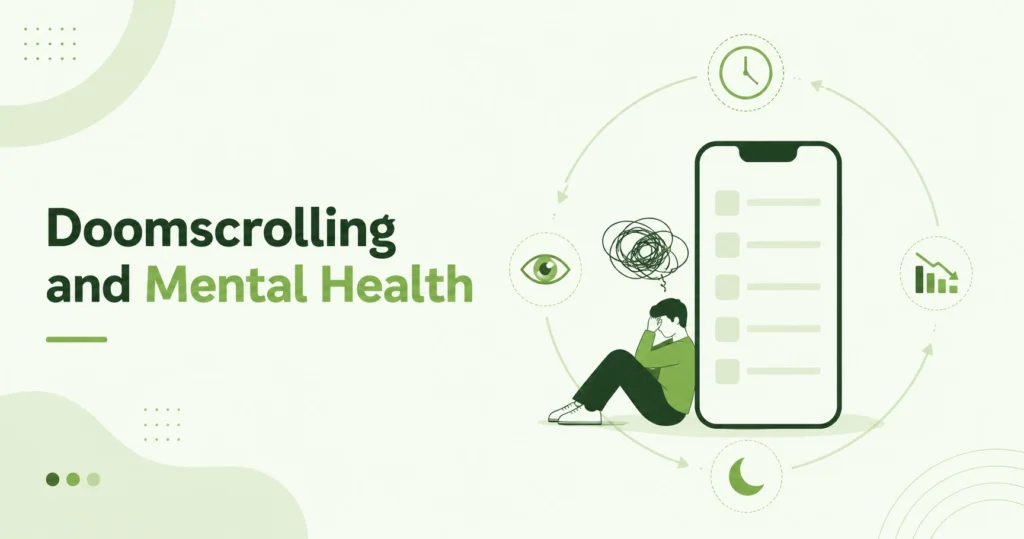
Doomscrolling is the compulsive habit of scrolling through negative or alarming news online, usually on social media feeds, news apps, or forums. The content feels urgent, so you keep going. Staying informed is healthy. Doomscrolling is the unconscious loop that leaves you feeling helpless, anxious, or afraid rather than better informed.
The term spread during the COVID-19 pandemic, when people refreshed case counts and tracked restrictions for hours. But the habit did not leave when the pandemic eased. For many people it became the new normal.
The point worth holding onto is this. Staying informed is not the problem. The problem is the automatic, often unconscious pull of negative content that leaves you drained instead of ready.
How Does Doomscrolling Affect Mental Health?
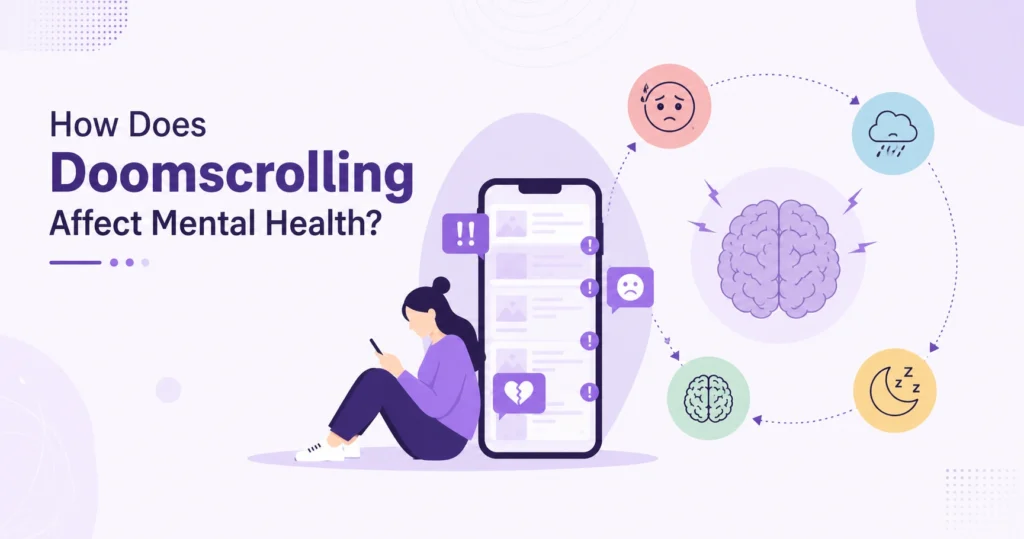
Heavy negative news consumption is tied to measurable harm. It raises baseline anxiety, can deepen low mood and feelings of helplessness, keeps the brain’s threat system switched on, and disrupts sleep. Over weeks and months these effects feed each other, which is why a habit that feels small can quietly wear down your wellbeing.
The link between doomscrolling and mental health is not just anecdotal. Research keeps pointing the same way. Here is what the evidence tells us, broken into the four places it tends to land: anxiety, mood, the brain, and sleep.
It Feeds Anxiety and Worry
Doomscrolling and anxiety reinforce each other. When you take in alarming content, your brain reads it as a threat, so your body runs a stress response even when the danger is thousands of miles away. Repeated exposure trains your nervous system to stay on alert, which is a real driver of ongoing anxiety. Over time this can show up as:
- Racing thoughts
- Constant worry
- Trouble relaxing
- More irritability
- Physical tension
- Fear about the future
In a national study of adults, McLaughlin, Gotlieb and Mills found that people with the highest levels of “problematic news consumption,” a compulsive, hard-to-switch-off pattern, reported worse mental and physical health than lighter news users, even after accounting for personality and overall news use (Health Communication, 2022).
It Contributes to Depression
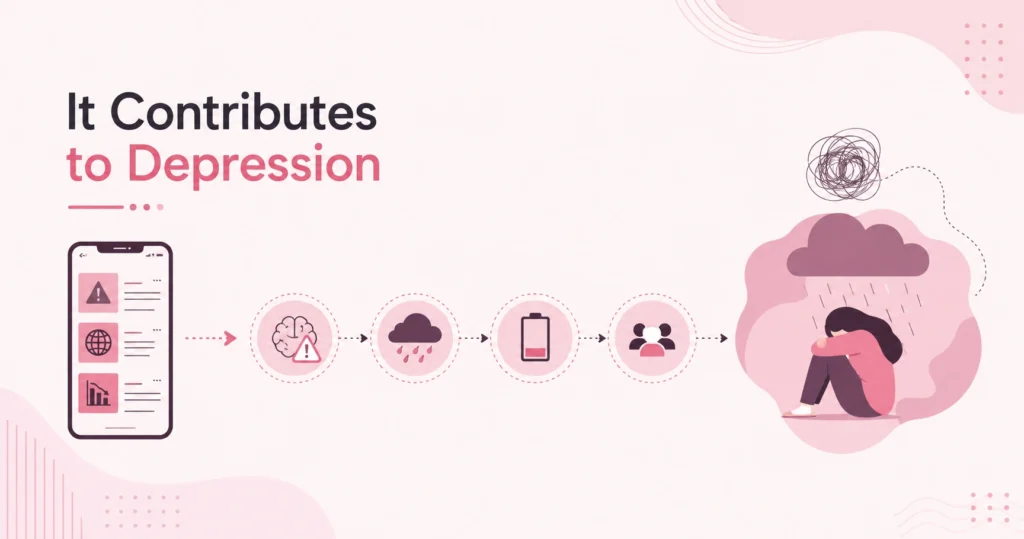
Doomscrolling and depression are closely connected too. A steady stream of hopeless or threatening news can reinforce the sense that nothing can change. You see problem after problem with no resolution and no sense of agency. That is fertile ground for low mood. You can read more about the patterns and support for depression on our conditions page.
The thinking habits that sit underneath depression, like catastrophising (expecting the worst), overgeneralising, and filtering for the negative, are common across many mental health struggles. Doomscrolling can quietly train the brain to repeat those patterns without you ever choosing it. It may also increase:
- Social comparison
- Emotional exhaustion
- Feelings of helplessness
- Pulling away from real-life relationships
- Less motivation for healthy routines
This matters most for adolescents and young adults. Research on doomscrolling, negative news, social media and anxiety in adolescents shows that teens are especially open to harm, because the parts of the brain that manage strong emotion are still developing. When scrolling starts to look compulsive, our guide on whether teens are addicted to social media helps parents read the signs. The scale of youth distress is sobering: in CAMH’s 2023 Ontario Student Drug Use and Health Survey, more than half of students, about 51 percent, reported a moderate to serious level of psychological distress, a figure that has doubled over a decade (CAMH, 2023). If you are a parent worried about a teen, the routing and support notes near the end of this guide are written with you in mind.
The Doomscrolling Effect on the Brain
The doomscrolling effect on the brain is real. Social media uses variable rewards, the same pull that makes a slot machine hard to walk away from. Every scroll might surface something alarming, funny, or interesting, and that unpredictability keeps the brain’s reward system engaged. For a wider look at how these platforms shape mood, see our guide to social media mental health effects.
When the content is steadily negative, the brain’s main threat-detection centre, the amygdala (the part that scans for danger), stays switched on. That makes calm harder to reach, makes clear thinking harder, and can reshape how you react to ordinary stress over time.
This is one reason doomscrolling can feel involuntary. Your brain is being pulled by the same circuits that respond to genuine danger. Knowing this is not meant to make you feel powerless. It is meant to help you meet the habit with patience instead of blame.
Doomscrolling and Sleep Problems
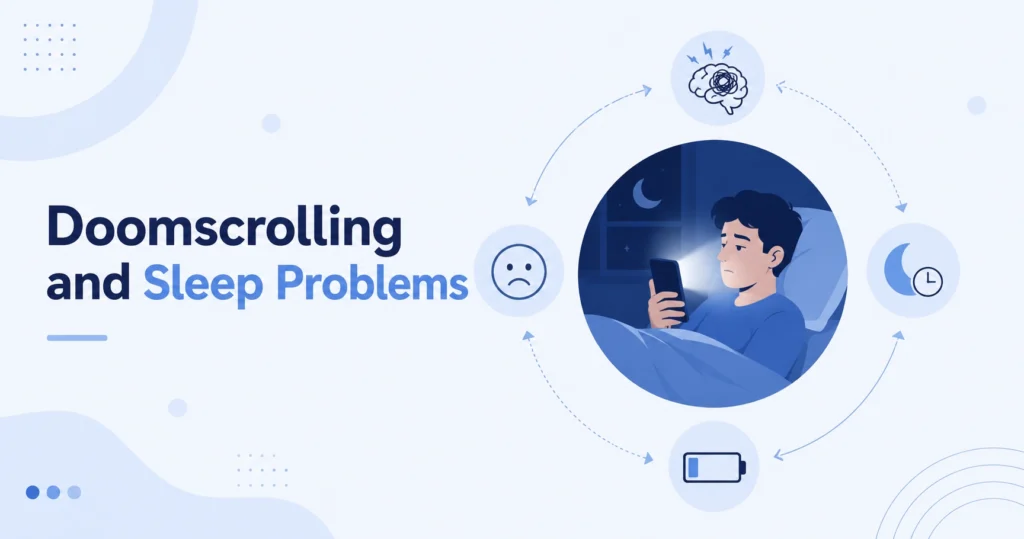
Doomscrolling and sleep problems are a harsh combination. Screen use before bed lowers melatonin (the hormone that signals your body it is time to sleep), which delays sleep onset. But the bigger issue is emotional, not just the light from the screen.
When you scroll through distressing news at night, your nervous system stays activated. Your mind keeps processing. You replay headlines. You picture worst cases. Sleep becomes hard to reach and hard to hold.
Poor sleep, in turn, lowers your emotional resilience. You wake up more reactive, more anxious, and less able to manage stress. It becomes a cycle that chips away at your mental health over weeks and months.
Sleep loss and anxiety feed each other. Changing your scrolling habit before bed is one of the few small moves that can lift both your sleep and your daytime mood at the same time.
Why Can’t You Just Stop?
It is hard to stop for two reasons. Platforms are built to hold you with infinite scroll, push notifications, and feeds picked by an algorithm to keep you there. And humans are wired for morbid curiosity, the pull to pay attention to threats, because noticing danger once kept our ancestors alive.
There is also a quiet paradox. The more anxious you feel, the more you reach for information to settle that anxiety. But negative news rarely brings resolution. It adds uncertainty. So the worry grows, and so does the scrolling. If the habit feels bigger than your willpower, that is not a character flaw. It is the design working as intended.
How to Stop Doomscrolling: Evidence-Based Tips
The good news is that change is genuinely possible. These are not vague lifestyle suggestions. They are practical, evidence-based tips, many rooted in cognitive behavioural therapy (CBT) principles, for how to stop doomscrolling and protect your wellbeing. Set one or two of them this week rather than all eight at once.
Set specific news windows
Choose one or two fixed times a day to check the news, say 15 minutes after lunch. Outside those windows, keep the apps closed. This protects your nervous system from all-day exposure without leaving you in the dark.
Use the 5-4-3-2-1 grounding technique
When you notice the urge to scroll, pause and name five things you can see, four you can touch, three you can hear, two you can smell, and one you can taste. This grounding technique for anxiety calms the body’s stress response and breaks the loop. It is one of the simplest ways to reduce screen time anxiety in the moment.
Create a phone-free wind-down routine
Set one clear boundary: no phone for at least 45 minutes before bed. This is the single best move for how to stop doomscrolling at night. Replace scrolling with something calming, like a warm drink, light reading, or slow breathing. Your sleep and your mood will both thank you.
Audit your notification settings
Every notification is an invitation to scroll. Turn off non-essential app alerts. Fewer triggers means far fewer times you land in a scrolling session you never chose to start.
Practise cognitive defusion
This CBT skill means stepping back from a thought instead of fusing with it. When a headline sparks a strong reaction, try naming it: “I am having the thought that this is a catastrophe.” Cognitive defusion (creating a little distance from a thought) softens the emotional flood.
Replace the habit, do not just remove it
Your brain resists a void. When the urge hits, have a ready alternative: a short walk, a stretch, a quick journal entry. Swapping in a new habit works better than relying on willpower alone, and research keeps supporting that approach.
Limit sensationalised and AI-generated content
Not all content is equal. Sensationalised headlines and AI-generated misinformation are especially likely to provoke outsized fear. Choose trusted sources, and consider a curated newsletter over an endless algorithmic feed.
Track your screen time on purpose
Use your phone’s built-in screen time tracking to build awareness. You do not need rigid limits on day one. Simply seeing the numbers slowly shifts your relationship with unconscious scrolling.
Building a Healthier Relationship With Technology
Technology is not the enemy. Digital spaces offer learning, connection, creativity, and support. The goal is not perfection. The goal is a healthier relationship with information and with your own emotional energy. A balanced digital routine might include:
- Intentional screen breaks
- Mindful social media use
- Regular movement
- Offline hobbies
- Restorative sleep habits
- Supportive relationships
- A little emotional self-awareness
These habits protect your wellbeing while still letting you stay informed. As technology changes quickly, the way we use it shapes our stress levels in ways we do not always notice, which is all the more reason to set the habit on purpose rather than by default. For a fuller picture of how daily screen use adds up, see our guide to the impact of screen time on mental health.
When to Seek Support
Sometimes doomscrolling is a symptom of something deeper. If anxiety, low mood, or sleep trouble sticks around even after you make changes, it may be time to talk with someone. Therapy, and CBT in particular, can help you understand the thought patterns that fuel compulsive scrolling, and can address the underlying anxiety or depression that may be driving it. If you are not sure where to begin, our guide on how to find a therapist walks through it step by step.
Saalvio connects people with our clinical team of registered psychotherapists and registered social workers for online therapy in Ontario, delivered from wherever you feel most at ease. You do not have to decide everything tonight. You can message a therapist before you book, at no cost and with no commitment, and simply ask whether the fit feels right. Every Canadian’s first therapy session with a Saalvio clinician is free, so trying therapy is not a gamble on whether it will help.
Across the rest of North America, the Saalvio app offers self-help tools you can use any time, including mood tracking, journalling, guided practices, sleep tools, and structured self-assessments. These are self-help tools, not therapy and not a substitute for a clinician. Therapy with a Saalvio clinician is offered in Ontario today, with expansion across Canada underway.
You deserve to feel calm in a world that keeps pulling at your attention. Change does not arrive all at once. It is built one small, repeatable step at a time.
If you need help right now
Saalvio is not a crisis service. If you are in immediate danger, please call 911. If you are in mental health crisis, please call 988 (the Suicide Crisis Helpline of Canada) or visit your nearest emergency department. You can find more crisis resources here.
Frequently Asked Questions
Is doomscrolling the same as being informed?
No. Staying informed means taking in balanced news at a healthy pace and on your own terms. Doomscrolling is compulsive and emotionally draining, and it usually leaves you feeling worse rather than better informed. The difference is not the news itself. It is whether you are choosing it or being pulled along by it.
How does doomscrolling affect mental health long-term?
Over time it can raise your baseline anxiety, worsen sleep, deepen low-mood thinking patterns, and shrink your sense of agency and hope. It can also leave your nervous system more reactive to everyday stress. If anxiety or depression is taking hold, support can help you turn the pattern around.
Can a mental health app help me stop doomscrolling?
Yes. Tools that support mindfulness, emotional check-ins, and CBT-based exercises can help interrupt the cycle. The Saalvio app includes self-help tools built for exactly this kind of challenge. To be clear, the app is a set of self-help tools, not therapy and not a clinician. It works alongside professional care when you need it.
Why can’t I stop doomscrolling?
It is hard to stop for two reasons. Platforms are designed to hold you with infinite scroll, notifications, and curated feeds. And humans are wired for morbid curiosity, since noticing threats once kept us safe. The more anxious you feel, the more you scroll for relief that negative news rarely delivers.
Is doomscrolling worse for teenagers?
Research suggests yes. Adolescent brains are still developing the skills to manage strong emotion, so teens are more open to the distress cycle. Calm conversations and shared screen-use boundaries help more than bans. If a teen is in crisis, they can reach Kids Help Phone any time at 1-800-668-6868, or text CONNECT to 686868.
Clinically reviewed
Usman Khan, Registered Psychotherapist
Usman Khan is the Clinical Director of Saalvio and a Registered Psychotherapist with the College of Registered Psychotherapists of Ontario (CRPO #13456). He holds an MD, an MPH from Western University, and an MA in Counselling Psychology from Yorkville University. He reviews all clinical content on saalvio.com before publish.
See also across Saalvio
Topics mentioned in this post that have their own page on the site.
Talk to our clinical team
Saalvio offers a free 30-minute consultation with any therapist on the team. There is no card on file. If we are not the right fit, we will say so and help you find one.