
Men’s Mental Health Month: Communication, Relationships, and Where to Get Support in Canada
Every June is Men’s Mental Health Month in Canada. If you are a man reading this, or someone who loves one and has been quietly worried for a while, this is for you.
There is a man somewhere right now who has not slept properly in a long time and tells himself this is just what fathers do, what husbands do, what men do. He has not said the words “I am not okay” out loud, because in the world he grew up in, nobody ever asked. Men’s Mental Health Month exists for him. The conversations that happen this month, or do not happen, are the whole point.
This guide looks at why men’s mental health deserves its own month, what the Canadian numbers actually say, how relationships and the ability to communicate are tied to how men feel inside, and where to find real support, including counselling and evidence-based tools you can start on your own. Better mental health for men starts with naming things plainly, because the silence is the problem, not the words.
When Is Men’s Mental Health Month in Canada?
Men’s Mental Health Month runs every June in Canada. In 2026 it falls across June 1 to June 30, with Men’s Mental Health Week from June 9 to 15 and Men’s Mental Health Awareness Day on June 13. The month is used to lower stigma and to encourage men to seek support earlier, before things reach a breaking point.
It returns every year for a reason. The need does not take a month off, and the men most likely to be struggling are the least likely to mark a calendar date about it. So the month is less a celebration and more a standing invitation: this is the time we say the quiet thing out loud, together, so it costs one man a little less to say it the rest of the year.
What Do the Numbers Say About Men’s Mental Health in Canada?
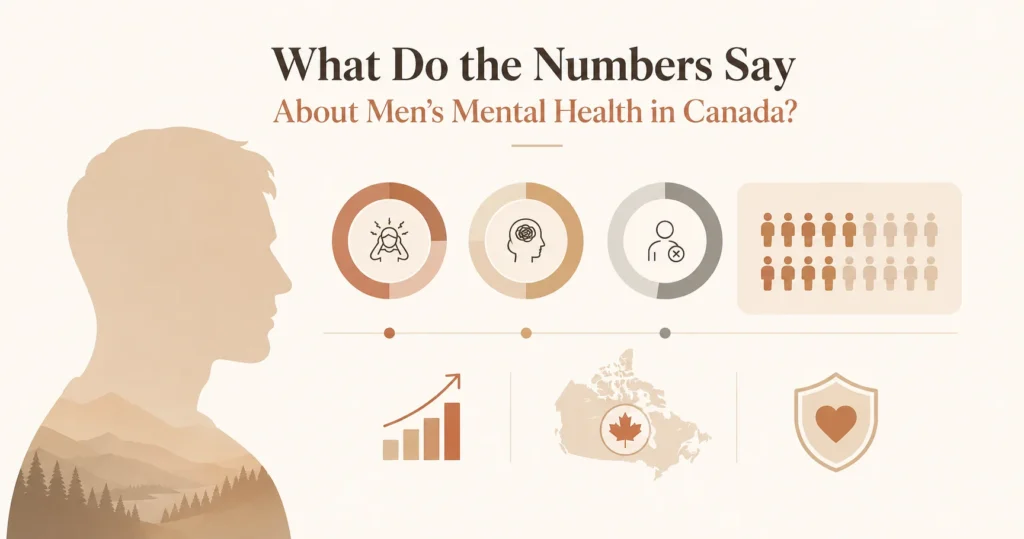
The mens mental health canada picture is clearer than it used to be. In a 2025 national survey of 2,000 Canadian men by the Canadian Men’s Health Foundation, 64 percent reported moderate-to-high stress and 23 percent were at risk of moderate-to-severe depression. Most striking, 67 percent had never used a professional mental health service even once.
These are not abstract figures. Behind the men’s mental health statistics are fathers, sons, partners, brothers, and the colleague who always says he is fine. According to the Canadian Men’s Health Foundation’s 2025 research, both the stress and the depression-risk numbers rose about four points in a single year, and half of Canadian men are now at risk of social isolation, which the research links directly to higher stress and a greater risk of depression.
The hardest number is the one we say carefully. The Mental Health Commission of Canada reports that suicide is the second leading cause of death for Canadian men aged 15 to 39, after accidents, and that around 75 percent of the roughly 4,000 suicide deaths in Canada each year are men. Each of those is someone’s son. Each one leaves an empty chair at a table that did not see it coming. These are, in large part, deaths driven by barriers to asking for help, and barriers can be lowered.
The federal government has started to treat this as the public health issue it is. Canada is now developing its first Men and Boys’ Health Strategy, built specifically to reduce stigma and to make it easier for men to reach for help sooner.
How Does Men’s Mental Health Show Up Differently?
Depression and anxiety in men often look like irritability, physical aches, fatigue, withdrawal, or overworking rather than visible sadness. CMHA Ontario notes that men are more likely to describe mental health concerns as physical symptoms, which is one reason their struggles are so often missed, both by the men themselves and by the people who love them.
One reason men’s mental health goes unrecognized is that it rarely arrives looking like the picture most people carry of depression. The signs of depression in men often show up sideways:
- A short fuse and constant irritability that feels out of proportion to whatever set it off
- Physical symptoms with no clear cause: headaches, back and shoulder tension, deep fatigue, stomach trouble
- Pulling away, going quiet, skipping the things he used to show up for
- Throwing himself into work, gaming, drinking, or a project, anything to keep moving
- The flat dismissal: “I’m fine,” “it’s just stress,” “I’ll sort it out”
As CMHA Ontario describes, when low mood and anxiety in men surface as physical complaints, the underlying mental health concern frequently goes undiagnosed and untreated for years.
This is where relationships come in, because it is so easy to read the signs wrong from the outside. A partner can hear withdrawal as rejection. A friend can take irritability for cruelty. A son can read his father’s silence as not caring. None of those readings help the man who is struggling, and none of them help the people trying to reach him. There is a reason communication in relationships keeps showing up in the same conversation as men and mental health. They are not separate topics. They are bound together.
How Do Healthy Relationships Protect Men’s Mental Health?
Close, supportive relationships are one of the strongest predictors of long-term mental well-being. The 2025 Canadian Men’s Health Foundation survey found that half of Canadian men are at risk of social isolation, which links directly to higher stress and depression. Connection is a genuine protective factor, not just a nice-to-have.
The research on social connection is steady and clear. Not having anyone to confide in is associated with more stress and a greater risk of depression, while having even a few people you can be honest with works the other way. A 2025 study in the Journal of American College Health, drawing on Canada’s 2022 National College Health Assessment data, found that romantic relationship challenges were significantly associated with poorer mental health among young Canadian men aged 18 to 24. The flip side matters just as much: supportive relationships are protective.
This does not mean relationships are easy, or that they are the whole answer. It means that the time and effort it takes to keep them honest and close is not separate from looking after your mental health. It is part of it.
When a Relationship Is the Source of the Stress
It is also true that relationships can be where the pain lives. Ongoing conflict, emotional distance, or the slow sense that something is eroding all carry a real cost. This is what couples therapy and relationship counselling are for. Couples therapy is professional counselling where partners work together to improve how they communicate, resolve conflict, and rebuild closeness, and research suggests that many couples who engage in it report meaningful improvement, both for relationships in distress and as a way to strengthen a good one before small cracks widen.
Saalvio’s virtual therapy in Ontario is individual psychotherapy with registered psychotherapists and registered social workers, so couples sessions are not part of what we offer today. That said, a great deal of relationship work can be done in your own individual therapy: understanding your patterns, learning to name what you feel, and changing how you show up in your closest relationships. If you and a partner want to work together, your family doctor or a local relationship counselling service can point you to clinicians who offer couples work.
How Can Men Communicate Better in Relationships?
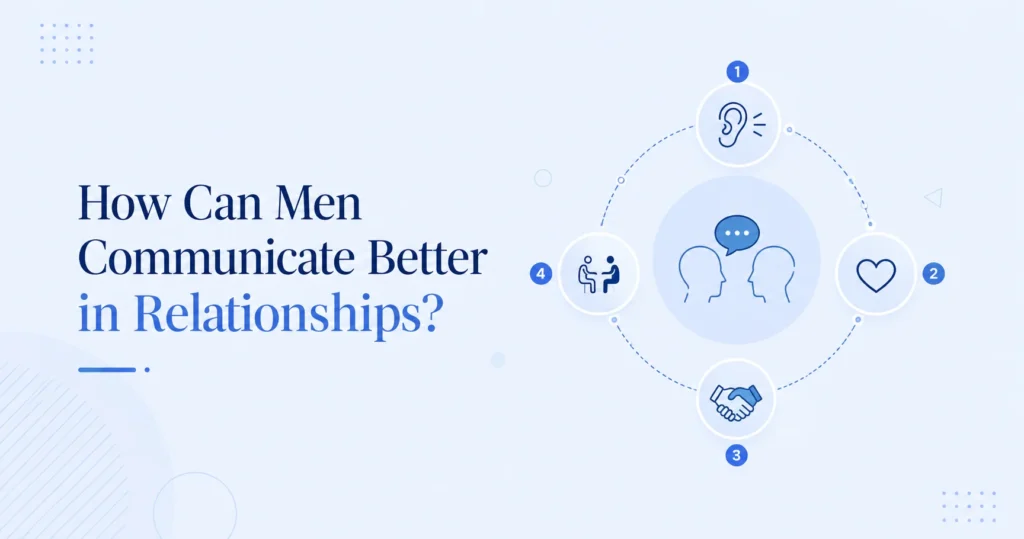
Four skills help most: active listening, which means listening to understand rather than to reply; naming what you feel out loud instead of swallowing it; staying in hard conversations instead of walking away; and genuine repair after conflict. These are learnable skills, not fixed traits, and they can be practised in your own therapy.
Healthy relationship communication is not about having fewer arguments. It is about arguing better, connecting more honestly, and being able to bring your real self into the relationships that matter most. None of this asks you to become a different person. It asks you to become a more honest version of the one you already are.
Active Listening
Active listening means listening to understand instead of planning your rebuttal. You make eye contact. You reflect back what you heard: “It sounds like you felt dismissed. Did I get that right?” That single shift, from listening-to-respond to listening-to-understand, changes the temperature of almost every difficult conversation.
Naming What You Feel
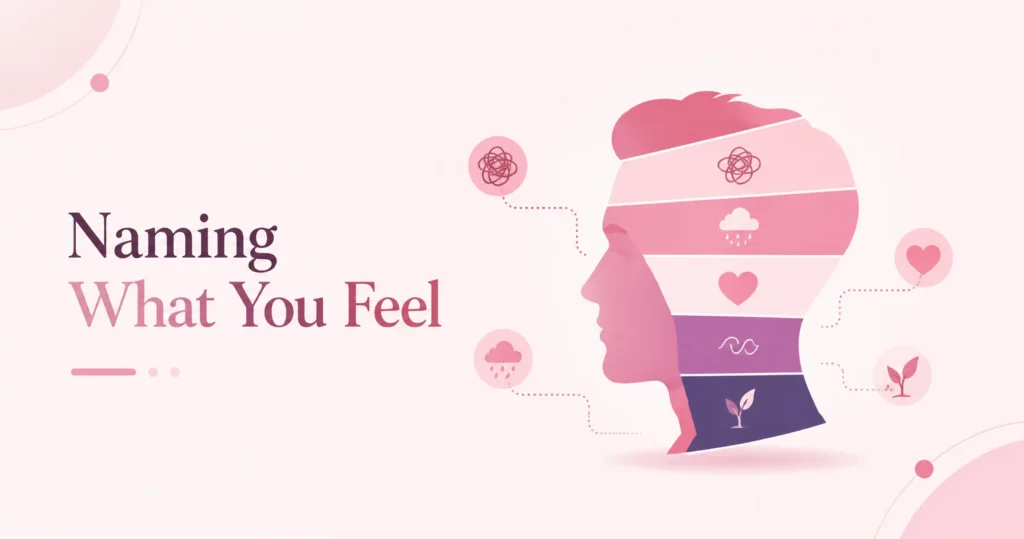
Many men were taught to name nothing, or to turn every feeling straight into an action item. But the ability to say “I feel overwhelmed” or “I am more worried than I have been letting on” is tied to handling emotions well and to relationship satisfaction. This is not a soft skill. It is a basic one, and most men were simply never taught it.
Conflict Resolution and Staying in the Room
Walking away can feel safer than escalating, and avoiding conflict is a common pattern. But when avoidance becomes the rule, the issues it skips just pile up. Conflict resolution in relationships means staying in the conversation when it is uncomfortable, and trusting that the relationship is strong enough to hold the hard parts.
Repair After Conflict
No two people stay close without ruptures. What sets healthy relationships apart is not the absence of conflict but the presence of repair: a real apology, an honest acknowledgment of the hurt, and a willingness to come back to each other after distance.
Building Emotional Intimacy Over Time
Emotional intimacy in relationships is built from small, repeated moments of honesty and presence. Asking a question you actually want answered. Sharing one true thing. Showing up when it is hard. These are the quiet building blocks of the trust that makes a relationship something you can lean on.
Why Do Many Men Avoid Seeking Mental Health Support?
Research points to three patterns: stigma from masculinity norms that frame help-seeking as weakness, not recognizing the signs as a mental health concern in the first place, and system-level barriers like limited or unfamiliar access. A systematic review of 47 studies found that traditional masculinity norms consistently block men from seeking help, through both social stigma and self-stigma.
Understanding why 67 percent of Canadian men have never sought support means understanding these barriers honestly. They are not personal failings. They are patterns built over a lifetime by culture, family, and the systems around us.
The Stigma Around Vulnerability
Decades of messaging that equate emotion with weakness produce men who have learned to suppress, minimize, and push through. Asking for help, from a therapist, a doctor, or a partner, can feel like an admission of failure rather than what it actually is, which is one of the harder forms of courage. The systematic review published in the American Journal of Men’s Health, which examined 47 studies, found this masculinity-norm barrier showing up again and again, operating as both social stigma, the fear of what others will think, and self-stigma, what it seems to mean about yourself.
Not Recognizing the Signs
If depression shows up as irritability and no one ever taught you that this counts, it is easy to name it “stress,” “a rough patch,” or “just how I am right now.” Without a name, the problem is much harder to solve, and reflecting on what you are actually carrying is not the same as a diagnosis. If you want a clearer picture of what you are experiencing, our guides to depression and anxiety walk through the signs in plain language.
System-Level Barriers
The Government of Canada’s men’s health resources note that men are less likely to use primary care and preventive services, with 65 percent of Canadian men waiting more than six days with symptoms before seeing a doctor. The system itself was not built around how men tend to communicate and reach for help.
The Shift That Is Happening
Men’s mental health awareness is genuinely growing. More men are speaking openly about their experiences. More workplaces are taking psychological safety seriously. More Canadians understand that strength includes knowing when to ask. That shift is slow, but it is real, and one honest voice still opens the door for the next person.
CBT-Informed Skills That Help Men Communicate and Connect
CBT, or cognitive behavioural therapy, is a structured, practical talk therapy that is among the most researched approaches we have. It suits the goal-oriented style many men prefer. You are not asked to dig endlessly through your past. You are given specific tools to see what your thinking is doing, how it shapes your behaviour, and what you can do differently. Here are three CBT-informed skills that support both mental health and how you connect with the people closest to you.
1. Spotting Thinking Traps
A lot of conflict is fuelled less by what happened than by how we read it. CBT helps you catch thinking traps: all-or-nothing thinking (“she never listens”), mind-reading (“he thinks I am useless”), or catastrophizing (“one argument means it is over”). Noticing the pattern is the first step to choosing a different response.
2. The STOP Skill for Reactive Moments
When a conversation heats up, the body takes over before the mind catches up. The STOP skill (Stop what you are doing, Take a breath, Observe what you are feeling without judging it, Proceed with intention) puts a small gap between the trigger and the reaction. In conflict, that gap is where the better choice lives.
3. Small Experiments for Closeness
Sometimes the surest way to build emotional intimacy is to try one small thing and see what happens. Share one thing genuinely on your mind. Ask one question you actually care about. CBT frames these as low-pressure experiments that test what is possible in a relationship, instead of letting old assumptions decide for you.
Finding Men’s Mental Health Support in Canada and Ontario
Knowing support exists is one thing. Knowing how to actually reach it is another. Here is what is genuinely available, with a focus on Ontario.
Free and Low-Cost Options in Ontario
- Ontario Structured Psychotherapy (OSP) Program: free, publicly funded CBT for Ontario residents aged 18 and older, including phone coaching, online CBT, group sessions, and individual therapy. You can self-refer.
- BounceBack Ontario: a free, guided self-help program from CMHA, using workbooks and phone coaching for low mood, stress, and worry.
- ConnexOntario: a free, confidential service that helps you find mental health, addiction, and crisis support across the province, available any time.
Across Canada
- Talk Suicide Canada: call or text 988, free, around the clock, in English or French, anywhere in Canada.
- Canadian Men’s Health Foundation: self-assessments, expert resources, and peer stories built specifically for men.
- HeadsUpGuys: a Canadian resource made for men dealing with depression, with practical self-monitoring tools.
- MenTELL: a grassroots Canadian men’s mental health movement with peer stories, provincial resource guides, and the #BeTheFlare campaign.
- Employee Assistance Programs (EAPs): many Canadian workplaces include free short-term counselling in their benefits. It is worth checking yours.
Men’s Mental Health Counselling in Ontario Through Saalvio
If you are in Ontario and looking for men’s mental health counselling, Saalvio offers online therapy in Ontario delivered by registered psychotherapists and registered social workers, including clinicians experienced with the stress, low mood, anxiety, and relationship strain that men often carry. Therapy happens in booked sessions, and the relationship and communication work you can do in your own individual therapy is a real part of it. Saalvio’s virtual therapy is offered in Ontario today, with expansion underway across Canada.
You do not have to commit to anything to start. Before you book, you can message a registered psychotherapist before you book and ask whatever you need to ask: whether they have worked with men in your situation, whether their approach fits, whether they will understand the life you come from. There is no cost and no pressure. Messaging is not therapy by text and it is not crisis support; it is just a way to ask your questions first. Every Canadian’s first session with a Saalvio clinician is free, and if it helps to know how the first hour goes, you can read what to expect in a first session beforehand, so deciding to try therapy is not a gamble on whether the fit will be right. If you are not sure where to begin, our guide on how to find a therapist can help.
Self-Guided Tools Through the Saalvio App
If you are not ready for a session yet, the Saalvio mobile app puts CBT-informed tools for stress, mood tracking, journaling, and guided practices in your hands, available across Canada and North America. It is a private, practical place to start at your own pace, on the App Store and Google Play. The self-help tools live in the mobile app; therapy sessions and self-assessments are also available through the web client portal at client.saalvio.com for anyone who prefers a browser.
If at any point things feel like more than you can hold, please reach for the crisis resources below. You do not have to wait until it is an emergency to ask for help, and you do not have to wait until it is an emergency to deserve it.
How to Support a Man Who Is Struggling
If a man you love is struggling, listen without rushing to fix it, ask how you can help instead of assuming, encourage small steps, and stay in contact even when he pulls away. Gently encourage professional support and offer to help him find it. Look after yourself too; you cannot carry someone else while running on empty.
The hardest part is often that he will not name it, and may wave you off with “I’m fine.” You do not need the perfect words. Staying, asking again gently another day, and not taking the silence personally is its own kind of care. If you are ever worried he is in danger, do not keep it to yourself. Use the crisis resources below, and if there is immediate danger, call 911.
Frequently Asked Questions
When is Men’s Mental Health Month in Canada?
Men’s Mental Health Month is observed every June in Canada. In 2026 it runs from June 1 to June 30, with Men’s Mental Health Week from June 9 to 15 and Men’s Mental Health Awareness Day on June 13. The month is used to lower stigma and encourage men to seek support earlier.
What are the key men’s mental health statistics in Canada?
In the Canadian Men’s Health Foundation’s 2025 survey of 2,000 men, 64 percent reported moderate-to-high stress, 23 percent were at risk of moderate-to-severe depression, and 67 percent had never used a professional mental health service. The Mental Health Commission of Canada reports about 75 percent of Canada’s roughly 4,000 annual suicide deaths are men.
How does men’s mental health connect to relationships?
Social connection is among the strongest protective factors for mental health. The Canadian Men’s Health Foundation’s 2025 survey found half of Canadian men are at risk of social isolation, which links directly to higher stress and depression. When communication difficulties in relationships go unaddressed, they tend to compound mental health challenges over time.
What is couples therapy, and does it work?
Couples therapy is professional counselling where partners work together to improve communication, resolve conflict, and rebuild closeness. Research suggests many couples who engage in therapy report meaningful improvement, both when a relationship is in distress and as a way to strengthen a good one. Saalvio offers individual psychotherapy in Ontario, not couples sessions, in Phase 1.
How can men communicate better in relationships?
Key skills include active listening (listening to understand rather than to reply), naming what you feel out loud, staying in difficult conversations instead of withdrawing, and genuine repair after conflict. These are learnable skills, not fixed traits, and they can be practised in your own individual therapy or with CBT-informed tools.
Where can men find free or affordable mental health support in Canada?
In Ontario, the OSP Program (free CBT for adults 18 and older), BounceBack Ontario, and ConnexOntario (free, around-the-clock navigation) are strong starting points. Across Canada, 988 Talk Suicide Canada, Employee Assistance Programs, HeadsUpGuys, and MenTELL are all free. Saalvio offers self-guided app tools and individual therapy booking in Ontario.
Why do men avoid seeking mental health support?
Research identifies three consistent patterns: stigma from masculinity norms that frame help-seeking as weakness, not recognizing the signs as a mental health concern, and system-level barriers like limited or unfamiliar access. A systematic review of 47 studies found masculinity norms consistently block help-seeking through both social and self-stigma. The culture is slowly but genuinely shifting.
Is online therapy effective for men?
Yes. For many common concerns, including anxiety, depression, and relationship strain, online therapy delivered by registered professionals produces outcomes comparable to in-person care. It is often more accessible for men with demanding schedules or anyone who finds a first in-person visit daunting. Saalvio’s online therapy is offered in Ontario today, with expansion underway across Canada.
Clinically reviewed
Usman Khan, Registered Psychotherapist
Usman Khan is the Clinical Director of Saalvio and a Registered Psychotherapist with the College of Registered Psychotherapists of Ontario (CRPO #13456). He holds an MD, an MPH from Western University, and an MA in Counselling Psychology from Yorkville University. He reviews all clinical content on saalvio.com before publish.
See also across Saalvio
Topics mentioned in this post that have their own page on the site.
Talk to our clinical team
Saalvio offers a free 30-minute consultation with any therapist on the team. There is no card on file. If we are not the right fit, we will say so and help you find one.