
IFS Therapy for Anxiety, Trauma and PTSD
Book a Free 30-Minute Consultation
Internal Family Systems, or IFS, is a talk therapy approach that treats anxiety, trauma, and PTSD as the work of protective inner parts rather than as flaws to fix. Saalvio’s clinical team offers IFS therapy for trauma and related concerns across Ontario, with a free first session and no referral required. Here is how the model actually applies to each of these three experiences.
Every IFS session, whatever the presenting concern, rests on the same foundation. A therapist helps you notice a part, get curious about it, and eventually understand what it is trying to protect you from. If you want a closer look at how that unfolds step by step, our breakdown of IFS parts work walks through the process in detail. What changes from anxiety to trauma to PTSD is not the method. It is which parts tend to show up, and what they are usually guarding.
Most people who come to IFS for the first time are not looking for a label. They are looking for some relief from a pattern that keeps repeating, a racing mind at 2 a.m., a body that reacts to something that happened long ago, or a heaviness that does not seem to go away. IFS does not ask you to explain everything perfectly before you begin. It simply gives you a way to get curious about what you are feeling, one part at a time. For those exploring therapy apps in Canada, this can also be a useful way to learn more about your inner world alongside professional support.
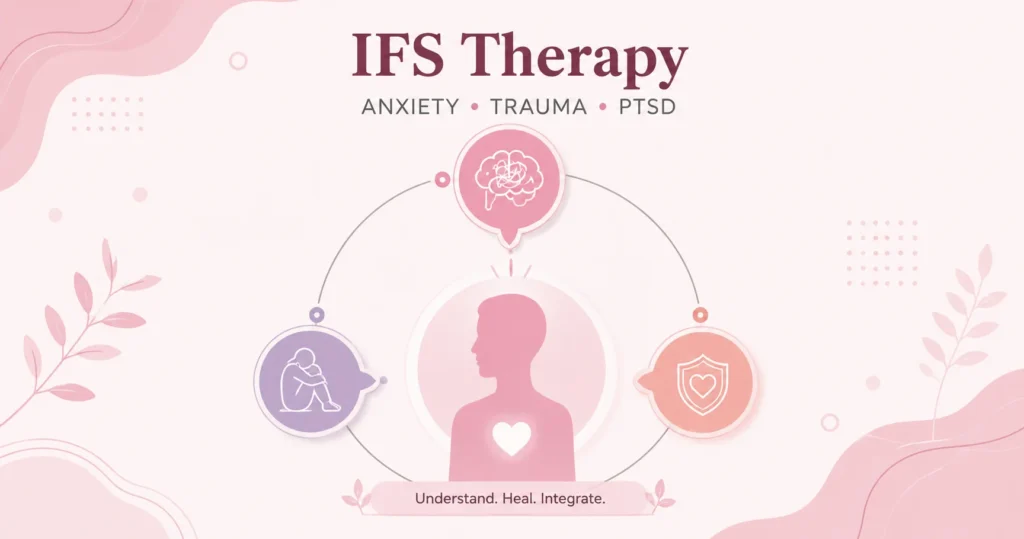
What is IFS therapy for anxiety?
Anxiety in the IFS model is rarely just one part. It is usually a manager, a part that works overtime to keep you prepared, in control, or one step ahead of anything that might go wrong. Managers show up as the voice that rehearses a hard conversation a dozen times before it happens, or the one that cannot let a task go until it feels perfect.
They are exhausting to carry, but they are not the enemy. In IFS terms, a manager took on an anxious, hypervigilant role because, at some point, it believed that vigilance was what kept you safe.
Internal family systems therapy for anxiety does not try to silence that manager. It gets curious about it instead, asking what it is afraid would happen if it eased up, and what it is protecting underneath the worry. According to the Canadian Mental Health Association, anxiety disorders affect how a person thinks, feels, and acts, and are among the most common mental health concerns in the country. IFS offers one way of understanding that pattern from the inside, part by part, rather than only symptom by symptom.
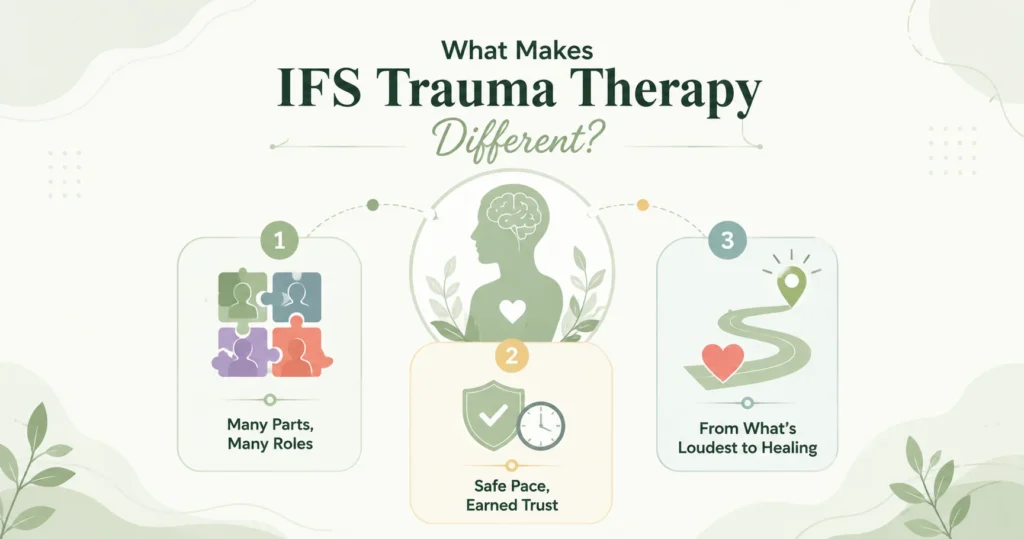
What makes IFS trauma therapy different?
Trauma changes how parts organize themselves. Where anxiety often centres on one or two anxious managers, internal family systems therapy for trauma usually uncovers a fuller cast: managers working hard to keep daily life functioning, firefighters that jump in fast when a memory gets triggered, sometimes through anger, numbing, or distraction, and exiles, the younger, more vulnerable parts carrying the original pain, kept out of view because they feel too overwhelming to face directly.
IFS trauma therapy moves at the pace the system can tolerate. A therapist will not ask you to relive a traumatic memory in detail before your protective parts trust that it is safe to step back. Building that trust, one manager and one firefighter at a time, is most of the early work. Only once enough Self-energy is present does the therapy approach an exile directly, and even then, always with the protective parts’ consent.
This pacing is often what people notice first, and what surprises them most. Many arrive expecting to be asked to describe what happened in detail from the first session. IFS tends to work the other way around, starting with whatever is loudest right now, a racing heart before a meeting, a wall of numbness after a hard phone call, and only moving toward the original memory once the parts protecting it feel it is safe enough to do so.
How IFS therapy for PTSD works
PTSD often narrows a person’s world. A flashback, a startle response, or a wave of shutdown can arrive without warning, hijacking a moment that had nothing to do with the original event. IFS reframes these responses as extreme protective strategies rather than malfunctions. A firefighter that floods the body with adrenaline during a flashback is, in its own way, trying to keep an exiled memory from overwhelming you completely.
Clinical guidance from CAMH notes that PTSD can seriously disrupt a person’s ability to regulate emotions and maintain relationships, and that proper treatment can meaningfully improve quality of life. IFS therapy for PTSD works by helping these protective parts unclench enough for a person to stay present, rather than working to erase the memory itself. Over time, as managers and firefighters trust that Self can hold what they have been guarding, PTSD symptoms tend to soften because the parts no longer feel they have to carry the weight alone.
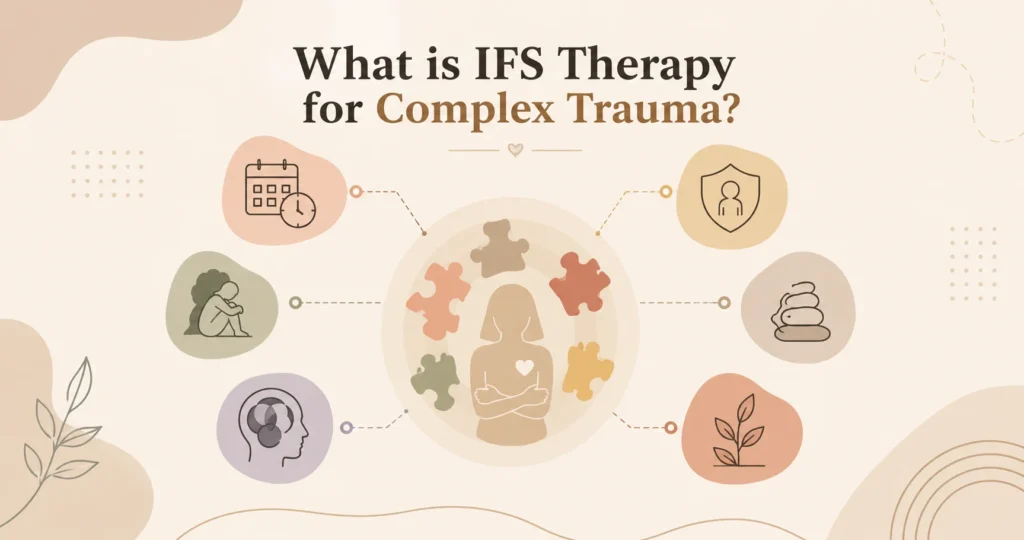
What is IFS therapy for complex trauma?
Complex trauma is different from a single traumatic event. It tends to build up from repeated or long-term experiences, like ongoing childhood neglect or an unsafe relationship that lasted years, rather than one identifiable incident. CAMH’s overview of trauma describes complex trauma as arising from long-term, chronic patterns, and notes that it can affect a person’s ability to form healthy, trusting relationships in ways a single-incident trauma often does not.
IFS therapy for CPTSD tends to involve more parts, and more layered protective strategies, than trauma from a single event. There may be several exiles of different ages, each carrying a different piece of what happened, and a more elaborate system of managers and firefighters built up over years to keep them contained. This does not make the work harder in a discouraging sense. It means the pacing matters even more, and a therapist trained in IFS will spend real time building trust with the protective parts before asking the system to open up further.
The neuroscience of IFS therapy for PTSD
Why would talking to an inner part actually calm a nervous system? Trauma researchers in Canada, including Dr. Ruth Lanius at Western University in London, Ontario, have studied how PTSD involves measurable changes in the way the brain processes threat, memory, and a felt sense of safety in the body. IFS did not originate from this research. But the model’s core idea, that protective, sometimes extreme responses are the nervous system trying to keep a person safe rather than a person simply being broken, lines up closely with what trauma researchers now understand about how threat responses get organized in the brain and body.
This is not the same as saying IFS itself has been proven through neuroscience the way a medication trial is studied. CAMH’s summary of PTSD research points to the broader body of work this thinking draws on. What it means in practice is that the model’s language, of parts trying to protect rather than symptoms to eliminate, reflects a wider shift in how clinicians now understand trauma responses generally. That shift changes how a session actually feels: less like being asked to fight your own reactions, more like being helped to understand what they were trying to do for you all along.
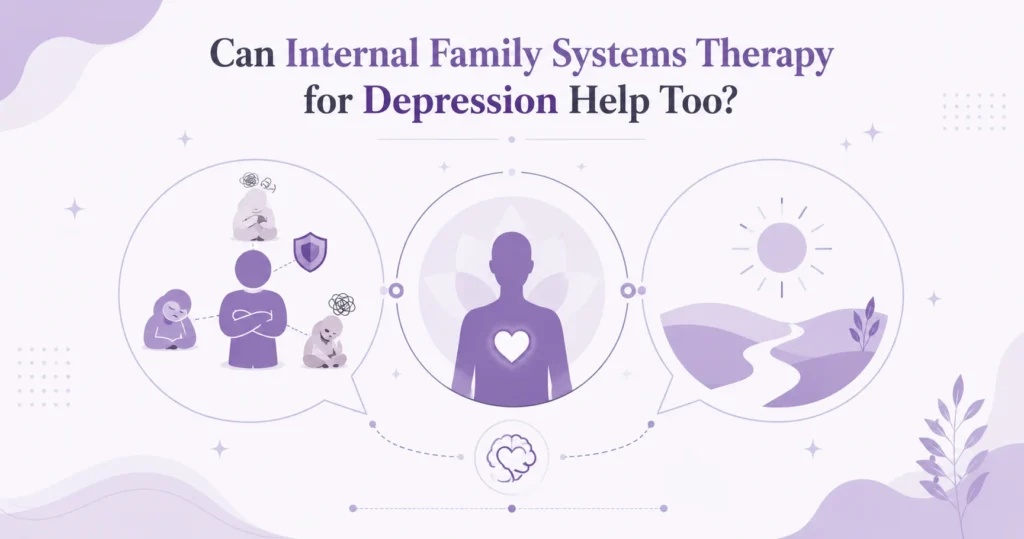
Can internal family systems therapy for depression help too?
Depression was not the focus of this piece, but it is worth a mention, because anxiety, trauma, and low mood often travel together. IFS therapy for depression tends to work with a different cast of parts than trauma work, often a heavy, shut-down manager that keeps a person from feeling too much, and an exile underneath carrying grief, shame, or exhaustion the manager has been working hard to keep contained. If depression is part of what you are carrying alongside anxiety or trauma, it does not need its own separate process. The same IFS framework, and often the same therapist, can hold all of it together.
If you want to go deeper into the qualities that guide this kind of work, the 8 c’s of IFS describes what it feels like when Self, rather than an anxious or protective part, is the one leading a session.
How do I get started with IFS therapy at Saalvio?
Getting started does not require choosing IFS by name before you book. You can message a therapist trained in IFS with your questions first, about how they work, whether IFS suits what you are dealing with, or how many sessions clients typically need before things start to shift. There is no cost and no commitment attached to that message.
Under CANADAHEALS, your first session is free, whether you are exploring IFS for anxiety, trauma, PTSD, or something else entirely. After that, sessions run on a collaborative $100 to $150 CAD range, agreed between you and your therapist. Saalvio does not bill insurers directly. You pay at the time of your session and receive a detailed receipt naming your clinician, their college, and their registration number, which is typically reimbursable under most extended health benefit plans. Coverage varies by plan, so it is worth confirming your specific benefit with your provider.
Frequently Asked Questions
Is IFS the right approach if I have never been in therapy before?
Yes. IFS does not assume any prior therapy experience. Your therapist will explain the parts and Self model as you go, at a pace that makes sense for you.
How many sessions does IFS usually take?
There is no fixed number. It depends on how many parts are involved and how much trust needs to build before the work can go deeper. Your therapist can talk through a realistic pace with you once they understand what you are carrying.
Do I need a diagnosis of PTSD or CPTSD to try IFS?
No. You can book a session without a diagnosis or a referral. Saalvio’s therapists do not diagnose. Self-assessment is something you can bring to a session as a starting point for reflection, not something the platform does for you.
Does research support using IFS for trauma and PTSD?
IFS has a growing base of clinical interest, and its underlying idea, that protective responses make sense once you understand what they are guarding, fits with the broader direction of current trauma research. It is still a developing evidence base compared to longer-established approaches. Many clients use IFS alongside other evidence-based therapies rather than in place of them, and your therapist can help you think through what combination makes sense for you.
Can I try IFS if I am already seeing a doctor or taking medication for anxiety or PTSD?
Yes. IFS therapy is not a substitute for medical care, and it works alongside medication and any other treatment you are already receiving. Saalvio’s therapists do not prescribe or adjust medication, so keep your prescribing doctor informed as you start therapy.
Clinically reviewed
Usman Khan, Registered Psychotherapist
Usman Khan is the Clinical Director of Saalvio and a Registered Psychotherapist with the College of Registered Psychotherapists of Ontario (CRPO #13456). He holds an MD, an MPH from Western University, and an MA in Counselling Psychology from Yorkville University. He reviews all clinical content on saalvio.com before publish.
See also across Saalvio
Topics mentioned in this post that have their own page on the site.
Talk to our clinical team
Saalvio offers a free 30-minute consultation with any therapist on the team. There is no card on file. If we are not the right fit, we will say so and help you find one.