
What is a Registered Psychotherapist?
A Registered Psychotherapist is a regulated mental health professional in Ontario, trained in talk therapy and overseen by the College of Registered Psychotherapists of Ontario.
Read moreGetting started
Finding a therapist in Canada means identifying a regulated mental health professional whose training, approach, and availability fit your specific needs. In Ontario, most therapists are regulated through the College of Registered Psychotherapists of Ontario (CRPO) or the Ontario College of Social Workers and Social Service Workers (OCSWSSW). You can search provincial directories, online platforms, or ask your family doctor for a referral.
Most people do not book a therapist the first time the thought occurs to them. They Google it at midnight. They close the tab. They tell themselves they will figure it out next week. Then next week comes, and the thought is still there, a little heavier than before.
That gap between knowing you want support and actually finding someone is one of the most documented barriers to mental health care in Canada. It is not laziness. It is the combination of a complicated system, unfamiliar language, and the particular exhaustion that comes from needing help while also being the one who has to go find it.
This guide explains how to find a therapist in Canada, what to look for, how to know if someone is the right fit, and what to do if you are not sure where to start.
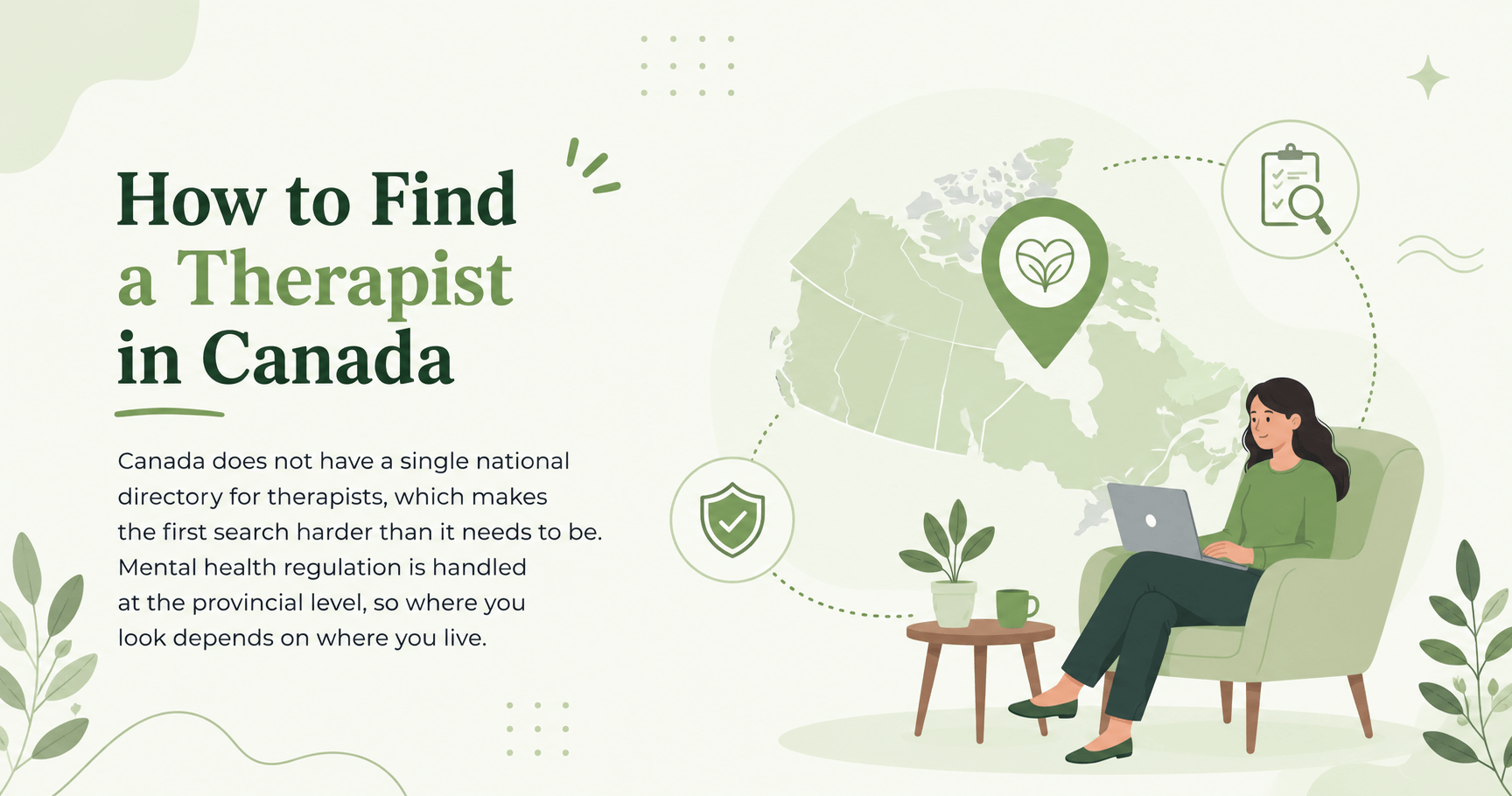
Canada does not have a single national directory for therapists, which makes the first search harder than it needs to be. Mental health regulation is handled at the provincial level, so where you look depends on where you live.
In Ontario, the two main regulatory bodies for talk therapy are the College of Registered Psychotherapists of Ontario (CRPO), which regulates registered psychotherapists, and the Ontario College of Social Workers and Social Service Workers (OCSWSSW), which regulates registered social workers who provide psychotherapy. Both maintain public online registries where you can verify that any therapist you are considering holds an active, in-good-standing registration.
Common starting points Canadians use to find a therapist include:
According to the Mental Health Commission of Canada, wait times for publicly funded mental health services in Canada can exceed several months. Private therapy, accessed directly through a regulated therapist or an online platform, is often faster.
Ontario has one of the more robust frameworks for regulated psychotherapy in Canada, but navigating it still takes effort. The province regulates the protected title "Registered Psychotherapist" under the Psychotherapy Act, 2007, which means anyone using that title must be registered with the CRPO. This protection matters because not everyone who calls themselves a therapist or counsellor in Ontario is subject to the same accountability.
If you are looking for a therapist in Ontario, the verification step is simple: go to the CRPO's public register, search the therapist's name or registration number, and confirm their status is active and in good standing. This takes two minutes and is worth doing before you share anything personal with someone new.
For insurance purposes, knowing a therapist's credentials matters. Sessions with a registered psychotherapist or registered social worker are typically reimbursable under most Canadian extended health benefit plans. Saalvio does not bill insurers directly. Clients pay at the time of service and receive a detailed receipt, including the clinician's college and registration number, for submission to their insurer. Understanding the difference between these professionals can help you choose, and our guide on regulated mental health professionals explains each credential in plain terms.

Toronto has one of the highest densities of registered psychotherapists in Canada. That is both an advantage and a problem. The volume of options can be paralyzing, and knowing where to narrow the search is the real skill.
In a city this size, the most useful filters are:
On Saalvio, you can filter the therapist directory by all four criteria before reaching out. And before you book anything, you can message any therapist directly to ask about their approach, experience, and availability. There is no cost to that first message, and no commitment required.
If you have never been to therapy before, the process of finding someone can feel more daunting than the therapy itself. That is understandable. You are being asked to evaluate a stranger for one of the most intimate kinds of work there is, without yet knowing what to look for.
Here is a simplified version of what the process actually looks like:
Read our full guide on what to expect in your first therapy session if you want to know exactly what will happen when you get there.
The right therapist is not just a credentialled professional who is available. It is a person with whom you feel enough psychological safety to be honest. That combination of competence and trust is sometimes called the therapeutic alliance (the working bond between you and your therapist), and decades of research show it is one of the strongest predictors of whether therapy actually helps.
What the right therapist looks like varies from person to person, but these are the things worth paying attention to:
A therapist who works primarily with couples is not the right choice if you are dealing with complex trauma. Specialization matters. Look at the areas a therapist lists in their profile and check whether they include the thing you are working through. Credentials confirm accountability. Specialization confirms relevance.
Different therapists use different methods. Some are primarily cognitive, working with thoughts and beliefs. Some are more body-based. Some focus on the past, others on the present moment. Knowing a little about different therapy approaches before you search can help you filter for someone whose method fits your needs.
Some people want a therapist who asks a lot of questions and reflects things. Others want more directness, more practical tools, more psychoeducation (learning about how your mind and symptoms work). Neither is wrong. But a mismatch in communication style can make sessions feel frustrating even when the therapist is technically excellent. Asking about style in a pre-booking message is completely appropriate.
Session time, cost, format (online or in-person), and session length all affect whether therapy is sustainable for you over time. A therapist who charges fees that stress you out, or who is only available at times you cannot make work, is not actually a good fit, regardless of how skilled they are.
Fit is not something you know before you start. It is something you discover in the first few sessions. These are the signals worth paying attention to.
Poor fit signals are equally worth noting: feeling judged, feeling dismissed, feeling like you are performing for the therapist rather than working with them, or consistently leaving sessions feeling worse without any sense of why. Those are things to name directly with your therapist if possible, or to use as information that a different match might serve you better.

A single session is rarely enough to know. One to three sessions give you a more accurate read. In that window, you are not just experiencing the therapy. You are assessing the relationship.
Things to track:
Three sessions are generally the minimum before making a meaningful evaluation. It is also a reasonable period after which, if things do not feel right, it is appropriate to raise concerns, ask for a different approach, or consider a different therapist.
Most people do not ask therapists any questions before booking. They scroll, choose someone who seems reasonable, and show up hoping it works. Asking questions in advance lowers the risk of a mismatch and signals to the therapist that you are an engaged client. On Saalvio, you can ask these questions by message before you commit to anything.
None of these questions is intrusive. A therapist who responds defensively to any of them is giving you useful information.
Anxiety is the most common reason people seek therapy in Canada, and it is also one of the most well-evidenced concerns for talk-based care. When you are looking for a therapist for anxiety, the most important filter is whether they are trained in approaches that have a strong evidence base for this specific presentation.
Cognitive behavioural therapy (CBT) is the most researched and most commonly recommended approach for anxiety. It works by identifying and shifting the thought patterns and behaviours that maintain anxious responses. Acceptance and commitment therapy (ACT) is another well-supported option, particularly useful when anxiety has become fused with avoidance or rigid self-criticism.
Not all anxiety looks the same. Panic attacks, health anxiety, social anxiety, generalized worry, and performance-related anxiety each have their own texture, and a good therapist for anxiety will understand those distinctions. When reviewing profiles or asking pre-booking questions, it is worth asking specifically about the kind of anxiety you are dealing with, not just "anxiety" as a general category.
Anxiety and depression frequently occur together. The combination is not unusual. What it means clinically is that the therapist needs to be able to hold both at once, without reducing the work to one or the other.
Approaches that work well for both include CBT, which addresses thought patterns common to both concerns, and behavioural activation, a method specifically designed for depression that also interrupts the avoidance patterns that maintain anxiety. Some therapists work integratively, drawing from multiple approaches depending on what a particular session calls for.
When searching for a therapist for this combination, look for someone who explicitly lists both anxiety and mood concerns as areas of focus. It is also worth asking, in a pre-booking message or consultation, how they think about treating both when they show up together.
Trauma work requires specific training. Not every registered psychotherapist has it, and working with trauma using an approach that is not designed for it can, in some cases, be counterproductive. When you are looking for a trauma therapist, the credential to look for is not just the therapist's designation but their specific training in trauma-informed and trauma-focused methods.
Evidence-based approaches for trauma include Eye Movement Desensitization and Reprocessing (EMDR), somatic therapy, trauma-focused CBT, and Internal Family Systems (IFS). A trauma-trained therapist will also work from a trauma-informed framework, meaning they understand how trauma affects the nervous system, prioritize safety in the therapeutic relationship, and do not push clients toward material faster than they are ready to go.
Complex trauma, childhood trauma, and single-incident trauma can all respond well to therapy, but the pace and approach may differ. When reviewing therapist profiles, look for explicit mention of trauma specialization, not just anxiety or depression, which are frequent but not the same as trauma-specific training.
Depression does not always announce itself loudly. Sometimes it looks like withdrawal. Sometimes, like irritability. Sometimes, like a kind of grey flatness that is hard to describe but impossible to ignore. Whatever form it is taking, therapy works, and finding the right therapist means looking for someone who understands the specific ways depression shows up for you.
CBT for depression focuses on identifying and challenging the thought patterns that maintain low mood. Behavioural activation, a component of CBT and a standalone approach in its own right, addresses the withdrawal and inactivity that depression often produces. Interpersonal therapy focuses on the relational dimensions of mood. A good therapist will help you identify which approach fits your situation.
If depression is affecting your functioning, your sleep, your relationships, or your ability to work, that is a clear signal that professional support is warranted. You do not need to wait until it is worse.
PTSD (post-traumatic stress disorder) is a specific clinical presentation that follows exposure to traumatic events and involves intrusive memories, avoidance, hypervigilance (being constantly on alert), and changes in mood and thinking. Finding a therapist for PTSD means finding someone with specific, recognized training in trauma-focused approaches.
EMDR is one of the most widely recommended evidence-based approaches for PTSD and is recognized by the World Health Organization. Trauma-focused CBT is another well-supported option. Both require the therapist to have completed specific training beyond general psychotherapy education.
When looking for a PTSD therapist, ask directly about their training and experience with PTSD specifically, not just "trauma." Ask how many clients with PTSD they have worked with and what their approach to the stabilization phase (the early work of building safety and coping skills) looks like before any trauma processing begins. A therapist who works with PTSD without a clear stabilization phase is a signal to ask more questions.
Pregnancy is one of the most psychologically complex periods of a person's life, and it is also one of the most underserved. Hormonal changes, identity shifts, relationship stress, fears about birth and parenting, and the weight of everything that has happened before, all of it can arrive at once during pregnancy. Therapy during this period is not indulgent. It is practical.
Perinatal mental health (mental health during pregnancy and the year after birth) is a recognized specialty. Therapists who work in this area are familiar with the anxiety, depression, and identity concerns that are common during pregnancy, as well as the particular emotional terrain of those who have experienced pregnancy loss, fertility challenges, or complicated family dynamics.
Virtual therapy is particularly accessible for people during pregnancy, removing commute, childcare, and scheduling barriers. Many people find that starting therapy during pregnancy also provides a foundation of support that carries into the postpartum period, when the need for support often intensifies, and the capacity to seek it out decreases.
Mental health does not look the same in every Canadian kitchen. The way distress is understood, expressed, and talked about is shaped by culture, family, faith, and history. A therapy relationship that ignores those dimensions is not providing culturally competent care. It is providing generic care to a person who is not generic.
Culturally sensitive therapy means working with a therapist who understands that your experience is shaped by the specific context you come from, not just the category you might fit. It means a therapist who does not require you to translate your inner life out of the community, family, or faith tradition in which it lives before they will take it seriously.
When looking for a culturally sensitive therapist, look for explicit mentions of cultural competence, lived experience with the communities they serve, and language matching. A therapist who speaks the language you think in is a meaningful clinical advantage, not just a convenience. Saalvio's clinical team currently offers sessions in English, Urdu, Hindi, Punjabi, and Arabic.
Moving to a new country is an act of profound courage that is rarely acknowledged as such. It involves leaving behind everything familiar, including the people, places, language, and rhythms that supported you, and building something from scratch in a place that did not know you before you arrived.
The mental health challenges specific to immigrants and newcomers, including acculturation stress (the strain of adjusting to a new culture), identity disruption, grief for what was left behind, and the particular exhaustion of navigating institutions in a second or third language, are real, named, and treatable. But accessing therapy for these experiences requires finding a therapist who understands them without needing you to explain what immigration actually feels like from the inside.
Our full guide on therapy for newcomers covers what to look for, how to find a therapist who understands your background, and how Saalvio's multilingual clinical team approaches this work. A Canadian who has carried her grief in Urdu for years should not have to leave her language at the door to ask for help.
Virtual therapy has moved from a pandemic workaround to a mainstream, well-evidenced option for most people seeking mental health support. For many Canadians, it is also more accessible than in-person care in practical terms: no commute, no waiting room, schedule flexibility, and access to therapists across the province rather than only those in your immediate area.
When finding an online therapist, the clinical evaluation criteria are the same as for in-person care. What changes is the format. You will want to ensure the platform being used is secure and private, that sessions are conducted over video rather than text (which matters for the quality of the therapeutic relationship), and that your therapist's session notes and your personal information are stored in compliance with Canadian privacy law (PHIPA in Ontario and PIPEDA federally).
Research consistently supports the effectiveness of online therapy for anxiety, depression, and many other concerns. For a detailed look at the evidence, see our guide on online therapy effectiveness.
Access is one of the most significant barriers to mental health care in Canada, and virtual therapy directly addresses several of its dimensions at once: geography, scheduling, stigma, and the cost of commuting to and from sessions.
For Canadians in rural or Northern communities, virtual therapy may be the only realistic way to access a regulated therapist. For parents of young children, people with irregular work schedules, or individuals who have delayed seeking support because the logistics were too complicated, virtual sessions remove the friction that was keeping them away.
Virtual therapy in Canada is subject to the same regulatory standards as in-person care when delivered by a regulated professional. A registered psychotherapist practising via video is still accountable to CRPO standards. Their regulatory obligations do not change based on the medium.
According to CAMH (the Centre for Addiction and Mental Health), only about a third of Canadians with a mental health need access any form of professional care. Virtual therapy reduces several of the barriers that account for the other two-thirds.
There is no correct answer to this question, and that ambiguity is itself a barrier. The implicit cultural message that therapy is for people who are really struggling keeps a lot of people in a waiting pattern that serves no one.
You do not need to be in crisis. You do not need a diagnosis. You do not need to have the problem figured out before you go. You can arrive with something vague, something that has been quietly wrong for a while, or something you cannot quite name yet. The therapist's job is to help you understand it, not the other way around.
These are reasonable signals that it is time:
That last one is as valid as the rest. Curiosity is a reasonable entry point. The first step is finding out whether it is right for you, not knowing in advance that it is.
In Ontario, search the therapist's name or registration number on the CRPO public register (crpo.ca) or the OCSWSSW register. Both are free and publicly accessible. An active, in good standing status confirms the registration is current.
On Saalvio, yes. You can send a message to any therapist on the team before you book anything. Ask about their approach, whether they have worked with people in your situation, what language they work in, or anything else that would help you make a more informed choice. There is no cost and no commitment.
Sessions with a registered psychotherapist or registered social worker are typically reimbursable under most Canadian extended health benefit plans, whether the session is conducted in person or online. Saalvio does not bill insurers directly. Clients receive a detailed receipt at the time of service for submission to their provider. Reimbursement levels vary by plan, so confirming your specific benefit before your first session is recommended.
It is normal for the first match not to be the right one. Therapeutic fit is real, it matters, and it sometimes takes a session or two to evaluate. If something feels off, it is appropriate to name it with your therapist, ask for a different approach, or consider trying someone new. Finding care that actually works is worth the additional effort.
It varies. Some people find a good match on the first try. Others need to try two or three therapists before finding someone who feels right. Pre-booking messaging, reading profiles carefully, and being specific about what you are looking for all reduce the time this takes.
Your first 30 minutes at Saalvio is a free consultation, with no card on file and no obligation to continue. If you are not sure where to start, our clinical team can help you figure out the right next step.