Where in Canada are you?

So we can show what is actually live in your province. Live therapy is in Ontario today; other provinces are on the waitlist.

CANADAHEALS: one year of the premium Saalvio app, a free first therapy session, and free pre-booking messaging. Every Canadian. See all three

Therapy basics

What Is a Registered Psychotherapist? Everything Canadians Need to Know

A registered psychotherapist is a regulated mental health professional in Ontario, credentialled by the College of Registered Psychotherapists of Ontario (CRPO). They are trained to assess and treat mental health conditions, emotional difficulties, and life challenges using evidence-based therapies. In Ontario, "Registered Psychotherapist" is a protected title, meaning only individuals who meet strict educational and clinical standards may use it.

Short answer

Sometimes the feeling arrives before the words do. Something is wrong, and you have been carrying it quietly for longer than you have told anyone. You have Googled at midnight. You have scrolled past helplines and closed the tab. You have told yourself you are fine, because that was easier than figuring out who to call.

If that sounds familiar, you are not alone. According to the Mental Health Commission of Canada, one in five Canadians lives with a mental health or substance use problem in any given year, and most do not receive care. Not because they do not want it. Because finding the right professional feels overwhelming, and the system does not exactly make it easy.

This guide explains what a registered psychotherapist is, what they do, how they differ from other mental health professionals, and how to find one in Ontario who is right for you. If you have ever wondered whether therapy is right for you, or simply what it would look like to start, this is a good place to begin.

What Is a Registered Psychotherapist?

Psychotherapy is a professional relationship built around talk-based care. It draws on psychological principles and evidence-based methods to help people understand their thoughts, manage their emotions, shift unhelpful patterns, and work through painful experiences. To learn more about the different approaches available, visit our guide to what psychotherapy is.

In Ontario, the title "Registered Psychotherapist" is a protected designation under the Psychotherapy Act, 2007. That means it is not a label anyone can give themselves. It signals that the person has met the CRPO's specific requirements for education, supervised clinical experience, and competency. When you see those two words together, you know you are working with someone accountable to a professional regulatory body.

Psychotherapy can help with a broad range of concerns, from anxiety and depression to relationship difficulties, grief, trauma, burnout, and more. It is not reserved for crisis moments. Many people find it useful long before things feel urgent.

What Does a Registered Psychotherapist Do?

A registered psychotherapist begins by listening. Not in the casual way people mean when they say they will listen. In a structured, trained way that involves understanding your history, identifying patterns, and building a picture of what is happening and why it is happening.

From there, the work typically involves:

  • Assessment: understanding your current struggles, background, and goals through structured questions and self-reflection tools.
  • Treatment planning: collaborating with you to set realistic, meaningful goals and agree on an approach that fits your needs.
  • Therapeutic interventions: using evidence-based techniques to help you work through emotional difficulties, shift thought patterns, and build practical coping skills.
  • Ongoing support: tracking progress over time, adjusting the approach as needed, and helping you apply what you learn between sessions.

The goal is not to tell you what to do. It is to help you understand yourself well enough to move differently through your own life. Whether you access this through online therapy or in-person sessions, the clinical process is the same.

What-Happens-During-a-Psychotherapy-Session

Who Regulates Registered Psychotherapists in Ontario?

The College of Registered Psychotherapists of Ontario (CRPO) is the regulatory body that governs the profession. It exists to protect the public, not to serve the interests of therapists. That distinction matters.

The CRPO:

  • Sets and enforces education and competency standards
  • Maintains a public register of every registered psychotherapist in Ontario
  • Reviews complaints and takes disciplinary action when standards are not met
  • Regulates the protected use of the title "Registered Psychotherapist" and "RP"

Before booking any therapist in Ontario, you can verify their credentials for free on the CRPO's public register. A legitimate registered psychotherapist will have an active registration status, a registration number, and a record of any formal notes or conditions. This verification step takes two minutes and is worth doing.

Qualifications Required to Become a Registered Psychotherapist

Becoming a registered psychotherapist in Ontario is not a short path. It requires a graduate-level education in a recognized counselling or psychotherapy program, a specified number of supervised clinical hours, demonstrated competency across multiple practice areas, and a successful entry-to-practice examination.

The CRPO requires candidates to show competency in areas including:

  • Therapeutic relationship and communication skills
  • Assessment and treatment planning
  • Safe and ethical clinical practice
  • Reflective practice and professional development

After registration, the obligation does not end. Registered psychotherapists must meet ongoing continuing education requirements and adhere to the CRPO's code of ethics and standards of practice throughout their careers. This ongoing accountability is part of what the protected title means.

What Is a Registered Psychotherapist?

Registered Psychotherapist vs Other Mental Health Professionals

The mental health system in Canada involves several different professional designations, and it is genuinely confusing. Knowing who does what helps you choose the right support. For a full comparison, see our resource on therapy vs counselling vs psychology.

Registered Psychotherapist vs Psychologist

Psychologists in Ontario hold a doctoral degree (PhD or PsyD) and are regulated by the College of Psychologists of Ontario. They are trained to conduct psychological assessments and testing, which registered psychotherapists are not. Both provide talk therapy, but psychologists have a broader diagnostic and assessment scope. Psychologists typically charge higher fees per session. For a detailed breakdown, see our guide on psychotherapist vs psychologist.

Registered Psychotherapist vs Psychiatrist

Psychiatrists are medical doctors who specialize in mental health. They can prescribe medication, order medical tests, and make psychiatric diagnoses. Most psychiatrists in Ontario focus on medication management and do not provide regular talk therapy. A registered psychotherapist and psychiatrist sometimes work collaboratively, particularly for individuals who benefit from both medication and therapy.

Registered Psychotherapist vs Social Worker

Registered social workers (RSWs) in Ontario are regulated by the Ontario College of Social Workers and Social Service Workers. Many RSWs provide psychotherapy and do work that closely overlaps with registered psychotherapists. RSWs may also provide community support, case management, and social systems navigation that fall outside a psychotherapist's scope. You can find more on how these roles compare in our guide on therapist vs social worker.

Registered Psychotherapist vs Counsellor

The word "counsellor" is not a protected title in Ontario. Anyone can use it, regardless of training, credentials, or regulatory oversight. This is one reason checking for a protected designation matters. A registered psychotherapist is accountable to professional standards set by their college. A counsellor without a regulated credential has no equivalent accountability structure.

What Issues Can a Registered Psychotherapist Help With?

One of the most common things people say after starting therapy is some version of: I wish I had done this sooner. The range of experiences registered psychotherapists work with is wider than most people expect.

Anxiety and Stress

Anxiety is not always loud. Sometimes it is the quiet voice that has been telling you for years that you are about to fall behind, be found out, or lose control of something. Panic attacks, health anxiety, social anxiety, workplace stress, and burnout all respond well to therapy for anxiety. Approaches like cognitive behavioural therapy (CBT) and acceptance and commitment therapy (ACT) are particularly well-evidenced for anxiety.

Depression and Mood Challenges

Depression does not always look like sadness. It can look like numbness, irritability, withdrawal, exhaustion, or simply losing interest in things that used to matter. Therapy for depression often focuses on identifying thought patterns that maintain low mood, building behavioural activation, and working through the underlying factors that sustain it.

Trauma and PTSD

Trauma changes how the nervous system responds to the world. It does not always announce itself as a single dramatic event. Complex trauma, developmental trauma, and accumulated difficult experiences all fall within a registered psychotherapist's scope. Trauma therapy approaches like EMDR, somatic therapy, and trauma-focused CBT are among the options a therapist trained in this area may offer.

Relationship and Family Concerns

Communication patterns, conflict cycles, attachment ruptures, and family stress can all be worked on in therapy, whether individually or with a partner or family member. A registered psychotherapist can help untangle what is happening beneath the surface of recurring arguments or the quiet distance that settles between people.

Self-Esteem and Personal Growth

Therapy is not only for a crisis. It is useful for people navigating identity questions, life transitions, career changes, or simply the persistent sense that something in their inner life deserves more attention. Self-worth, confidence, and clarity about values are all legitimate things to bring into a therapy room.

Types of Therapy Used by Registered Psychotherapists

Registered psychotherapists are trained in a range of evidence-based modalities. In practice, many therapists are integrative, meaning they draw from several approaches depending on what serves the client best. Below is a brief overview of the most common ones.

Cognitive Behavioural Therapy (CBT)

CBT is one of the most researched psychological therapies in the world. It works by helping people identify the connections between thoughts, emotions, and behaviours, and learn to interrupt unhelpful patterns. It is practical, skills-focused, and effective for anxiety, depression, and many other concerns. Learn more about CBT therapy.

Acceptance and Commitment Therapy (ACT)

ACT is a third-wave behavioural therapy that helps people accept difficult thoughts and feelings rather than fighting them, while committing to actions that align with their values. It is particularly useful for chronic stress, anxiety, and situations where struggling with internal experience has become part of the problem. Read more about ACT therapy.

Dialectical Behaviour Therapy (DBT)

DBT was originally developed for individuals with intense emotional dysregulation. It builds skills in four areas: mindfulness, distress tolerance, emotional regulation, and interpersonal effectiveness. It has since been adapted for a range of presentations. More on DBT therapy.

EMDR Therapy

Eye Movement Desensitization and Reprocessing (EMDR) is a structured, evidence-based therapy for processing traumatic memories. It uses bilateral stimulation (such as guided eye movements) while a client focuses on distressing material, allowing the memory to be processed in a way that reduces its emotional charge. Learn more about EMDR therapy.

Somatic Therapy

Somatic therapy works with the body as well as the mind. It recognizes that stress and trauma are held in the nervous system and that physical sensations carry information that talk-based approaches alone may not fully reach. Somatic therapy is particularly useful for people whose experiences of anxiety, trauma, or chronic stress have a strong physical dimension.

What Happens During a Psychotherapy Session?

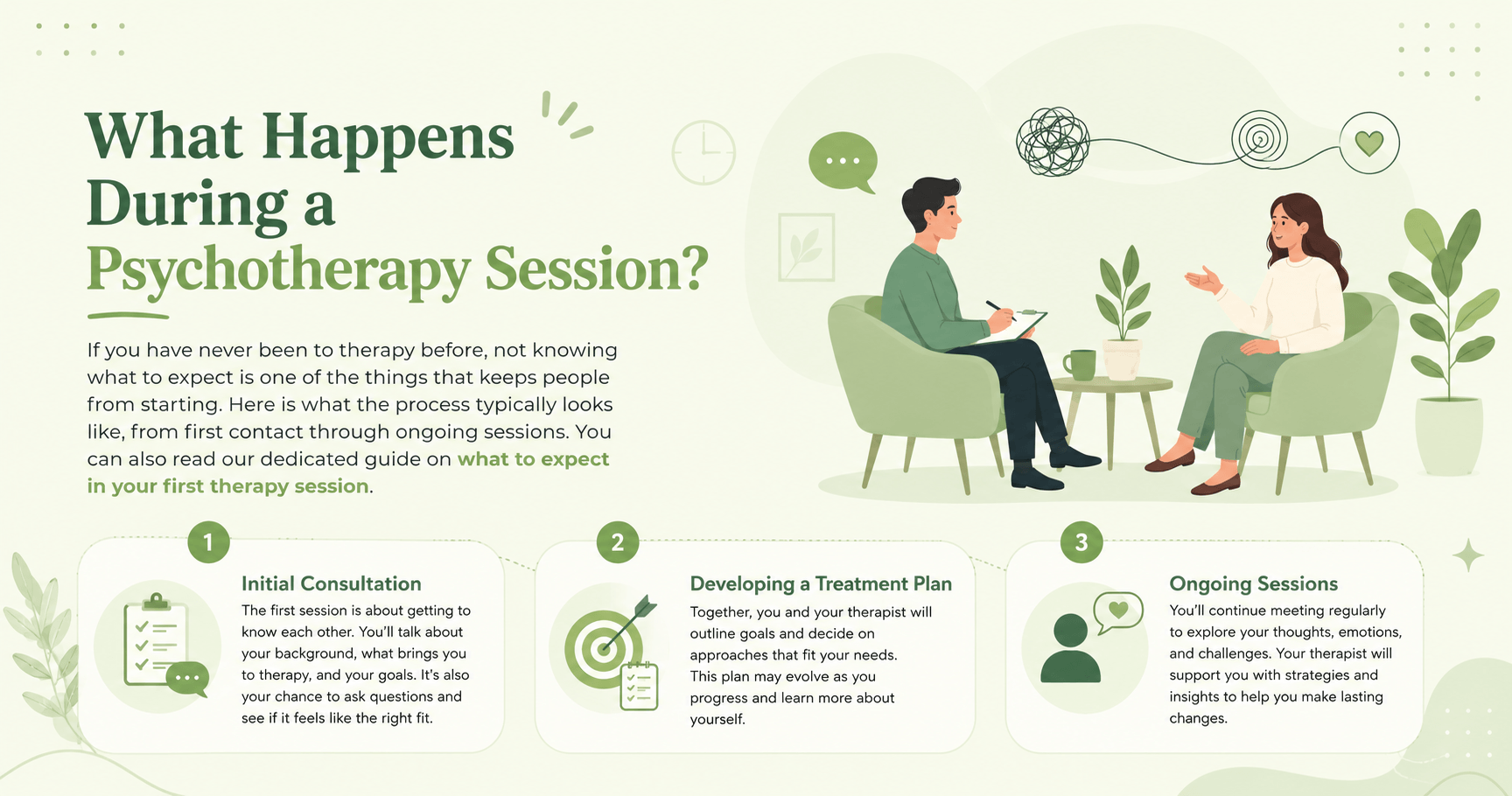
If you have never been to therapy before, not knowing what to expect is one of the things that keeps people from starting. Here is what the process typically looks like, from first contact through ongoing sessions. You can also read our dedicated guide on what to expect in your first therapy session.

Initial Consultation

The first session is usually an intake. Your therapist will ask about what brought you in, your history, your current situation, and what you are hoping to work on. You do not need to have a neat answer. You do not need to know exactly what is wrong. Coming in with something like "I have been struggling and I am not sure where to start" is enough.

This session is also a chance for you to assess the fit. Does this person make you feel heard? Does their approach make sense to you? The therapeutic relationship is one of the strongest predictors of good outcomes in therapy, so finding the right match matters.

Developing a Treatment Plan

After the intake, you and your therapist will typically develop a shared understanding of your goals and an approach for working toward them. This might be explicit and documented, or it might be a more informal collaborative agreement depending on the therapist's style. Session frequency, the modalities to be used, and what success might look like are all part of this conversation.

Ongoing Sessions

Sessions are usually 50 to 60 minutes. They involve a mix of reflection, skill-building, working through difficult material, and tracking how things are shifting over time. A good therapist adjusts the approach as you progress and checks in regularly on whether the work is still feeling relevant and useful.

Can Registered Psychotherapists Diagnose Mental Health Conditions?

Diagnosis in the formal clinical sense falls outside a registered psychotherapist's scope of practice in Ontario. Formal diagnosis is typically made by physicians, psychiatrists, or psychologists.

A registered psychotherapist can conduct structured clinical assessments, discuss your experiences in detail, and help you bring organized, meaningful information to other healthcare providers. Structured self-assessments can help you reflect on your experiences and bring that reflection into the therapeutic relationship. But a formal diagnostic label is not something a registered psychotherapist is authorized to assign.

How Much Does a Registered Psychotherapist Cost in Ontario?

Therapy fees in Ontario vary. Most registered psychotherapists charge between $100 and $200 per session, depending on their experience, specialization, and location. Some community clinics and training clinics offer lower-cost options. For a full breakdown, see our guide on therapy costs in Ontario.

Under CANADAHEALS, every Canadian's first therapy session with a Saalvio clinician is free. This is not a promotional offer. It is a public health commitment, because deciding to see a therapist should never require a financial gamble on a stranger you have not yet met.

Insurance Coverage

Psychotherapy sessions with a registered psychotherapist or registered social worker are typically reimbursable under most Canadian extended health benefit plans, though coverage levels vary by provider and plan. Saalvio does not bill insurers directly. Clients pay at the time of service and receive a detailed receipt identifying the clinician's name, credentials, college, and registration number for submission to their insurer. For more information, see our resource on insurance coverage for therapy. Confirming your specific benefit level with your plan provider before your first session is always worth doing.

Online vs In-Person Costs

Online therapy is often more accessible than in-person care, both in terms of scheduling and cost. Without the overhead of a physical office, some therapists are able to offer lower fees for virtual sessions. For a comparison of the formats beyond cost, read our guide on online vs in-person therapy.

How to Find a Registered Psychotherapist in Ontario

Knowing you want therapy and actually finding the right person are two different things. Here is a practical framework. For a more detailed guide, see how to find a therapist.

Verify Professional Registration

Start by confirming that any therapist you are considering is in good standing with their regulatory college. For registered psychotherapists, that means searching the CRPO's public register. It takes two minutes, and it is one of the most important things you can do before you share anything personal with someone new.

Consider Your Therapy Goals

What brought you here? Being clear, even roughly, about what you are hoping to work on will help you filter for therapists who specialize in the relevant areas. A therapist who specializes in trauma will approach things differently than one focused primarily on relationship concerns or burnout.

Evaluate Therapy Format

Decide whether you want to meet in person or virtually. Both are effective. Online therapy offers flexibility, accessibility for people in rural areas, and the option to work with a therapist based anywhere in Ontario, rather than only those near you. Before your first session, read our guide on preparing for online therapy to set yourself up well.

Review Practical Factors

Session availability, response time, fee range, and whether the therapist speaks your preferred language are all legitimate considerations. None of them is shallow. An affordable therapist, available at times that actually work for you, and who speaks the language in which you think about your feelings, is a better fit than one who is theoretically excellent but inaccessible in practice.

Online Therapy With a Registered Psychotherapist

Virtual therapy with a registered psychotherapist delivers the same clinical care as in-person sessions, conducted over a secure, private video platform. It has the same evidential base, the same regulatory requirements, and the same therapeutic relationship at its core.

For many Canadians, it is also more accessible. No commute. No waiting room. No need to take time off work or arrange childcare. The session is there when you are ready for it, in the space where you already feel most like yourself. For newcomers and individuals from communities where attending a therapy office carries stigma, the privacy of connecting from home can also lower a real barrier. Our guide on therapy for newcomers explores this further.

On Saalvio, every therapist profile shows the languages offered. Sessions are currently available in English, Urdu, Hindi, Punjabi, and Arabic, because the language in which you learned to feel your feelings matters.

When Should You See a Registered Psychotherapist?

There is no threshold of suffering you need to clear before therapy is appropriate. The idea that you have to be in crisis to deserve support is one of the most damaging myths in mental health culture, and it keeps a lot of people waiting longer than they should.

Signs Therapy May Help

You do not need all of these. Even one is enough.

  • You have been managing something difficult for a while, and it is not getting better on its own
  • Anxiety, low mood, or stress is affecting your sleep, your relationships, or your ability to function the way you want to
  • You find yourself withdrawing from people or things that used to matter to you
  • You are going through a significant life transition and want support navigating it
  • You simply have the sense that something deserves more attention than you have been able to give it

Seeking Support Before Problems Escalate

Therapy is more effective, and often shorter, when people access it early rather than waiting until they are in crisis. The same way you do not wait for a full breakdown to manage physical health, waiting for rock bottom to engage with mental health care means more time struggling than necessary.

Starting early also means building the skills and the relationship before you really need them. A therapist who already knows you, and who you already trust, is a different resource than a stranger you are meeting for the first time during the worst week of your life.

Common questions

Is a registered psychotherapist the same as a therapist?

"Therapist" is not a protected title in Ontario. A registered psychotherapist is a therapist, but not everyone who calls themselves a therapist is a registered psychotherapist. Always look for the protected designation and verify registration with the CRPO.

Can I see a registered psychotherapist without a referral?

Yes. You do not need a physician's referral to access psychotherapy in Ontario. You can book directly.

How long does therapy take?

It depends on what you are working on and what you are hoping to achieve. Some people find meaningful progress in six to twelve sessions. Others benefit from longer-term work. This is worth discussing openly with your therapist during the intake and revisiting as you go.

Is online therapy as effective as in-person therapy?

For most presentations, yes. A substantial and growing body of research supports the effectiveness of virtual therapy. The therapeutic relationship, which is the strongest predictor of outcomes, translates well to video-based sessions.

What if I message a therapist but do not feel ready to book?

That is exactly what messaging is for. On Saalvio, you can send a message to any therapist on the team before you commit to anything. Ask about their approach, whether they have worked with someone in your situation, what language they work in, or anything else that would help you feel safe choosing. There is no cost, no commitment, and no script.

Ready to talk to someone?

The first session at Saalvio is free, with no card on file and no obligation to continue. If you are not sure where to start, our clinical team can help you figure out the right next step.