
Exposure therapy for anxiety disorders: What it is and how it helps
Book a Free 30-Minute Consultation
You keep saying no to the party. No to the highway. No to the meeting where you might have to speak. Each no feels small. But the fear behind it keeps growing, because avoiding a thing tells your brain that the thing was too dangerous to face.
‘’Exposure therapy for anxiety disorders is a well-studied, evidence-based therapy approach that helps you face feared situations in small, planned steps, with support, so your brain slowly learns that fear does not have to run your life.’’
It is one of the most researched tools we have for anxiety, and it works for many different fears, not just one.
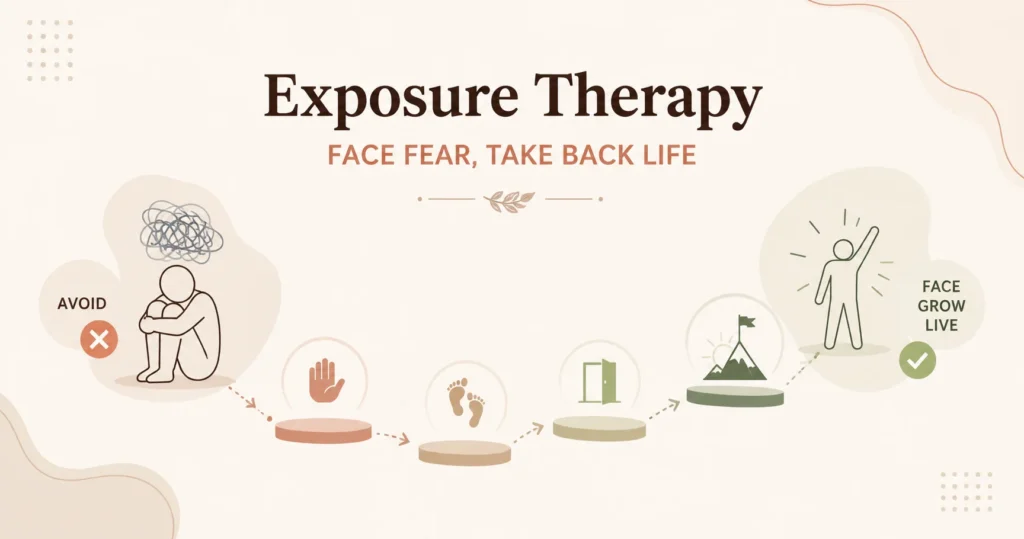
What is exposure therapy for anxiety disorders?
Exposure therapy is a form of talk therapy. It comes from cognitive behavioural therapy, often called CBT. The idea is simple to say and hard to do alone: you face the thing you fear, on purpose, in a safe and planned way, instead of running from it.
At first this sounds scary. It is not about being thrown into the deep end. A good therapist builds a plan with you first. You choose the steps together. You go at a pace that respects what you can handle that day.
Anxiety disorders and exposure therapy have been studied together for decades, and the evidence is strong. Groups like Anxiety Canada describe exposure as one of the most effective tools we have for facing fear, because it teaches the nervous system something avoidance never can: that the feared thing is survivable.
Why does exposure therapy anxiety disorders work?
Anxiety and exposure therapy work together because of a simple loop your brain gets stuck in.
You feel scared of something. You avoid it. The fear drops right away, so your brain learns “avoiding work.” Next time, the fear feels even bigger, because you never got to find out what would have actually happened. This is exposure therapy social anxiety disorder cycle, and it is the same cycle behind almost every anxiety disorder, not only social anxiety.
Exposure therapy breaks that loop. Gradual exposure reduces anxiety. Evidence shows something important: when you stay in a feared situation long enough, without running, your body’s alarm system naturally calms down on its own. You do not have to talk yourself out of fear. You simply give your nervous system the chance to learn a new lesson: this is uncomfortable, but it is not dangerous, and I can get through it.
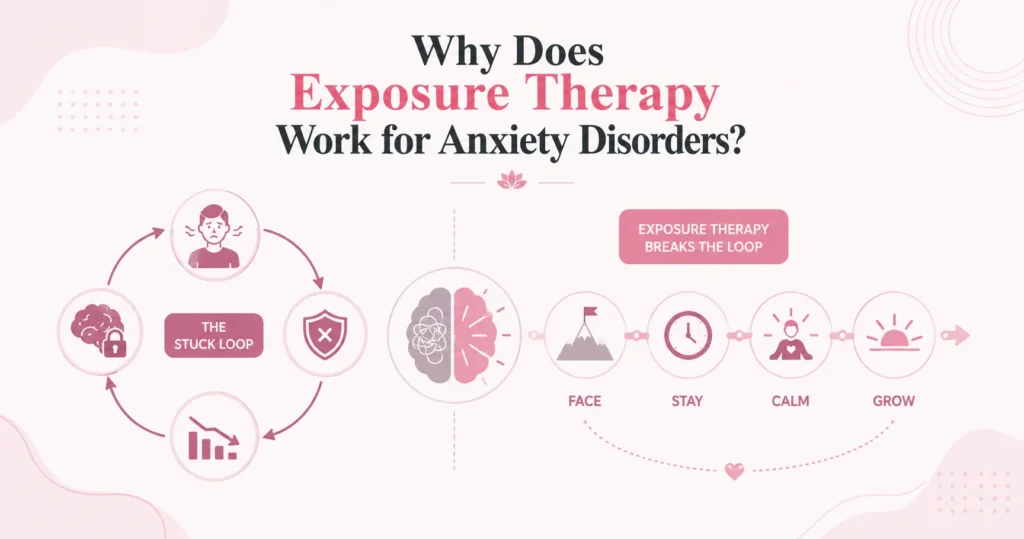
The principles behind exposure therapy for anxiety
Exposure therapy for anxiety, principles and practice, usually follows a few steady steps:
- Naming the fear. You and your therapist talk through what you avoid and why.
- Building a fear list. Together, you list feared situations from easiest to hardest. This is sometimes called a fear ladder.
- Starting small. You begin with something manageable, not the scariest item on the list.
- Staying with it. You stay in the situation long enough for the fear to rise and then settle, instead of leaving the moment it spikes.
- Moving up the list. Once a step feels easier, you move to the next one, at your own pace.
Cognitive therapy for anxiety, examples of exposure scenarios, might include things like sitting in a crowded café instead of the corner table, driving one exit further than usual, or reading a symptom list without immediately checking your body for signs of illness. Every scenario is chosen to match the fear that is actually getting in the way of your life.
Exposure therapy for different anxiety disorders
Exposure therapy is not one single exercise. It is shaped around what a person is actually afraid of. Here is how it tends to show up across a few common anxiety disorders.
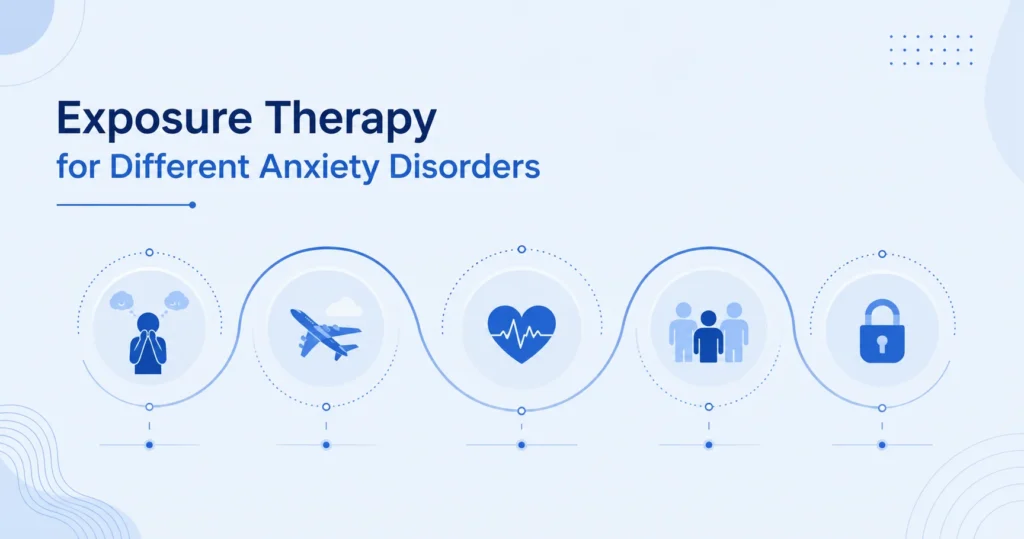
Social anxiety exposure therapy
Social anxiety disorder exposure therapy often starts small: making eye contact with a cashier, asking a stranger for directions, or staying five extra minutes at a gathering instead of leaving early. Exposure therapy for social anxiety disorder effectiveness has been shown again and again in research, in part because it directly targets the pattern that keeps social anxiety alive: avoiding the very interactions that would prove the fear wrong.
Exposure therapy vs avoidance for social anxiety enjoyable activities matters here too. Avoidance does not just remove fear. It also quietly removes birthdays, dinners, and small moments of connection. Facing the fear, one step at a time, is often the path back to the parts of life that anxiety has been taking.
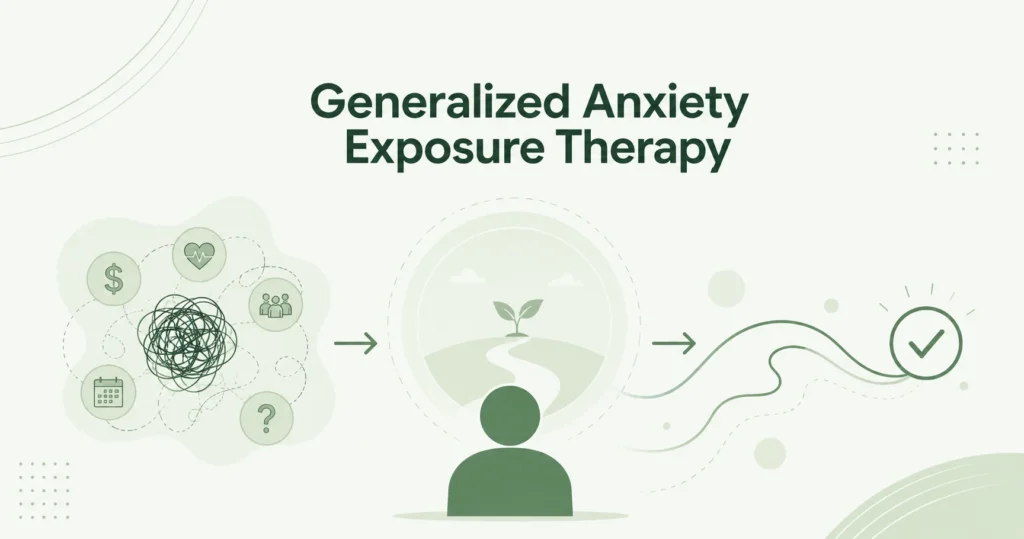
Generalized anxiety exposure therapy
Generalized anxiety disorder, or GAD, does not always centre on one clear fear. It can feel like constant worry about many things at once: money, health, family, the future. Exposure therapy for generalized anxiety disorder often works a little differently here. Instead of facing one specific situation, a person may practise sitting with uncertainty itself, on purpose, rather than trying to plan or worry their way to total certainty, which is never actually possible.
Panic disorder exposure therapy
Panic disorder exposure therapy usually includes something called interoceptive exposure. That is a long word for a simple idea: getting used to the physical feelings of panic itself, like a racing heart or shortness of breath, in a safe setting, so those feelings stop feeling like an emergency. A therapist might guide a client through spinning in a chair or breathing quickly on purpose, then staying with the sensation until it passes, which it always does.
Driving anxiety exposure therapy
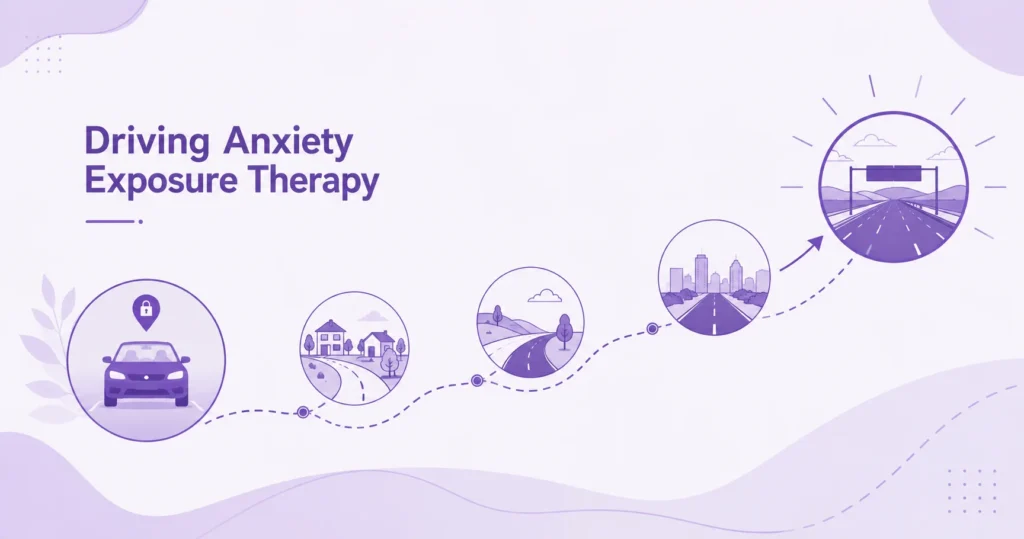
Driving anxiety exposure therapy might start with simply sitting in a parked car, then driving around the block, then merging onto a quiet road, before working up to a highway. Efficacy driving anxiety with exposure therapy is well documented for this kind of specific fear, because the steps are concrete and easy to build a ladder around.
Illness anxiety and fears about serious illness or death
Exposure therapy for illness anxiety disorder can help someone who spends hours checking their body, researching symptoms, or seeking reassurance from doctors and loved ones. CBT exposure protocols here might involve sitting with a scary thought about illness or death without immediately searching for reassurance, so the mind learns it can tolerate uncertainty about health without needing to solve it completely, right now, every time.
Can exposure therapy make anxiety worse?
This is one of the most common questions people ask, and it deserves an honest answer.
Exposure-based therapy can feel harder before it feels easier. That is expected, and your therapist will prepare you for it. But when it is done properly, with a trained clinician, a clear plan, and steps sized to what you can actually handle, exposure therapy does not make anxiety worse over time. It is the opposite: the whole point of gradual exposure is to lower anxiety in a lasting way, not to overwhelm you.
What can make anxiety worse is doing exposure without support: jumping straight to the hardest fear, going too fast, or stopping the moment it gets uncomfortable, which teaches the brain the old lesson all over again. That is exactly why this work is done with a trained clinician, not alone.
Exposure therapy stays until anxiety drops: How long does it take?
A common question is how long you need to stay in a feared situation. There is no single fixed percentage that applies to everyone. What matters more than a number is the pattern: staying until the fear has clearly started to come down, rather than leaving at its peak.
For some people that takes a few minutes. For others it takes longer. Your therapist will help you notice this shift in real time, so leaving the situation is a choice you make on purpose, not a fearful reflex.
What does a CBT exposure therapy session look like?
CBT protocols for anxiety exposure therapy usually start with a conversation, not a task. Your therapist will ask what you are hoping to face and why it matters to you. From there, sessions tend to include:
- Reviewing your fear ladder and choosing the next step
- Practising a grounding skill before starting, if that helps you feel ready
- Doing the exposure itself, in session or as homework between sessions
- Talking through what happened afterward, including what you noticed in your body and mind
Homework between sessions matters as much as the session itself. Facing a fear once is a start. Facing it a few times, in different settings, is what helps the learning stick.
Is exposure therapy used for anything besides anxiety?
Exposure-based techniques are also used in the wider field of mental health for other concerns, including obsessive-compulsive disorder, post-traumatic stress, and, in some cases, exposure therapy for eating disorders, where a person may practise sitting with distress around food or body image without turning to old coping behaviours.
These are specialized applications with their own protocols. If one of these concerns is what you are facing, message a therapist on our team so they can talk with you honestly about scope and the right next step for your specific situation.
How Saalvio supports exposure-based approaches
Saalvio’s clinical team includes Registered Psychotherapists and Registered Social Workers trained in CBT (cognitive behavioural therapy), the approach exposure work is built on. Online therapy with Saalvio is virtual, offered across Ontario today, with expansion across Canada underway, so you do not need to search for exposure therapy for anxiety near you in Toronto, Vaughan, or any other Ontario city. You can meet with a registered clinician from wherever you feel safest, which for many people is exactly where the work needs to start.
If you are not sure exposure-based work is the right fit, you do not have to guess. You can message a therapist on our team with your questions before booking anything. Ask what the first few sessions might look like, whether they have experience with your specific fear, and how they typically build a fear ladder with clients. There is no cost and no pressure attached to asking.
When you are ready for the next step, you can book a free 30-minute consultation with a registered clinician. It is a chance to meet them, share a little about what brought you here, and find out together whether it feels like the right fit, before any full therapy session begins.
Between sessions, Thrive AI, our CBT-based companion inside the Saalvio app, can offer grounding exercises and simple coping tools for the moments anxiety shows up outside a session. Thrive AI is not a therapist and is not a substitute for therapy or crisis support. It is there for the small moments between the bigger work.
Frequently Asked Questions
Do I have to stay in a feared situation until my anxiety drops to a specific point?
There is no single number that applies to everyone. What matters is staying long enough to notice your fear start to settle, rather than leaving right when it peaks. Your therapist will guide this with you.
Is exposure therapy only for social anxiety?
No. Exposure-based techniques are used across many anxiety disorders, including generalized anxiety, panic disorder, specific fears like driving anxiety, and illness anxiety, along with other concerns like OCD and PTSD.
Do I need to find anxiety exposure therapy near me?
Not with Saalvio. Sessions are virtual and available across Ontario, so you can work with a registered clinician from home, wherever that is.
Is exposure therapy safe to do alone?
It is safest with a trained clinician who can help you build a realistic plan and pace it to what you can manage. Going too fast, alone, is one of the main reasons exposure work backfires.
If you need help right now
Saalvio is not a crisis service. If you are in immediate danger, please call 911. If you are in mental health crisis, please call 988 (the Suicide Crisis Helpline of Canada) or visit your nearest emergency department. You can also find more support on our crisis resources page.
Clinically reviewed
Usman Khan, Registered Psychotherapist
Usman Khan is the Clinical Director of Saalvio and a Registered Psychotherapist with the College of Registered Psychotherapists of Ontario (CRPO #13456). He holds an MD, an MPH from Western University, and an MA in Counselling Psychology from Yorkville University. He reviews all clinical content on saalvio.com before publish.
See also across Saalvio
Topics mentioned in this post that have their own page on the site.
Talk to our clinical team
Saalvio offers a free 30-minute consultation with any therapist on the team. There is no card on file. If we are not the right fit, we will say so and help you find one.