
The 6 F’s and 5 P’s of IFS Therapy Explained
Book a Free 30-Minute Consultation
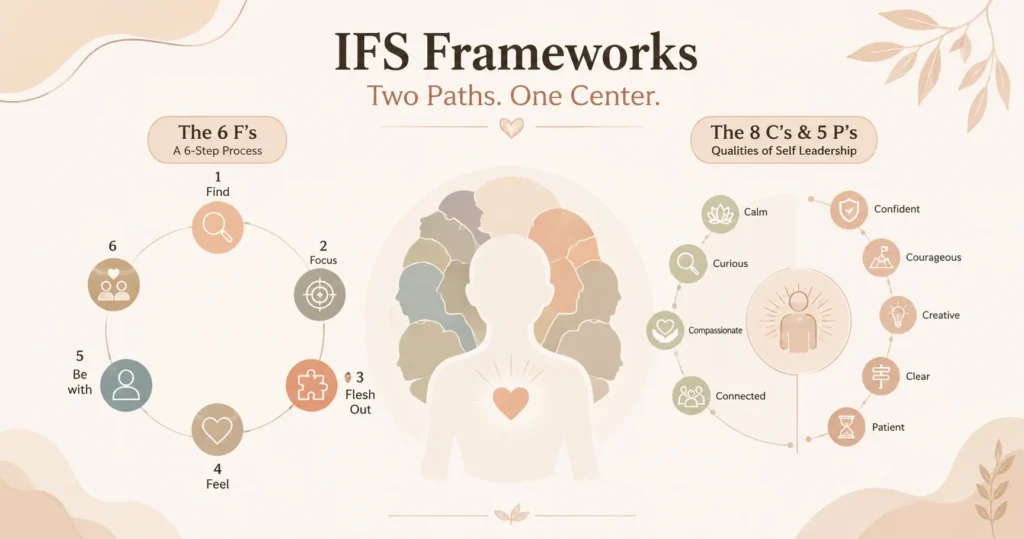
Internal Family Systems (IFS) uses two memorable frameworks to guide the work: the 6 F’s, a six-step process for getting to know a part of you, and the 8 C’s and 5 P’s, the qualities that show up when you are leading from your calm, grounded core.
Together, they explain both what you do in IFS and how you approach it. These ideas can also be explored through online counselling in Canada, where you can work through the process with a trained therapist.
What Is IFS Therapy?
If you are still working out what IFS therapy is, here is the short version. Internal Family Systems is a talk therapy approach developed by Dr. Richard Schwartz in the 1980s. It is built on one idea: your mind is not one single voice. It is made up of different parts, each with its own feelings, memories, and way of trying to protect you. There is also a core Self underneath all of it, calm and steady, that can lead the way once the parts feel safe enough to step back.
IFS is not about deciding which parts are good or bad. A part that pushes you to overwork, or one that goes quiet in conflict, developed for a reason. IFS treats every part as trying to help, even when the way it helps causes trouble now. The goal is not to get rid of parts. It is to build a working relationship with them, led by your Self.
This is one of the modalities on Saalvio’s clinical roster, alongside CBT (cognitive behavioural therapy), DBT (dialectical behaviour therapy), and EMDR (eye movement desensitization and reprocessing). If IFS sounds like the right fit for what you are carrying, you can message a Saalvio therapist trained in this approach before you book anything.
What Are the 6 F’s of IFS Therapy?
The 6 F’s are the steps a therapist uses to help you get to know one part at a time, without rushing in to fix or judge it. They are Find, Focus, Flesh Out, Feel Toward, Befriend, and Fear.
You will see this search in a few different ways. Some people type 6 f’s of ifs. Others search 6fs in ifs, ifs 6fs, or 6 fs of ifs. However the words are arranged, everyone is asking about the same six steps.
- Find. You notice a part that is asking for attention. Maybe it is the part that snaps at your kids after a long day, or the part that keeps you scrolling until 2 a.m. instead of sleeping. Finding it is simply naming that it is there.
- Focus. You turn your attention toward that part on purpose. This is different from thinking about it. It means noticing where it shows up in your body, what it feels like, what images or words come with it.
- Flesh Out. You get to know the part in more detail. What does it look like, if it had a shape? What is its tone? Some people picture it clearly. Others just get a feeling or a colour. Both are normal.
- Feel Toward. This is the checkpoint. You ask yourself how you feel toward the part right now. If the answer is curiosity, calm, or compassion, your Self is present and leading. If the answer is frustration or wanting the part to go away, that is usually another part stepping in, and the therapist will help you work with that one first.
- Befriend. Once your Self is in the lead, you get curious about the part’s job. What is it afraid would happen if it stopped doing what it does? What has it been carrying, sometimes for years?
- Fear. You ask the part directly what it is afraid of. This is often where the real story comes out, the old belief or memory the part has been guarding against ever since.
The 8 C’s and 5 P’s of IFS: The Qualities of Self
If the 6 F’s are the steps, the 8 C’s and 5 P’s are how you can tell your Self is the one doing them. Richard Schwartz described these as the qualities of Self-energy, and IFS therapists use them as a kind of internal compass.
The 8 C’s are Curiosity, Calm, Clarity, Connectedness, Confidence, Courage, Creativity, and Compassion. When you notice one or more of these while thinking about a part, that is a sign you are leading from Self rather than being taken over by another part.
The five qualities that sit alongside them are usually called the 5 p’s of IFS, though the more precise phrase is the 5 Ps of Self IFS, since Presence, Perspective, Patience, Persistence, and Playfulness describe the state of the Self, not the part being worked with. Presence means being here, aware of what is happening inside without getting swept away by it.
Perspective is the ability to step back and see the whole picture instead of just the immediate feeling. Patience is letting healing move at its own pace instead of rushing it. Persistence means coming back to the work even when it is slow or difficult. Playfulness keeps the process from feeling too heavy, which matters, because parts often relax faster around a Self that is not gripping them too tightly.
Taken together, IFS therapists sometimes refer to the whole set as the 8 c’s and 5 p’s of IFS. You do not need to memorize all thirteen qualities before you start. Most people notice them showing up gradually, session by session, as the work with a therapist trained in IFS parts work continues.
What Is IFS Parts Work?
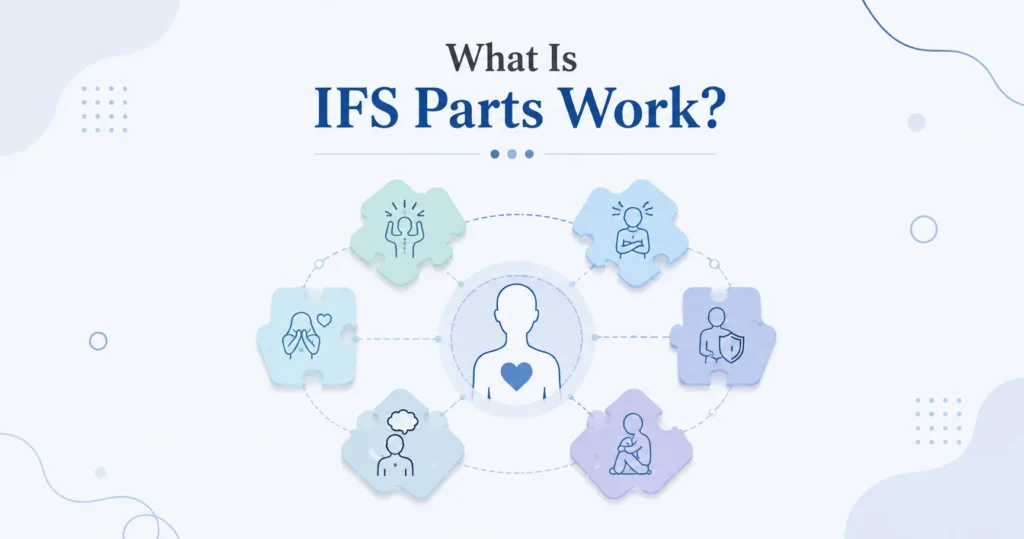
Parts work is the everyday name for what happens inside the 6 F’s. It is the practice of relating to different pieces of yourself, rather than treating your thoughts and reactions as one single, unified voice. If you have ever said “part of me wants to leave this job, but part of me is terrified to,” you already understand parts work intuitively. IFS gives that instinct a structure.
In a typical session, a therapist will not tell you what your parts mean. They will ask questions that help you find out for yourself, using the 6 F’s, while checking in on whether you are approaching the part with the 8 C’s and 5 P’s or whether another part has taken over the conversation. Over time, many clients find they can start noticing their own parts outside of session too, in the middle of an argument or a hard decision.
Who Does IFS Therapy Help?
IFS is used with a wide range of concerns, including anxiety, depression, and trauma. Trauma-informed care, the kind of approach where the pace and safety of the work are shaped around what a person has been through, is one of the reasons therapists reach for IFS with clients carrying difficult histories. CAMH notes that trauma can seriously disrupt a person’s ability to regulate emotions and maintain healthy relationships, which is exactly the territory IFS parts work is built to hold with care.
IFS can also be a good fit for people who feel stuck in inner conflict, people who relate strongly to the idea of “parts of me,” and people who have tried other approaches and want something that does not ask them to push past a reaction before understanding it. It is not a diagnostic tool, and Saalvio’s platform does not diagnose. If you are not sure whether it fits what you are dealing with, that is exactly the kind of question worth asking before you book.
What to Expect From IFS Therapy at Saalvio
Saalvio’s clinical team includes registered psychotherapists and registered social workers trained in Internal Family Systems, alongside other approaches like CBT, EMDR, and somatic therapy. Virtual therapy in Ontario with Saalvio starts the same way no matter which modality you are curious about.
Every new client also begins with a free 30-minute consultation with a registered clinician. It is not a full therapy session. Think of it as a version of the first F: finding out whether this is the right starting point, before any deeper work with a part begins. A fuller picture of what you are working through, and a plan for the sessions after that, comes once therapy itself starts.

Frequently Asked Questions
What do the 6 F’s stand for in IFS?
Find, Focus, Flesh Out, Feel Toward, Befriend, and Fear. They are the six steps an IFS therapist uses to help a client build a relationship with one part at a time, starting with noticing it and ending with understanding what it is afraid of.
What are the 8 C’s and 5 P’s of IFS?
The 8 C’s (Curiosity, Calm, Clarity, Connectedness, Confidence, Courage, Creativity, and Compassion) and the 5 P’s (Presence, Perspective, Patience, Persistence, and Playfulness) are the qualities of Self-energy in IFS. They describe how a person’s core Self shows up when it is leading, rather than being taken over by a reactive part.
Is IFS the same as regular talk therapy?
No. IFS uses a specific structure, the 6 F’s, to work with individual parts of a person’s inner world, rather than treating thoughts and feelings as one single voice. Many clients find it easier to work with a difficult reaction once they can name it as a part rather than as all of themselves.
Can I try IFS through Saalvio in Ontario?
Yes. Saalvio’s registered clinical team offers IFS as one of several evidence-based approaches for clients across Ontario. You can message a therapist trained in this approach with your questions, then book a free 30-minute consultation to see if it is the right fit.
Do I need to already know my parts before starting IFS?
No. Most people begin with a general sense that something feels stuck or in conflict inside them. Your therapist will use the 6 F’s to help you find and get to know your parts together, starting from wherever you currently are.
Clinically reviewed
Usman Khan, Registered Psychotherapist
Usman Khan is the Clinical Director of Saalvio and a Registered Psychotherapist with the College of Registered Psychotherapists of Ontario (CRPO #13456). He holds an MD, an MPH from Western University, and an MA in Counselling Psychology from Yorkville University. He reviews all clinical content on saalvio.com before publish.
See also across Saalvio
Topics mentioned in this post that have their own page on the site.
Talk to our clinical team
Saalvio offers a free 30-minute consultation with any therapist on the team. There is no card on file. If we are not the right fit, we will say so and help you find one.