
What Is IFS Therapy? Guide to Internal Family Systems
IFS therapy, short for Internal Family Systems therapy, is a talk therapy model developed by Richard Schwartz. It sees the mind as made up of different inner parts, each one carrying its own feelings and history, all guided by a calm inner core called the Self. If you are looking for online therapy in Canada, an IFS-trained therapist can help you understand these parts, rather than fighting or judging them.
What does IFS stand for?
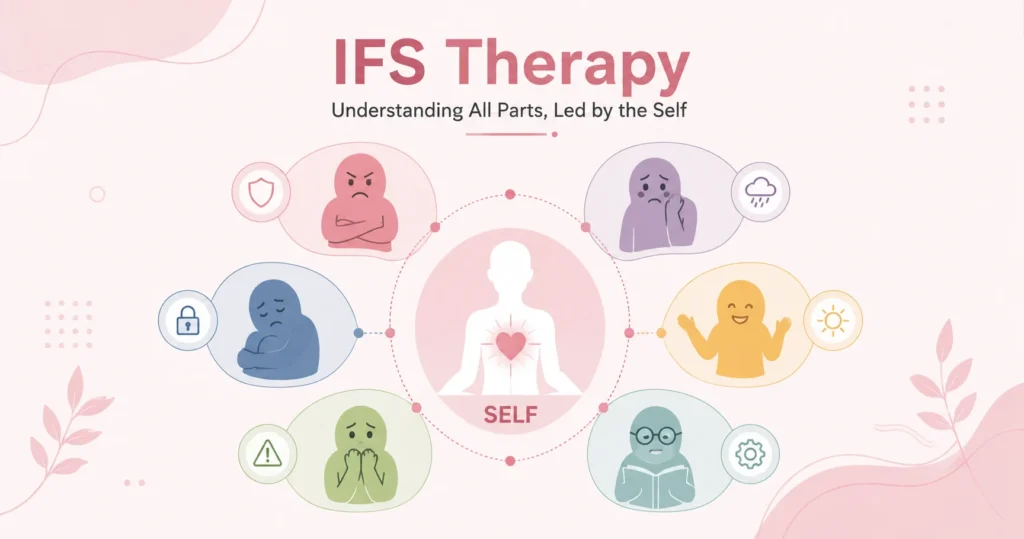
IFS stands for Internal Family Systems. The IFS meaning is right there in the name: your inner world is treated like a family, made up of different members (or parts) who each have their own job, their own worries, and their own way of trying to protect you.
Some parts work hard to keep you in control. Others hold onto old pain. IFS therapy, at its simplest, is learning to listen to all of them instead of silencing the ones that feel uncomfortable.
Where did the internal family systems model come from?
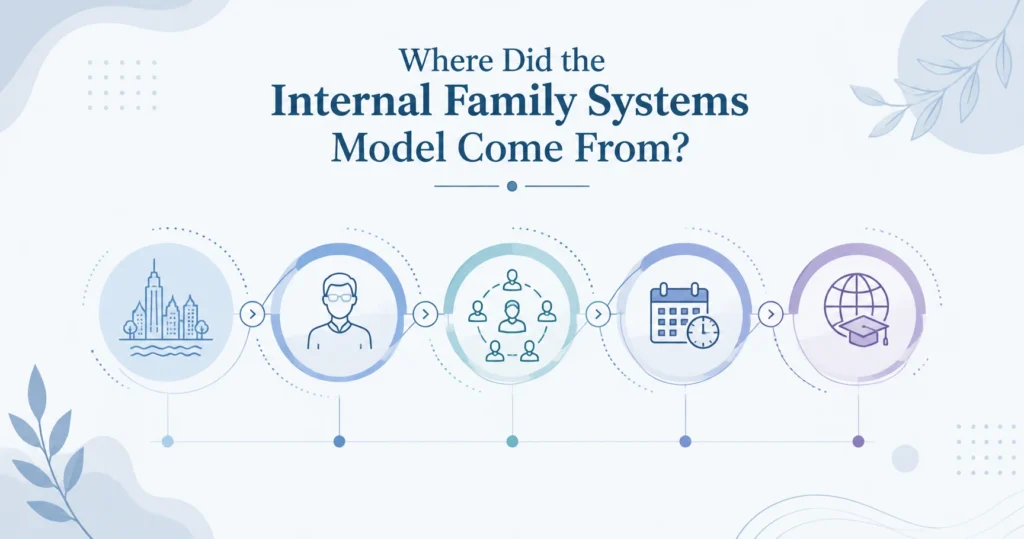
Richard Schwartz developed the Internal Family Systems model in the 1980s. He was a family therapist in Chicago at the time, and his clients kept describing their inner experience in terms of distinct parts with their own voices and feelings.
Instead of dismissing this, he built a model around it. In 2000, he founded a training organization now known as the IFS Institute, which remains the primary source for IFS training and certification worldwide.
What is IFS? An introduction to internal family systems
So, what is IFS, in practice? The model groups your inner parts into three general roles. IFS parts work focuses on understanding these different parts and the roles they play within your internal system. Exiles are parts that carry old pain, often from a hard or frightening moment earlier in life. Managers try to keep daily life running smoothly and keep the exiles from surfacing.
Firefighters step in when an exile’s pain breaks through, often through urgent or impulsive reactions. Underneath all of it is the Self: the calm, curious, grounded part of you that IFS believes is never damaged, no matter what you have been through.
This is a short introduction to Internal Family Systems, not a substitute for working with a trained clinician. A real course of therapy moves at your pace and is shaped around your specific history.
How does the internal family systems theory work?
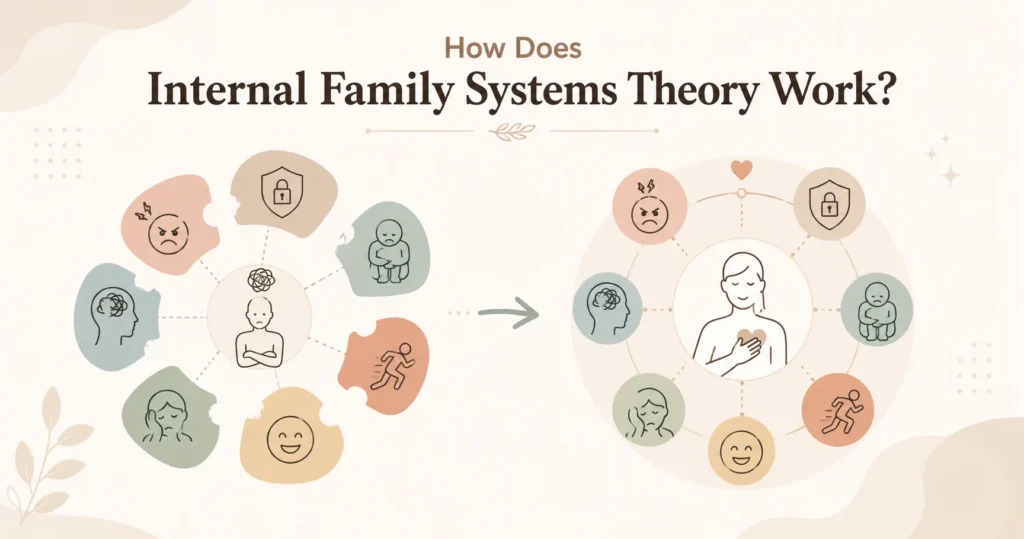
The internal family systems theory rests on one core idea: no part of you is bad. A part that criticizes you harshly, or one that pushes you to numb out at the end of a hard day, is trying to help in the only way it learned how.
The internal family systems model does not try to get rid of these parts. It works to build a relationship between them and your Self, so the parts that have been working overtime can finally rest.
IFS therapy explained: What a session can look like
In IFS therapy explained simply: a session is a conversation, not a script. Your therapist helps you notice a part as it shows up, whether that is anxiety before a hard conversation, a familiar wave of shame, or the urge to shut down. From there, you get curious about that part together. What is it afraid would happen if it stopped doing its job? What is it protecting? Over time, many clients find this approach brings more self-compassion and a steadier sense of who they are underneath the noise.
Not ready to book? You can message a Saalvio therapist trained in IFS with your questions first. There is no cost, no commitment, and no awkward sales call. Just a conversation.
Is there research behind internal family systems?
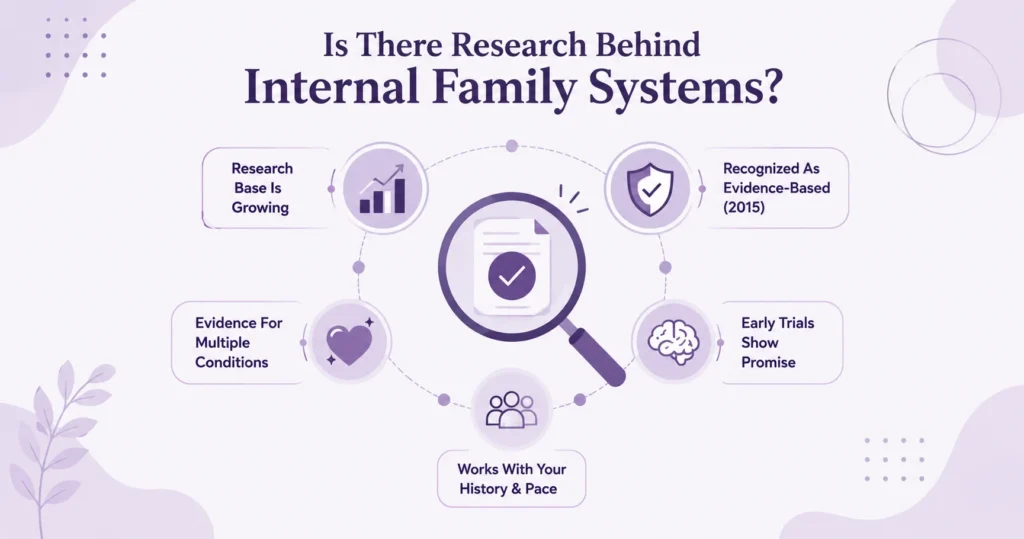
IFS is a newer model compared to approaches like CBT (cognitive behavioural therapy), so its research base is still growing. A recent scoping review found quantitative evidence supporting IFS for trauma, depression, chronic pain, and self-compassion, alongside a call for more large-scale trials.
Psychology Today Canada notes that IFS was recognized as an evidence-based practice by the US Substance Abuse and Mental Health Services Administration in 2015, and that early trials show promise for conditions such as PTSD and depression, though its evidence base is not yet as large as more established modalities. As with any approach, IFS works alongside your own history and pace, not as a guaranteed result.
Who might find IFS therapy helpful?
People often turn to IFS therapy when they notice a pattern they cannot seem to shift on their own: a harsh inner critic, a habit of shutting down under stress, or a sense that one part of them wants something different from another. IFS is trauma-informed, which makes it a common choice for people carrying the effects of a difficult past. Whether IFS is the right approach for you is something to work through with a clinician, not something to self-diagnose from an article.
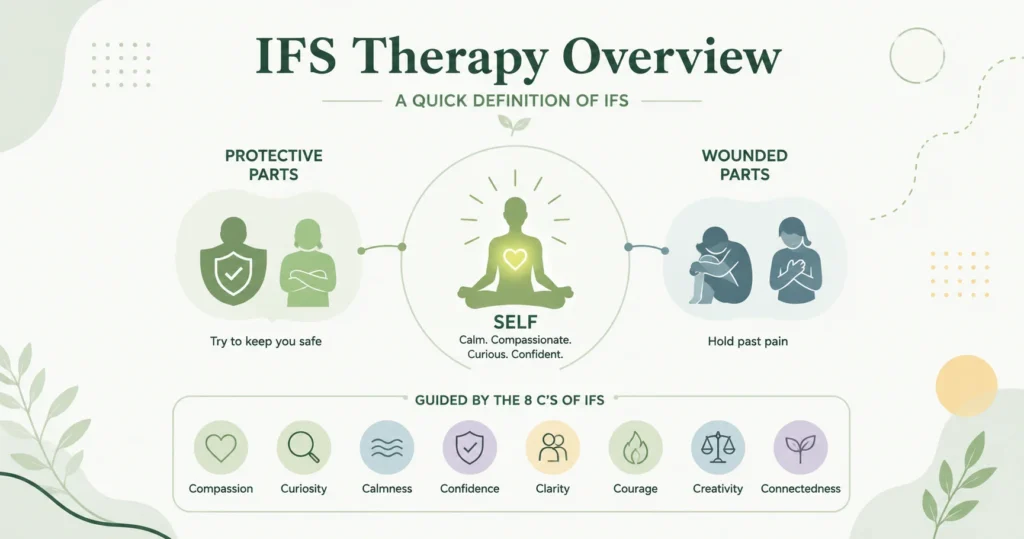
IFS therapy overview: A quick definition of IFS
For a short internal family systems summary: an internal family system is the picture IFS uses to describe your inner world, made up of protective and wounded parts, all guided by a core Self that already knows how to heal. The qualities of this Self are often described through the 8 C’s of IFS, which highlight characteristics such as compassion, curiosity, calmness, and confidence that support deeper self-understanding.
In one line, the definition of IFS is a non-judgmental, trauma-informed talk therapy that helps you build a working relationship with every part of yourself, rather than fighting the parts you like least.
How to start with IFS at Saalvio
Saalvio’s clinical team includes therapists trained in IFS, as well as other trauma-informed approaches. If you are curious whether it fits what you are carrying, you do not have to figure that out alone.
Every new client can start with a free 30-minute consultation with a registered clinician, a chance to ask questions and get a sense of fit before any full session is booked. If you want to read more first, our guide on how to find a therapist and our explainer on what a Registered Psychotherapist is are good places to start.
If you need help right now
Saalvio is not a crisis service. If you are in immediate danger, please call 911. If you are in mental health crisis, please call 988 (the Suicide Crisis Helpline of Canada) or visit your nearest emergency department.
If you want more options for urgent support, our crisis resources page lists where to turn.
Frequently Asked Questions
What is IFS therapy in one sentence?
IFS therapy is a talk therapy model, developed by Richard Schwartz, that helps you understand and work with the different inner parts that make up your mind, guided by a calm inner core called the Self.
Is IFS the same as having multiple personalities?
No. IFS uses the language of parts to describe the normal, everyday multiplicity of the mind, such as the part of you that worries and the part that wants to rest. It is not describing a diagnosis, and it does not replace an assessment by a qualified clinician.
How long does IFS therapy take to work?
There is no fixed timeline. It depends on what you are working through and how you and your therapist build your work together. A member of our clinical team can talk through what a realistic pace might look like for you during a consultation.
Can I try IFS therapy online in Ontario?
Yes. Saalvio offers virtual psychotherapy in Ontario, and clients can message a therapist trained in IFS before booking a session to ask about fit, approach, and experience.
If you need help right now
Saalvio is not a crisis service. If you are in immediate danger, please call 911. If you are in mental health crisis, please call 988 (the Suicide Crisis Helpline of Canada) or visit your nearest emergency department.
Clinically reviewed by Usman Khan, RP (CRPO #13456)
Clinically reviewed
Usman Khan, Registered Psychotherapist
Usman Khan is the Clinical Director of Saalvio and a Registered Psychotherapist with the College of Registered Psychotherapists of Ontario (CRPO #13456). He holds an MD, an MPH from Western University, and an MA in Counselling Psychology from Yorkville University. He reviews all clinical content on saalvio.com before publish.
See also across Saalvio
Topics mentioned in this post that have their own page on the site.
Talk to our clinical team
Saalvio offers a free first session with any therapist on the team. There is no card on file. If we are not the right fit, we will say so and help you find one.