Mental Health Awareness Month Canada 2026: What It Means and How to Get Involved
There is a quiet kind of courage in the people who notice this month at all. The colleague who wears a green ribbon without making it a speech. The mother who reads an article like this one at 11 p.m., after the kids are asleep, wondering if what she has been carrying has a name. The newcomer who has been in the country two years and has not yet found one person to talk to about the home she left behind. Mental Health Awareness Month is for all of them, and it is most likely for you too.
This guide answers the practical questions: when Mental Health Awareness Month is, what the green ribbon means, when Mental Health Week 2026 in Canada falls, and how to get involved in a way that is real and not just symbolic. It also points you toward evidence-based tools you can use right now, whether you live in Ontario, elsewhere in Canada, or you are simply trying to understand your own mind a little better. We will keep it plain, and we will keep it honest.
What Is Mental Health Awareness Month?
Mental Health Awareness Month is observed every May in Canada and in many countries around the world. It is a dedicated stretch of time to reduce stigma, share credible information, and encourage people to reach out for support. In Canada the month is anchored by Mental Health Week, led by the Canadian Mental Health Association, which falls during the first full week of May.
The wider month creates room for ongoing conversations at workplaces, schools, hospitals, and community centres. Schools across Ontario use it to launch mental-health lessons. Hospitals light up in green. People wear green ribbons. The message underneath all of it is simple: mental health is health, full stop. If you have ever wondered why mental health awareness is so important, this is the heart of it. May mental health awareness is not about a single day of attention; it is about lowering the cost of being honest, every day of the year.
Why May?
The timing is deliberate. Spring carries a quiet association with renewal, with light returning after a long winter. For many people, longer days and warmer weather bring a real shift in mood. Mental health advocates chose May to meet that energy and turn it toward awareness and, more importantly, toward action.
When Is Mental Health Awareness Week Canada in 2026?
Mental Health Week in Canada runs from May 4 to 10, 2026. It is led by the Canadian Mental Health Association under the theme Come Together, Canada. It is one of the busiest weeks in Canada’s mental health calendar, with events at workplaces, schools, hospitals, and community centres, and with the green ribbon worn across the country.
The week is the centre of gravity for the whole month. If you only have the energy to notice one thing this May, notice this week. Whether you call it mental health awareness week, mental health awareness week may, or mental health awareness week 2026 canada, it is the same seven days, and it belongs to everyone.
What Is the 2026 Mental Health Week Theme in Canada?
The 2026 Mental Health Week theme is Come Together, Canada. The Canadian Mental Health Association chose it because social connection is one of the strongest protective factors for mental health. The campaign points to research that millions of Canadians feel lonely often or always, and it invites small, real acts of connection rather than grand gestures.
The come together canada mental health week theme rests on something most of us already know in our bodies. According to the Canadian Mental Health Association’s 2026 campaign, about five million Canadians, roughly 13 per cent, say they feel lonely often or always. Nearly one in five young Canadians aged 16 to 24 report feeling lonely often or always, even though they are among the heaviest users of social media. Loneliness has been linked to anxiety, depression, and pulling away from the people and places that used to feel like home.
The theme is not asking anyone to fix all of that this week. It is asking for the small things. A genuine conversation. A shared lunch. A check-in text to the friend who stopped texting back. These are not only kind gestures. Connection is one of the most evidence-supported things we can offer each other.
Key Dates in May 2026
May holds several focused moments inside the wider Mental Health Awareness Month Canada 2026. Keeping them in one place makes it easier to plan a conversation, an event, or simply a quiet act of care:
- May 4 to 10: Mental Health Week in Canada, the Canadian Mental Health Association Come Together, Canada campaign.
- May 7: National Child and Youth Mental Health Day, observed by Children’s Mental Health Ontario.
- May 11 to 17: National Nursing Week.
- All of May: Mental Health Awareness Month in Canada, alongside Asian Heritage Month and South Asian Heritage Month.
You can find the full Government of Canada health-promotion calendar, including every May date, on the Canada.ca health-promotion days and weeks calendar.
Is There a Ribbon for Mental Health Awareness?
Yes. The green ribbon is the internationally recognized symbol for mental health awareness. Green stands for growth, renewal, and recovery. Wearing one during May shows support, starts conversations, and signals, quietly but clearly, that stigma is not welcome here. The Canadian Mental Health Association offers free ribbon and poster assets in its campaign toolkit.
What Does the Green Ribbon Mean?
Green was chosen on purpose. The colour is tied to growth, to the natural world, to the season the month sits in. In mental health, the green ribbon mental health meaning carries a particular weight: it points to the possibility of recovery and to the belief that healing is within reach for everyone, not only for the lucky few. Wearing a mental health awareness ribbon in May says, without a word, that you stand with the millions of Canadians living with a mental health challenge.
Some workplaces and community groups hand out green ribbon pins during Mental Health Week. If you are planning an event in Ontario or anywhere in Canada, the Canadian Mental Health Association toolkit includes free downloadable posters, email signatures, and digital assets you can use.
For some people, a ribbon may seem small. But for the person who has been struggling in silence, a small visible sign that someone close to them takes this seriously can be the thing that finally makes asking feel possible.
Signs Someone May Be Struggling With Their Mental Health
Mental health challenges are not always visible. Many people keep going to work, keep showing up at school, keep smiling in the group chat, while quietly carrying far more than they have told anyone. Recognizing the signs in the people around us is part of what awareness is for.
Common signs that an adult may be struggling can include:
- feeling constantly overwhelmed or emotionally worn out
- sleeping much more or much less than usual
- pulling away from family and friends
- losing interest in things that used to matter
- feeling anxious, numb, or hopeless for long stretches
- trouble concentrating, or finding ordinary stress harder to manage
Not every hard day means someone has a mental illness. But ongoing emotional distress deserves attention and care, the same way a physical health concern would. If you notice these signs in someone you love, you do not need the perfect words. Asking “how are you really doing” and staying long enough to hear the answer is often enough to start.
If you need help right now
Saalvio is not a crisis service. If you are in immediate danger, please call 911. If you are in mental health crisis, please call 988 (the Suicide Crisis Helpline of Canada) or visit your nearest emergency department.
If a young person in your life needs someone to talk to, Kids Help Phone is free, confidential, and available across Canada, day or night, at 1-800-668-6868, or by texting CONNECT to 686868.
Mental Health Awareness in Ontario: Why It Matters
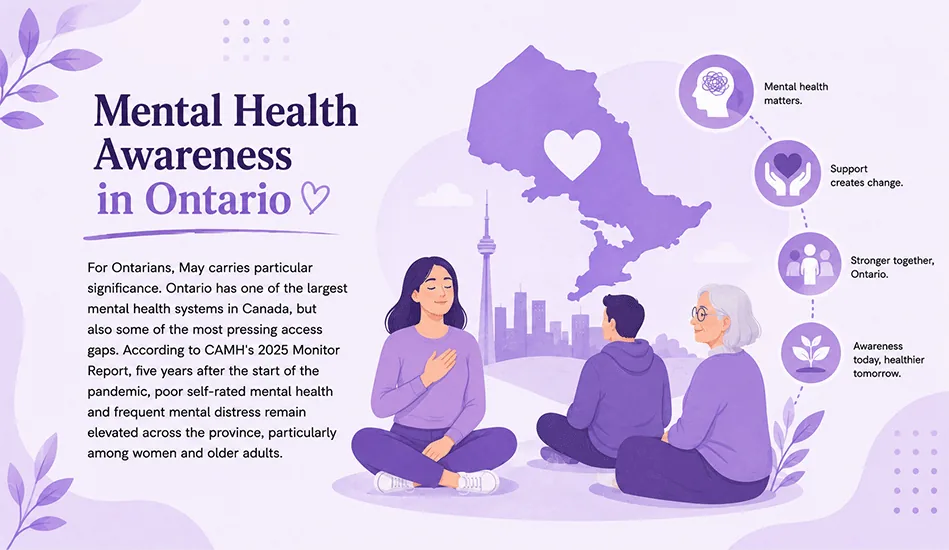
For Ontarians, May carries particular weight. Ontario has one of the largest mental health systems in the country, and also some of the most pressing access gaps. According to CAMH’s 2025 Mental Health and Addictions Monitor, five years after the start of the pandemic, poor self-rated mental health and frequent mental distress in Ontario have not returned to where they were, and in several measures they have worsened.
Young people are carrying a heavy share of it. According to School Mental Health Ontario, between 18 and 22 per cent of students in Ontario meet the criteria for a mental health concern or illness, which is part of why Children’s Mental Health Ontario uses Mental Health Week to call for stronger community-based care and greater investment in the services families rely on.
If you are looking for mental health resources Ontario residents can turn to, the Centre for Addiction and Mental Health maintains listings of provincial resources, and CMHA Ontario provides local branch directories and crisis-line information. For finding ongoing care, our guide on how to find a therapist walks through the steps without the overwhelm.
Mental Health in Schools and Workplaces
Awareness lands most where people spend their days: in classrooms and at work.
In Schools
Across Ontario, more schools are recognizing that emotional well-being is tied to learning, confidence, and belonging. May is often when mental-health lessons, peer-support programs, and open conversations get their fullest attention. National Child and Youth Mental Health Day on May 7 gives that work a focused moment.
In Workplaces
Employers across Canada are paying closer attention to burnout, stress, and the slow toll of long hours, financial pressure, and being reachable around the clock. Meaningful workplace efforts during May mental health awareness can include:
- regular wellness check-ins that are genuine, not a formality
- flexible support programs and access to counselling
- mental health days that people are actually allowed to take
- mindfulness and stress-management options
- honest conversations about burnout and balance
Awareness matters most when people feel safe enough to ask for help without fear of being judged or quietly penalized for it.
How to Get Involved During Mental Health Awareness Month Canada 2026
You do not have to organize anything large to take part. Whether you are an individual, an employer, a teacher, or a healthcare worker, here is how to get involved in mental health week and the wider month in ways that are real:
1. Wear or Share the Green Ribbon
Pin a green ribbon to your jacket, add the green ribbon frame to your LinkedIn profile from the Canadian Mental Health Association toolkit, or hang an awareness poster where people will see it. Small visible acts normalize the conversation and make the next person’s question feel a little safer to ask.
2. Start One Real Conversation
The Come Together, Canada theme is a reminder that connection itself is protective. Reach out to someone you have not spoken with in a while. Ask a colleague how they are actually doing, and mean it. Share your own experience if it feels safe to do so. One honest conversation does more than a dozen posts.
3. Share Credible Information
Misinformation about mental health is everywhere. Sharing accurate, stigma-free content from sources like the Canadian Mental Health Association and CAMH builds shared understanding and pushes back against the myths that keep people silent.
4. Use Evidence-Based Self-Help Tools
Awareness matters most when it leads to a next step. Cognitive behavioural therapy, a structured, well-researched talk therapy that helps you notice and reshape unhelpful thought patterns, is one of the most studied approaches for everyday stress, anxiety, and low mood. The Saalvio app brings CBT-informed tools to your phone so the small daily habits that support well-being are easier to keep. The app is available across Canada and North America on the Apple App Store and Google Play.
5. Take the Next Step Toward Therapy
If you, as an adult, are ready to talk to someone, speaking with a therapist can make a real difference. Saalvio offers online therapy in Ontario today, delivered by registered psychotherapists and registered social workers, with active expansion underway across Canada.
You do not have to commit to anything to begin. Before you book, you can message a registered psychotherapist before you book and ask whatever you need to ask: whether they have worked with someone like you, whether they speak your first language, whether their approach fits the life you come from. There is no cost and no commitment, and messaging is not therapy by text; it is simply a way to find out if the fit is right. Every Canadian’s first therapy session with a Saalvio clinician is free, so deciding to try therapy is never a financial gamble. If it helps to know how the first hour goes, you can read what to expect in a first session beforehand.
Small Ways to Support Your Mental Health Every Day
Caring for your mental health does not always start with a big life change. Often it starts with daily habits for mental health that are small enough to actually keep:
- getting enough sleep, and protecting it
- spending a little time outside
- easing up on the late-night doomscrolling
- talking to someone you trust
- taking real breaks during the day
- eating regular meals
- moving your body gently, even just a short walk
These steps are not a replacement for therapy or medical care, but they can genuinely support your well-being in everyday life. With a heavy mind, a little is a lot.
CBT-Informed Strategies You Can Try This May
You do not have to wait for a diagnosis or a crisis to care for your mental health. Here are three CBT-grounded practices anyone can explore during Mental Health Awareness Month:
Thought Journaling
CBT teaches that thoughts, feelings, and behaviours are connected. Writing down a difficult thought, noticing if it is a thinking trap such as catastrophizing or all-or-nothing thinking, and gently questioning it is a foundational skill. Even five minutes a day can begin to loosen patterns that have felt fixed for years.
Behavioural Activation
When we feel low, we tend to pull back from the things that once brought us a little life. Behavioural activation means intentionally scheduling small, meaningful activities to slowly rebuild engagement. It is not about forcing happiness. It is about giving yourself small chances to feel capable, connected, or simply at ease.
Grounding Techniques
Grounding helps anchor you to the present when anxiety or overwhelm takes hold. The 5-4-3-2-1 technique, naming five things you can see, four you can touch, three you can hear, two you can smell, and one you can taste, is a simple, effective way to settle a racing nervous system in real time.
The Saalvio app puts guided versions of these tools within reach. You can explore CBT-informed exercises built to fit into your day, wherever in Canada or North America you are.
A Note on Language and Stigma
One of the most useful things any of us can do during Mental Health Awareness Month is pay attention to the words we use. Language shapes how people see themselves, and how safe they feel asking for help.
- Instead of “crazy” or “psycho,” try “experiencing a mental health challenge,” or simply name the specific condition.
- Instead of “committed suicide,” say “died by suicide.” The first implies a crime; the second does not.
- Instead of “that person is schizophrenic,” say “a person living with schizophrenia.” Person-first language honours the whole human being, not the diagnosis.
Language is not just politeness. It is a form of care. During May, and every other month, the words we choose can make the difference between someone feeling judged and someone feeling safe enough to speak.
Frequently Asked Questions
When is Mental Health Awareness Month?
Mental Health Awareness Month is observed every May in Canada and in many countries around the world. In Canada the month is anchored by Mental Health Week, led by the Canadian Mental Health Association, during the first full week of May. The goal is to reduce stigma and encourage people to reach out for support.
When is Mental Health Awareness Week Canada in 2026?
Mental Health Week in Canada runs from May 4 to 10, 2026. It is led by the Canadian Mental Health Association under the theme Come Together, Canada. It is one of the busiest weeks in Canada’s mental health calendar, with events at workplaces, schools, hospitals, and community centres across the country.
Is there a ribbon for mental health awareness?
Yes. The green ribbon is the internationally recognized symbol for mental health awareness. Green stands for growth, renewal, and recovery. Wearing one during May shows support, sparks conversations, and signals that stigma is not welcome. The Canadian Mental Health Association offers free ribbon and poster assets in its campaign toolkit.
What is the 2026 Mental Health Week theme in Canada?
The 2026 Mental Health Week theme is Come Together, Canada. The Canadian Mental Health Association chose it because social connection is one of the strongest protective factors for mental health. The campaign points to research that millions of Canadians feel lonely often or always, and invites small, real acts of connection.
What is Mental Health Awareness Day?
In Canada, May 7 is National Child and Youth Mental Health Day, observed by Children’s Mental Health Ontario. Internationally, World Mental Health Day falls on October 10 each year. These dates sit inside the wider Mental Health Awareness Month and give focused moments to talk about specific groups and needs.
What mental health resources are available in Ontario?
Key Ontario resources include CAMH, CMHA Ontario, and Children’s Mental Health Ontario, which offer provincial listings, local branch directories, and crisis-line information. For adults seeking therapy, Saalvio offers online therapy in Ontario, delivered by registered psychotherapists and registered social workers, and every Canadian’s first session is free.
What does the green ribbon mean?
The green ribbon is the symbol for mental health awareness. Green was chosen for its links to growth, renewal, and the natural world, and it represents the possibility of recovery and the belief that healing is within reach for everyone. Wearing one in May is a quiet way to show support and reduce stigma.
If you need help right now
Saalvio is not a crisis service. If you are in immediate danger, please call 911. If you are in mental health crisis, please call 988 (the Suicide Crisis Helpline of Canada) or visit your nearest emergency department.
Clinically reviewed by Usman Khan, RP (CRPO #13456)
Clinically reviewed
Usman Khan, Registered Psychotherapist
Usman Khan is the Clinical Director of Saalvio and a Registered Psychotherapist with the College of Registered Psychotherapists of Ontario (CRPO #13456). He holds an MD, an MPH from Western University, and an MA in Counselling Psychology from Yorkville University. He reviews all clinical content on saalvio.com before publish.
See also across Saalvio
Topics mentioned in this post that have their own page on the site.
Talk to our clinical team
Saalvio offers a free first session with any therapist on the team. There is no card on file. If we are not the right fit, we will say so and help you find one.