Couples Therapy Techniques: A Plain Guide
Some weeks with a partner are easy. You finish each other’s sentences and the small fights blow over by morning. Other weeks, the same kitchen feels like two people sharing a wall and not a life. If you are in one of the hard stretches right now, you are not failing, and you are not the only ones. A great many couples reach a point where the old way of talking stops working, and they go looking for a better one.
Choosing to work on a relationship takes more courage than people give it credit for. It is easier to go quiet. It is easier to keep score. Learning a few couples therapy techniques will not erase what hurt, but it can change how you talk about it, which is often where the real damage gathers. This guide explains the main approaches that registered psychotherapists and registered social workers use, in plain words, so you can see which one might fit your own story. If you want the bigger picture of what brings partners to therapy in the first place, our guide to couples therapy for relationship issues covers it.
What Are Couples Therapy Techniques?
Couples therapy techniques are structured skills that registered psychotherapists and registered social workers use to help two partners talk more clearly, calm conflict, and rebuild trust. Common approaches include Emotionally Focused Therapy, the Gottman Method, and cognitive behavioural work. Most of them focus on the same two things: better communication, and a safer emotional connection between partners.
None of these techniques is a trick. They are habits, practised on purpose, until they start to feel less like effort and more like how you simply are with each other. A good therapist does not pick a favourite method and force your relationship into it. They start with what is actually happening between you, then choose the couple therapy techniques that fit. Many of these sit within the therapy approaches we offer, so it helps to see how they connect.
Why Connection Lives in the Body, Not Just the Mind
How you react in a fight is not only about your personality. It is partly your nervous system, the part of the body that controls the automatic “fight or flight” response. When you feel disconnected from a partner, that system can take over and turn a small disagreement into a fight that feels endless.
Many couple therapy techniques teach co-regulation, which simply means helping each other stay calm when a conversation gets hard. When one person can keep a steady voice and an open face, it is easier for the other to settle too. This is not about being a saint. It is a skill you can build, the same way you build any other.
The Foundation: Communication Techniques for Couples
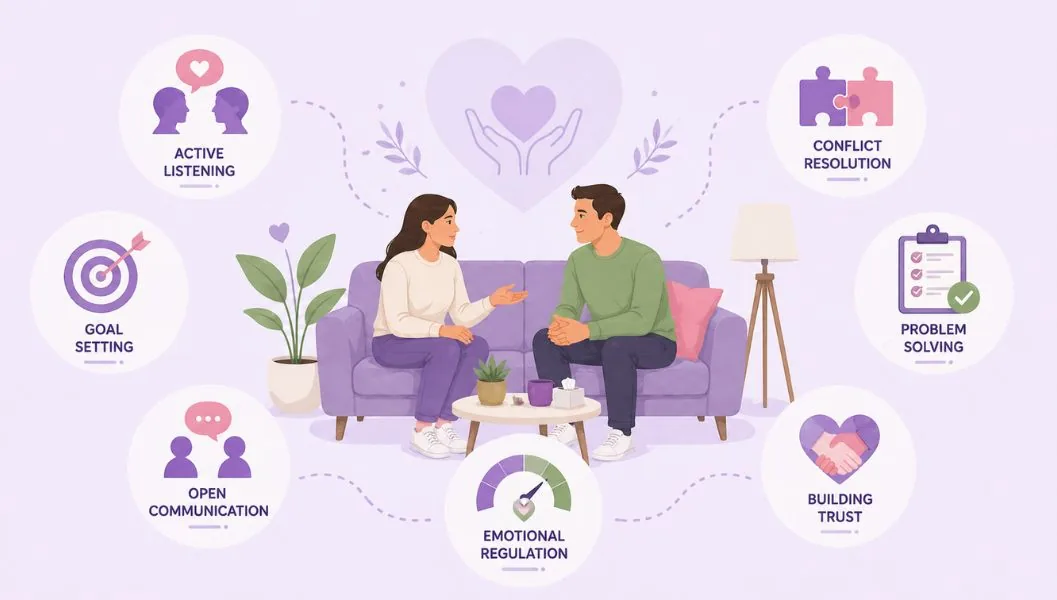
At the centre of almost every struggle is a moment where someone could not say what they needed, or could not be heard when they tried. Couples therapy techniques for communication move you out of the loop of blame and toward understanding. That means more than talking. It means real listening, and letting your partner know their view of the world has landed with you.
These are not complicated. They are couples therapy communication techniques you can start tonight.
What Communication Techniques Can Couples Try First?
The easiest place to start is with three small habits: I statements, reflective listening, and a daily check-in. I statements describe your own feeling instead of accusing. Reflective listening means repeating back what you heard before you answer. A ten-minute check-in is a short, regular talk about how each of you is doing, not the to-do list.
- I statements. Instead of “you always ignore me,” try “I feel lonely when we do not get time together.” The first line starts a fight. The second one opens a door.
- Reflective listening. Before you reply, say back what you think your partner meant. “So you felt left out when I made plans without asking.” When someone feels heard, the heat drops.
- The ten-minute check-in. A short daily habit where you ask how each other is really doing. Not chores. Not logistics. Just the two of you, for ten minutes.
Leading Frameworks: Gottman and EFT
Two of the most studied couples approaches are the Gottman Method and Emotionally Focused Therapy. Both work on emotional safety and on changing the tired patterns a couple keeps repeating, but they come at it from different angles.
What Is the Gottman Method?
The Gottman Method is a research-based approach built by Drs. John and Julie Gottman. It uses an idea called the Sound Relationship House: knowing your partner’s inner world (love maps), keeping fondness alive, and turning toward each other instead of away. It teaches couples to manage conflict, not to erase it.
The Gottman Institute describes the Sound Relationship House as the result of decades of relationship research. The down-to-earth part is the comfort in it: the goal is not a fight-free marriage, which does not exist, but a fair and steady way through the fights you will have. Gottman couples therapy techniques are practical, and many couples find them easy to start using right away.
How Does Emotionally Focused Therapy Work for Couples?
Emotionally Focused Therapy, or EFT, looks at the emotions underneath the conflict. A therapist helps partners spot the pattern they get stuck in, often one person pushing and the other pulling away, then guides them toward a safer, more secure bond. The goal is connection, not winning the argument.
EFT was developed by Dr. Sue Johnson, and according to the International Centre for Excellence in Emotionally Focused Therapy (ICEEFT), it treats adult love as an attachment bond, the deep sense that your partner is there for you and will respond when you reach. Emotionally focused therapy techniques for couples work on that bond directly. When you apply emotionally focused couples therapy techniques in session, the therapist keeps the focus on the here-and-now feelings that drive how you act, which is also the heart of emotion-focused therapy techniques for couples. The aim of these eft couples therapy techniques is a secure, safe connection, not a perfect one.
What Is the Difference Between Gottman and EFT?
The short version: Gottman is more practical and skills-based, EFT is more emotion-based. The Gottman Method gives you concrete tools and habits for friendship and conflict. Emotionally Focused Therapy works underneath the conflict, on the attachment fears that set it off. Many therapists draw on both, depending on what a couple needs most.
Cognitive and Behavioural Approaches
If you and your partner prefer something structured and goal-focused, the cognitive and behavioural family may fit.
CBT couples therapy techniques help you spot the negative thought loops that quietly hurt a relationship. Cognitive behavioural therapy, often shortened to CBT, is a way of noticing a thought, checking whether it is really true, and choosing a more accurate one. For example, if one partner assumes the other is being unkind on purpose, cognitive behavioural couples therapy techniques help reframe that thought into something more realistic and less painful.
Behavioural couples therapy techniques focus on the doing part of love. They lean on positive reinforcement and “caring days,” where each partner makes a point of doing something kind for the other. Small actions, repeated, rebuild goodwill faster than big declarations.
Integrative behavioural couple therapy techniques go a step further. Often shortened to IBCT, this approach helps a couple find the balance between wanting things to change and accepting who a partner truly is. It is especially useful for the differences that never fully resolve, the ones most long-term couples simply learn to live with well.
Other Approaches: Gestalt, Narrative, and Systemic
Relationships are not tidy, and sometimes a more creative or wider-angle method helps.
Gestalt couples therapy techniques keep the focus on the present moment. You might try role-play or an “empty chair” exercise, speaking out loud to an imagined version of your partner, to finally say the thing you have been holding back.
Narrative therapy techniques for couples help you “externalize” the problem, which means treating the trouble as a force outside the two of you rather than as a flaw in one person. Instead of “you are the problem,” the problem becomes something like “the Stress” or “the Silence,” and the two of you team up against it together.
Systemic couple therapy techniques look at your relationship as part of a bigger picture, including family history and culture. This view can be a relief. It helps you see that some struggles come from patterns much older than your relationship, and not from a failure between you.
Specialized Techniques for Specific Needs
Sometimes talking is not enough for a particular issue, like physical closeness or a hard life change.
Sex therapy techniques for couples can help when physical closeness has cooled. A common tool is sensate focus, a slow, low-pressure way to rebuild physical comfort and trust over time, with the pressure to perform deliberately taken off the table.
Solution-focused couple therapy techniques are for couples who want to see progress quickly. Also called solution-focused therapy techniques for couples, they look at what is already working and how to do more of it, rather than digging endlessly through the past.
Couples group therapy techniques happen in guided sessions alongside other couples. Hearing that other people sit in the same hard places can ease the loneliness of it, and there is real learning in watching others work.
What Couples Therapy Techniques Can You Try at Home?
You can practise several skills at home today. Try I statements (“I feel lonely when we miss our time” instead of “you ignore me”), reflective listening (repeat back what you heard before you reply), a daily ten-minute check-in, and the softened start-up: raise a worry gently, without criticism. For a fuller set of these, see our guide to couples therapy exercises at home.
The softened start-up is one of the most useful relationship exercises to do at home, because most painful conversations are decided in their first few seconds. How you open a hard topic tends to predict how it ends. Adding a habit of small thank-yous helps too. So many couples therapy techniques to try at home come down to one thing: choosing, on purpose, to act like a team even on the nights you feel like opponents. That is the quiet work, and it counts.
If you would like a steadier place to practise these skills, individual support can help. You can explore individual online therapy in Ontario, or read about how to find a therapist who fits what you are carrying.
How Long Does Couples Therapy Take to Work?
Every couple is different, and there is no set number of sessions that fits everyone. Many couples begin to notice a shift in how they talk once they have practised the skills together over a stretch of regular sessions. Practising the skills between sessions is what makes the change stick. Deeper or long-standing patterns can take longer. Couples therapy is meant to build lasting habits, not deliver a quick fix, and there are no guaranteed timelines.
Does Saalvio Offer Couples Therapy?
Here is the honest answer. Saalvio’s registered psychotherapists and registered social workers currently provide individual online therapy in Ontario. Couples therapy is not part of what Saalvio offers today, so this guide is here to teach the techniques and the language, not to book you into a couples service we do not run.
That said, individual therapy can change a relationship more than people expect. When one person learns to stay calm in conflict, to name a feeling instead of firing an accusation, or to soften how they open a hard topic, the pattern between two people often shifts with it. If you are an adult in Ontario, you can message a registered psychotherapist before you book and ask whatever you need: whether they have worked with someone like you, whether their approach fits, whether they will understand the family you come from. There is no cost and no commitment. Every Canadian’s first therapy session with a Saalvio clinician is free, so deciding to start is not a gamble on whether the fit will be right. If it helps to picture it, here is how sessions with Saalvio work.
Across the rest of Canada and North America, the Saalvio app offers mood tracking, a private journal, guided practices, and structured self-assessments you can use any time. Therapy with a Saalvio clinician is offered in Ontario today. If you want to understand the research first, you can read whether online therapy is as effective as in-person.
A note for parents. If the relationship you are worried about is your teenager’s, or if a young person in your life is struggling, Saalvio’s therapy is for adults in Phase 1. For someone under 18, Kids Help Phone offers free, confidential support across Canada at 1-800-668-6868, or by texting CONNECT to 686868.
Frequently Asked Questions
What are the main types of couples therapy techniques?
The main types are Emotionally Focused Therapy (EFT), the Gottman Method, and cognitive behavioural approaches, along with behavioural, integrative behavioural (IBCT), Gestalt, narrative, systemic, sex therapy, and solution-focused work. Most focus on clearer communication and a safer emotional bond. A therapist matches the technique to what is actually happening between the two of you.
What is the difference between the Gottman Method and EFT?
The Gottman Method is more practical and skills-based, giving couples concrete tools for friendship and conflict, drawn from decades of Gottman Institute research. Emotionally Focused Therapy, developed by Dr. Sue Johnson, works underneath the conflict on the attachment bond between partners. Many therapists blend both, depending on what a couple needs most.
How long does couples therapy take to work?
Every couple is different, and there is no set number of sessions that fits everyone. Many couples begin to notice a shift in how they talk once they have practised the skills together over a stretch of regular sessions. Practising the skills between sessions is what makes the change last. Deeper or long-standing patterns can take longer. Couples therapy is built to create lasting habits, not a quick fix, and no honest therapist promises a guaranteed timeline.
Can couples therapy work if only one partner is ready?
It works best when both partners take part, since the patterns live between two people. That said, one person can begin. Working on your own communication, your own reactions, and how you open hard conversations can shift the pattern at home. Most couples counselling therapy techniques still work best with both partners present and willing.
What is sensate focus in sex therapy?
Sensate focus is a slow, low-pressure way to rebuild physical closeness and trust between partners. With a therapist’s guidance, the pressure to perform is set aside, and the focus moves to simple comfort and connection at a pace that feels safe for both people. It is one of several sex therapy techniques for couples.
Does Saalvio offer couples therapy?
Not in Phase 1. Saalvio’s registered psychotherapists and registered social workers currently provide individual online therapy in Ontario, and the Saalvio app offers self-help tools across Canada and North America. Couples therapy is not a service Saalvio runs today. This guide is educational. For individual support, you can message a therapist before you book, at no cost.
If you need help right now
Saalvio is not a crisis service. If you are in immediate danger, please call 911. If you are in mental health crisis, please call 988 (the Suicide Crisis Helpline of Canada) or visit your nearest emergency department.
Clinically reviewed by Usman Khan, RP (CRPO #13456)
Clinically reviewed
Usman Khan, Registered Psychotherapist
Usman Khan is the Clinical Director of Saalvio and a Registered Psychotherapist with the College of Registered Psychotherapists of Ontario (CRPO #13456). He holds an MD, an MPH from Western University, and an MA in Counselling Psychology from Yorkville University. He reviews all clinical content on saalvio.com before publish.
See also across Saalvio
Topics mentioned in this post that have their own page on the site.
Talk to our clinical team
Saalvio offers a free first session with any therapist on the team. There is no card on file. If we are not the right fit, we will say so and help you find one.