Art Therapy Mindfulness Activities for Inner Calm
Some nights the quiet is the hardest part. You finally sit down, the house goes still, and that is exactly when your mind starts running. Sitting in silent meditation, the way it is usually described, can feel impossible when your thoughts will not slow down. If that has been your experience, you are not failing at calm. You may just need a different door into it.
This is one of those doors. When you put a pen on paper and let your hand move, you give your mind one small thing to hold onto instead of everything at once. That is what art therapy mindfulness activities are for. They are not about making something beautiful. They are about being somewhere quieter than your own worry for a few minutes. This guide explains what mindfulness-based art therapy is, whether it helps with anxiety and stress, and five easy art therapy exercises at home you can try tonight with nothing but paper and a pen.
What Is Mindfulness-Based Art Therapy?
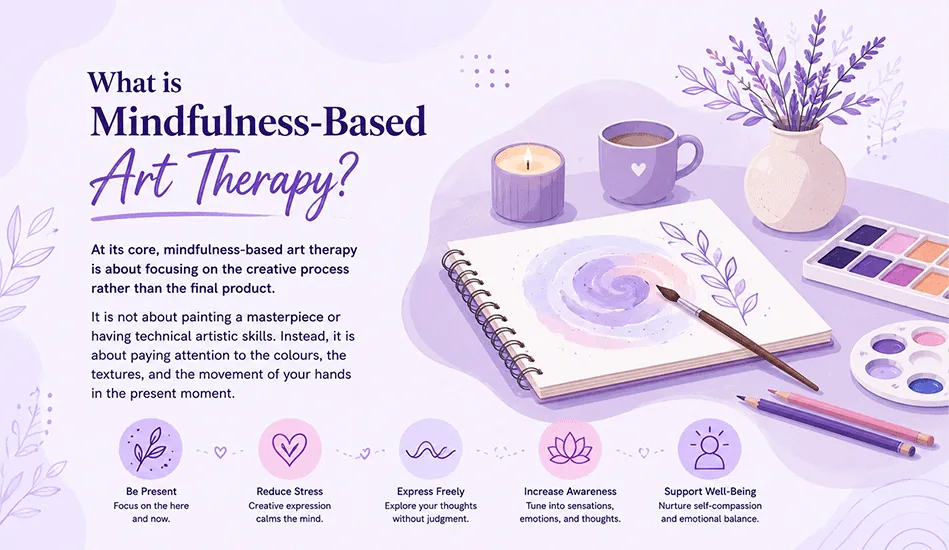
Mindfulness-based art therapy means paying full attention to the act of making art, the colours, the textures, and the movement of your hands, rather than to the finished picture. It gives your mind a gentle task to focus on, which can settle anxious thoughts. You do not need any artistic skill to benefit from it. A scribble counts.
The idea sits on top of a simple practice called mindfulness. CAMH describes mindfulness as being aware and present in the moment, with acceptance and without judgment. When you practise mindfulness art therapy, the art is just the thing your attention rests on. Instead of being pulled into tomorrow’s what-ifs or yesterday’s regrets, you are here, watching a colour spread across the page. For many people who find plain meditation too still, mindful art activities for anxiety give the restless mind something to do, which is sometimes the only way the present moment will let you in. If sitting meditation is what keeps slipping away from you, our guide to meditation for mental health offers gentler ways in.
Do Art Therapy Mindfulness Activities Help Anxiety and Stress?
They can help. Focusing on a simple creative task brings your attention to the present moment, which many people find calming when worry feels loud. The Canadian Mental Health Association notes that mindfulness practices may help reduce stress and anxiety. Art is one easy, low-pressure way to practise that present-moment focus at home, on your own time.
Does art therapy help anxiety in a way researchers can measure? There is some evidence worth knowing. CMHA reports that mindfulness practice can help improve quality of life and well-being, reduce stress and anxiety, and improve physical health. And in one study published in the journal Art Therapy, researchers found that 45 minutes of art making lowered cortisol, a hormone the body releases under stress, in most of the adults who took part, regardless of whether they had any artistic experience (Kaimal, Ray and Muniz, 2016). That last part matters. You do not have to be good at art for art therapy for stress relief to do something for your nervous system.
None of this is a cure, and it is not a replacement for talking to someone when things are heavy. Think of these as art therapy activities for anxiety and stress that sit alongside the rest of your care, not instead of it.
What Are Some Easy Art Therapy Mindfulness Activities I Can Try at Home?
You only need paper and a pen. Try five-minute mindful doodling, colour-mapping where you feel emotions in your body, a texture collage, watercolour breathing where each stroke follows a breath, or drawing a safe, calm place. Focus on how each one feels, not on how it looks. There is nothing to get wrong.
Below are five easy art therapy exercises you can do at the kitchen table, on the couch, or anywhere you can sit for a few minutes. These are creative mindfulness activities built for an adult reader at home. Pick one. You do not have to do them all.
1. The Mindful Doodling Exercise
The mindful doodling exercise is simple: set a timer for five minutes, put your pen on the page, and let it wander without lifting it. Follow the sound of the pen scratching the paper and the feeling of your hand moving. That is the whole practice.
You are not drawing anything in particular. When your mind drifts back to the list of things you have to do, and it will, you just bring your attention back to the line your pen is making. This is one of the gentlest art therapy mindfulness activities for adults because there is no skill in it at all. The only goal is to notice.
2. Colour Mapping Your Emotions
The colour mapping emotions activity is a quiet way to check in with yourself. Draw a rough outline of a body. Pick a few colours and decide what each one means to you, maybe blue for calm, red for tension, yellow for something lighter. Then colour in the parts of the body where you feel those things right now.
There is no correct map. Some people are surprised to see how much red sits in their shoulders or their chest. Putting it on paper can make a feeling that has been vague and heavy suddenly visible, and a feeling you can see is a feeling you can start to work with.
3. The Grounding Texture Collage
Gather a few things with different textures: a smooth magazine page, a piece of rough cardboard, a scrap of soft fabric. Tear or cut them, and glue them onto a sheet of paper, paying full attention to how each one feels between your fingers as you go.
This one uses touch to bring you back to your body. When worry pulls your mind up into your head, the feeling of something rough or soft under your fingertips is a small, real thing to hold onto in the present.
4. Watercolour Breathing
Watercolour breathing pairs each brushstroke with a breath. Dip a brush in watercolour or any wet paint. As you breathe in, paint a stroke upward. As you breathe out, paint a stroke downward. Let the breath set the pace, not the other way around.
The water moves slowly and so do you. Many people find that the rhythm of stroke and breath, stroke and breath, slows their breathing on its own, which is often what an overwhelmed body needs most. If you do not have paint, a soft pencil and slow shading works too.
5. Creating a Safe Space Landscape
Picture a place where you feel completely safe and at ease. It might be a forest somewhere in Ontario, a small room from childhood, a beach that only exists in your head. Draw or paint it, in as much or as little detail as you want.
Keep the finished page somewhere you can find it. The next time everything feels like too much, you can look at it and let your mind go there for a moment. You are giving yourself a place to return to.
The Mind and Body Connection
Our feelings do not only live in our heads. Stress can show up as a tight chest, anxiety as tense shoulders, grief as a weight you carry in your whole body. Mind body awareness activities are simply ways of noticing that, gently, without judging it.
The five exercises above all quietly do this. When you doodle or paint, see if you can notice what happens in your body. Does your jaw loosen? Does your breath drop a little lower? Tuning into how your body feels is its own kind of skill, and it grows with practice. The Saalvio app includes calming music and guided practices that work the same way, giving your attention something steady to rest on.
If gentle, body-aware movement appeals to you, a slow stretch or a short walk can do the same job as a doodle, anchoring you in the present through the body instead of the page. This is the same idea behind mind body therapy in Ontario, and if you want to understand the science underneath it, our piece on mind body healing therapy explains how it works and why it can help. There is no single right tool. There is only the one that helps you feel a little safer in your own skin today.
Beyond Visual Art: Other Ways to Soothe Yourself
Visual art is one path. It is not the only one. Sound helps many people, and calming music and rhythm can settle the body when words feel like too much. The Saalvio app carries calming music as one of its self-help tools for exactly these moments.
Between the activities, when it is late and you would rather not wake anyone, Thrive AI is there as a companion to talk through how a practice felt or what is sitting heavy. Thrive is an AI companion, not a clinician and not therapy, but it can be a quiet presence at an hour when no one else is awake.
When Self-Help Is Not Enough
Sometimes a doodle takes the edge off. Sometimes it does not, because what you are carrying is bigger than a five-minute exercise can hold, and that is not a failure of yours. Art therapy for inner calm is a tool, not a treatment, and there is no shame in needing more than a tool.
Saalvio is not a crisis service. If you are in immediate danger, please call 911. If you are in mental health crisis, please call 988 (the Suicide Crisis Helpline of Canada) or visit your nearest emergency department.
If the stress or anxiety under all of this has been with you for a while, or if stress and burnout have started to wear you down, talking to someone can help. Saalvio offers therapy in Ontario delivered by registered psychotherapists and registered social workers. Whether you are in Toronto, Ottawa, or a quieter corner of the province, support does not depend on where you live.
One of the evidence-based approaches our clinical team uses, mindfulness-based cognitive therapy, builds on the same present-moment focus these art activities practise, with the structure and guidance of a trained clinician behind it. (Art therapy itself is its own profession, and it is not a service Saalvio offers; these activities are self-help you can do on your own.)
You do not have to decide everything tonight. If you are not sure where to start, our guide on how to find a therapist walks through it gently. And every Canadian’s first therapy session with a Saalvio clinician is free, so finding out whether the fit is right is never a financial gamble. Across Canada and North America, the Saalvio app offers calming music, guided practices, a private journal, and structured self-assessments you can use any time. Therapy with a Saalvio clinician is offered in Ontario today.
Frequently Asked Questions
What is mindfulness-based art therapy?
Mindfulness-based art therapy means paying full attention to making art, the colours, textures, and movement of your hands, rather than to the finished result. It gives your mind one gentle task to focus on, which can quiet anxious thoughts. There is no skill to master. The benefit comes from slowing down and noticing, not from making something that looks good.
Do I need to be good at art to try these activities?
No. These art therapy mindfulness activities for adults are about the process, not the product. A scribble counts and there is nothing to get wrong. In one study, art making lowered the stress hormone cortisol in adults regardless of artistic experience. The point is to slow down and notice colour, texture, and movement, not to make anything anyone else will see.
Can art therapy mindfulness activities help with anxiety?
They can. Focusing on a simple creative task pulls your attention into the present moment, which many people find calming when worry is loud. The Canadian Mental Health Association notes mindfulness practices may reduce stress and anxiety. Mindful art activities for anxiety are a low-pressure way to practise that focus at home, alongside professional support rather than instead of it.
How long should each activity take?
About five minutes is enough to start. You do not need an hour or an art studio. Set a timer, do one of the mindfulness art exercises at home, and stop when it ends. Short and regular beats long and rare. If five minutes feels good, you can always stay longer, but a few quiet minutes is a real and complete practice on its own.
Is this a replacement for therapy?
No. These activities are self-help tools that can sit alongside professional care, not stand in for it. If stress, anxiety, or low mood has been heavy or lasting, talking to a registered psychotherapist or registered social worker can help. Saalvio offers therapy in Ontario, and every Canadian’s first session with a Saalvio clinician is free.
If you need help right now
Saalvio is not a crisis service. If you are in immediate danger, please call 911. If you are in mental health crisis, please call 988 (the Suicide Crisis Helpline of Canada) or visit your nearest emergency department.
Clinically reviewed by Usman Khan, RP (CRPO #13456)
Clinically reviewed
Usman Khan, Registered Psychotherapist
Usman Khan is the Clinical Director of Saalvio and a Registered Psychotherapist with the College of Registered Psychotherapists of Ontario (CRPO #13456). He holds an MD, an MPH from Western University, and an MA in Counselling Psychology from Yorkville University. He reviews all clinical content on saalvio.com before publish.
See also across Saalvio
Topics mentioned in this post that have their own page on the site.
Talk to our clinical team
Saalvio offers a free first session with any therapist on the team. There is no card on file. If we are not the right fit, we will say so and help you find one.