
IFS couples therapy: Healing relationships through parts work
Book a Free 30-Minute Consultation
IFS couples therapy is a way for two partners to understand the hurt parts inside each of them that show up during a fight. It comes from Internal Family Systems, or IFS, a therapy built on the idea that everyone carries different inner parts. In couples work, partners learn to notice those parts and speak from a calmer place instead of letting the parts fight for them.
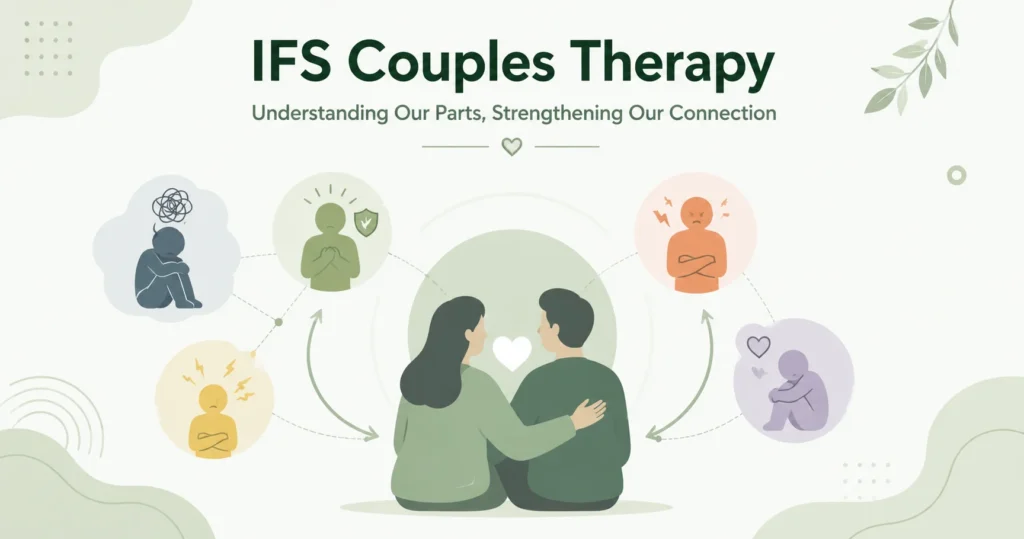
Understanding the parts behind relationship conflict
It starts small. A dish left in the sink. A missed text. A tone of voice that lands wrong at the end of a long day. And then, somehow, two people who love each other are standing in the kitchen saying things they do not mean, both of them wondering how a small thing turned into this.
If that sounds familiar, you are not the only couple who feels this way. Most fights are not really about the dish. They are about old parts inside each partner, parts that learned a long time ago how to protect against feeling small, ignored, or not enough. IFS in couples therapy gives those parts a way to be heard before they take over the room.
What is IFS, and what does it mean for a relationship?
Every person carries different sides of themselves. There is the side that stays calm and clear. There is the side that gets defensive the second it feels criticized. There is the side that goes quiet and pulls away rather than risk another disappointment. IFS meaning is simple at its root: it is a therapy that treats these sides, called parts, as real and worth understanding, not as flaws to fix.
At the centre of every person, IFS says, is a steady, caring place called the Core Self. The Core Self of IFS is not another part. It is who you are underneath the parts, the version of you that can stay curious and warm even when things are hard. When a couple can speak from that place instead of from a scared or angry part, conversations change.
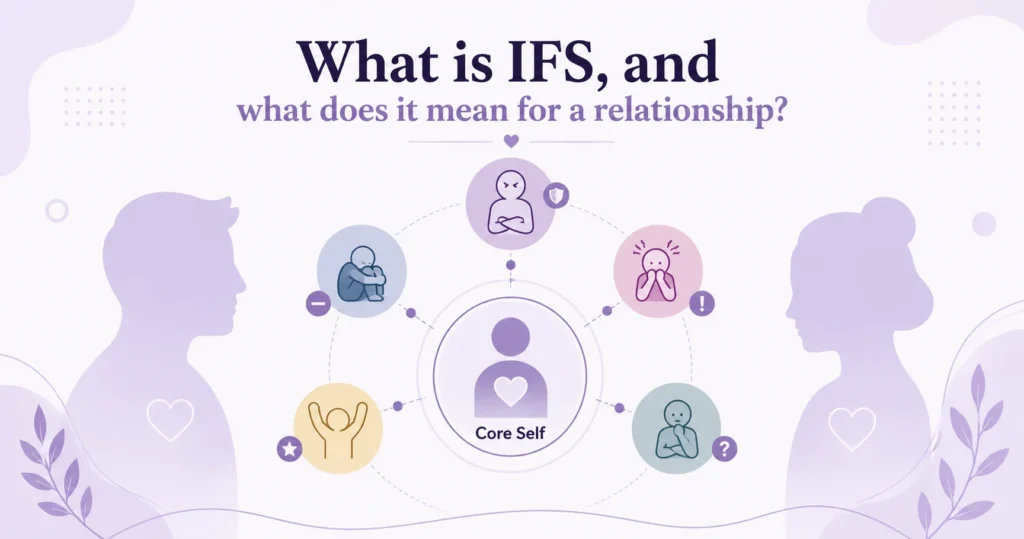
How parts show up between two people
In a relationship, one partner’s protective part often meets the other partner’s protective part, and the two collide. She goes quiet to protect herself from feeling dismissed. He raises his voice to protect himself from feeling shut out. Neither one is trying to hurt the other. Both are trying to keep an old wound from being touched again.
Learning how parts work in therapy is often the first step for a couple. Instead of asking “why did you do that,” a therapist trained in this approach helps each partner ask “what part of me just took over, and what is it trying to protect.” That single shift, from blame to curiosity, is often where the real work of IFS for couples begins.
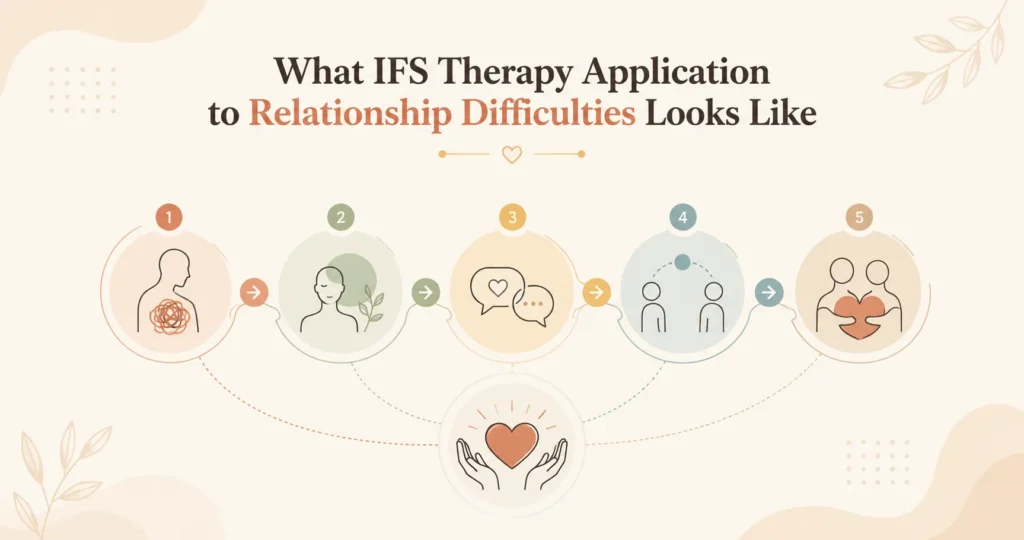
What IFS therapy application to relationship difficulties looks like
This IFS therapy application to relationship difficulties usually plays out in session in a few steady moves. A therapist helps each partner slow down and notice which part just spoke. She helps that partner get some space from the part, enough space to speak from the Core Self instead of from the hurt or the anger. Then, with support, each partner listens to the other’s part without needing to fix it or fight it.
Some of the specific IFS therapy techniques used in this work include naming a part out loud, asking a part what it is afraid would happen if it stopped protecting, and inviting the Core Self to speak directly to the partner’s hurt part with care instead of judgment. None of this happens overnight, and no therapist can promise a certain number of sessions will change a relationship. What many couples do find is a new way to hear each other, one part at a time.
Is IFS couples therapy right for trauma, anxiety, or conflict?
Many people bring old pain into new relationships without meaning to. A partner who grew up walking on eggshells around an angry parent may flinch at a raised voice years later, even from someone safe. A partner who lived through a hard breakup may brace for abandonment at the first sign of distance. This is where IFS therapy for trauma, anxiety, and PTSD connects directly to Internal Family Systems couples therapy, because the parts that show up in a relationship are often the same parts carrying pain from somewhere else.
A therapist trained in IFS does not ask a couple to relive painful memories in front of each other before they are ready. The pace is set by what each person can safely hold. If you are working through this on your own between sessions, resources on doing IFS yourself can help you get familiar with your own parts first, though relationship work with a trained therapist is where the deeper healing tends to happen for IFS couples.
Where the approach comes from
IFS was developed by Dr. Richard Schwartz, and its use with couples grew from that same root. A model called Intimacy from the Inside Out, built specifically to bring IFS into couples work, describes the goal plainly: helping each partner access the calm, caring Self so they can offer real love and care to their own inner family, and in turn to each other, according to the IFS Institute. If you want to go deeper on your own, a few IFS therapy books written by clinicians in this field walk through the model step by step.
What a real next step looks like
You do not have to decide tonight whether this approach is right for your relationship. If you are curious whether IFS relationship therapy could help, you can message a therapist on our team with your questions first. Ask whether they are trained in this approach, whether they work with couples, and what a first conversation would look like. There is no cost and no commitment to messaging, and it is often easier than picking up the phone.
If you are not sure where to start looking, our post on how to find a therapist walks through the steps at your own pace.
Frequently Asked Questions
What does IFS mean in couples therapy?
IFS stands for Internal Family Systems, a therapy built on the idea that each person has different inner parts, along with a calm core Self underneath them. In couples work, partners learn to notice which part is speaking and to respond to each other from a calmer, clearer place.
How does IFS help a struggling relationship?
IFS helps partners see conflict as two sets of protective parts reacting to old pain, rather than as one partner simply being wrong. This shift from blame to curiosity can open space for real listening, though results vary and no outcome is guaranteed.
Is IFS couples therapy good for anxiety, trauma, or PTSD in a relationship?
IFS can be a supportive approach when past pain shows up in present-day conflict, since it works directly with the parts carrying that pain. A therapist trained in trauma-informed IFS will set a pace that feels safe for both partners.
What is a part in IFS?
A part is a piece of a person’s inner world with its own feelings, fears, and job, such as a part that goes quiet to avoid conflict or a part that gets defensive to avoid feeling small. IFS treats every part as trying to help, even when its method causes pain.
How do I find a therapist trained in IFS couples therapy?
You can message a therapist on the Saalvio team to ask about their training and experience with IFS and with couples, before you book anything. This gives you a chance to ask questions and get a feel for fit first.
Clinically reviewed
Usman Khan, Registered Psychotherapist
Usman Khan is the Clinical Director of Saalvio and a Registered Psychotherapist with the College of Registered Psychotherapists of Ontario (CRPO #13456). He holds an MD, an MPH from Western University, and an MA in Counselling Psychology from Yorkville University. He reviews all clinical content on saalvio.com before publish.
See also across Saalvio
Topics mentioned in this post that have their own page on the site.
Talk to our clinical team
Saalvio offers a free 30-minute consultation with any therapist on the team. There is no card on file. If we are not the right fit, we will say so and help you find one.