
Anxiety and Stress · Depression
What is the best therapy for anxiety and depression in Toronto?
There is no single best therapy for anxiety and depression in Toronto. The right fit depends on you, your story, and what you need right now. Cognitive behavioural therapy (CBT) is the most studied option and often the first one tried. Other approaches, like ACT and solution-focused therapy, help too. A registered therapist can help you find the one that fits.
You are not the only one feeling this way
Maybe you are the mother who cries in the shower so the kids do not hear. Maybe you are the university student who cannot get out of bed, even though the semester starts today. Maybe you are the new Canadian who feels a tight chest every time the phone rings, because bad news used to come that way.
None of that is weakness. It is your body and mind carrying a lot, for a long time, without much help.
If you want to understand what you are feeling first, our complete guide to anxiety walks through it in plain words. Some people also find it helpful to read about the symptoms of anxiety or how anxiety becomes more than stress so they know when it is time to ask for support.
What kinds of therapy help with anxiety and depression?
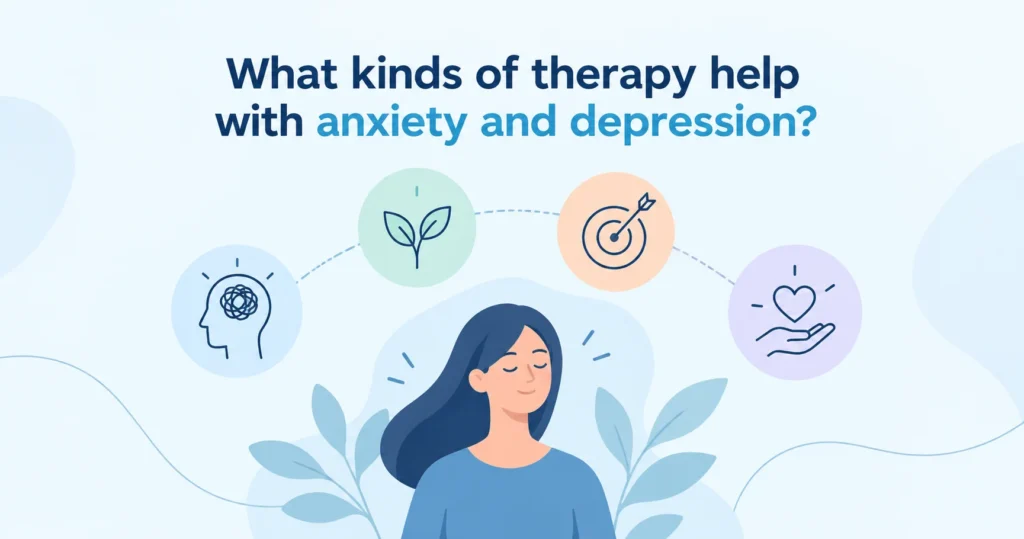
There is real, evidence-based anxiety treatment in Toronto, and it does not look the same for everyone. Here are the main approaches used by Saalvio’s clinical team:
- CBT (cognitive behavioural therapy). CBT is a structured approach that helps you notice unhelpful thought patterns and change them, step by step. It is one of the most researched forms of CBT therapy for anxiety and depression in Toronto, and many clients start here.
- ACT (acceptance and commitment therapy). ACT teaches you to make room for hard feelings instead of fighting them, while still moving toward the life you want. Some clients find ACT therapy for anxiety especially helpful when anxious thoughts feel impossible to argue away.
- Solution-focused therapy. This is a shorter, goal-based approach. Instead of digging deep into the past, solution-focused therapy for anxiety and depression in Toronto looks at what is working now and builds on it.
- Trauma-informed and somatic approaches. For clients whose anxiety or depression is tied to past hurt, a trauma-informed lens matters. Ask your therapist about this during your consultation.
A therapist trained in anxiety management therapy will usually blend a few of these tools around your specific goals, not hand you a script.
Therapy techniques that can help right now
You do not need to wait for your first session to try something small. These are a few common therapy techniques for anxiety and depression that clients learn early on:
- Naming the thought. Say out loud, “This is anxiety talking, not fact.”
- Slow breathing. In for four counts, hold for four, out for six.
- Grounding. Name five things you can see, four you can touch, three you can hear.
- Catching the spiral. Many clients ask their therapist how to stop catastrophizing anxiety, the habit of jumping straight to the worst outcome. A therapist can teach you to catch that jump earlier each time.
These are starting points, not a replacement for care. If anxiety or depression is affecting your daily life, real therapy for anxiety in Toronto makes the biggest difference.
What about anxiety attacks, phobias, and social anxiety?
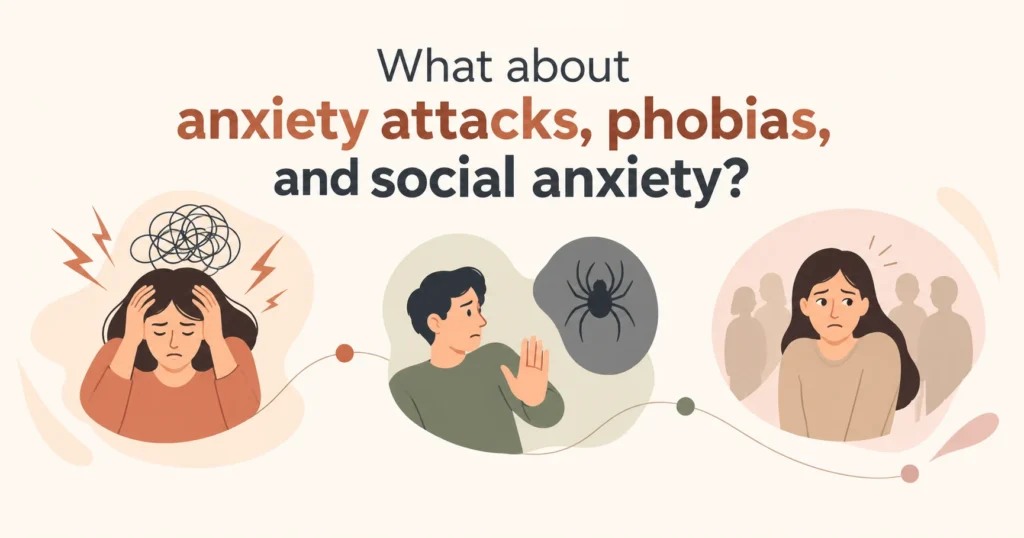
Some clients come to Saalvio because a specific fear runs their life. This is common, and it is treatable.
- Therapy for anxiety attacks in Toronto often starts with understanding your body’s alarm system and slowing it down before it takes over.
- Therapy for phobias and anxiety in Toronto may use gradual, gentle exposure, at a pace you control, never forced.
- If the fear is centred on being judged or watched by others, that may be a social anxiety disorder, and a therapist trained in this area can help you learn to reduce anxiety in those specific moments, not just in general.
Do I need a psychiatrist or a therapist to manage anxiety?
This is one of the most common questions we get, so let us be direct about it.
A psychiatrist in Toronto, Ontario, is a medical doctor. They can diagnose conditions and prescribe medication. Saalvio does not employ psychiatrists, and Saalvio’s platform does not diagnose or prescribe.
Saalvio’s clinical team is made up of Registered Psychotherapists and Registered Social Workers. They provide anxiety counselling in Toronto and depression therapy, using talk-based approaches like the ones above. If your situation may need medication or a formal diagnosis, your Saalvio therapist can talk that through with you and help you find the right next step, including a referral to your family doctor or a psychiatrist.
Many clients use both kinds of care at the same time. Therapy and medication are not competing choices. They are two tools that can work side by side.
Can young adults find therapy for anxiety and depression in Toronto?
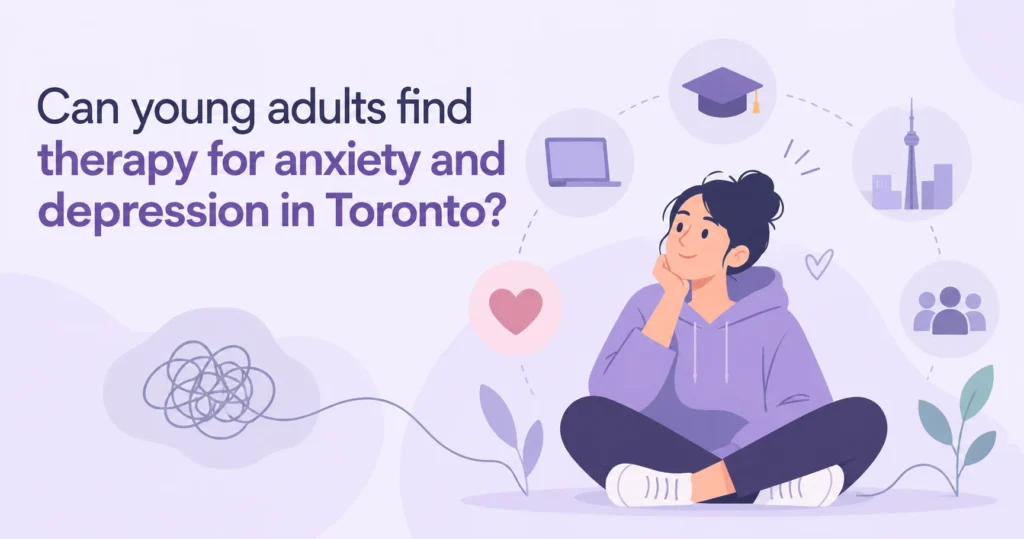
Yes. A lot of what brings young adults to therapy is specific to this stage of life: school pressure, a first job, moving out, dating, comparing yourself to everyone online at 1 a.m.
Therapy for young adults with anxiety and depression in Toronto works best when the therapist understands that stage, not just the symptoms. Saalvio’s roster includes clinicians who work with young adults building their footing in a new city, a new job, or a new stage of independence.
How does online therapy for anxiety and depression work?
Many Saalvio clients choose an online therapist for anxiety and depression because it fits real life better than a waiting room does.
- Sessions happen by secure video, from wherever you feel safest.
- Online anxiety therapy in Toronto means no commute, no waiting room, and no awkward run-in with a neighbour.
- You can book a session on your lunch break or after the kids are asleep.
- The full self-help side of Saalvio, including mood tracking and the mental health app, lives on your phone alongside your therapy.
If your anxiety feels severe and hard to manage day to day, online therapy for extreme anxiety in Toronto is still therapy, delivered by video instead of in person. It is not a crisis service. If you are in danger right now, please see the note at the end of this article before reading further.
You can learn more about how online therapy in Ontario works, including who it is a good fit for.
What does therapy for anxiety cost in Toronto?
Cost is often the thing that stops people from ever calling. Saalvio was built to remove that barrier.
- Every new client starts with a free 30-minute consultation with a registered clinician. This is a chance to meet your therapist, share what brought you here, and ask questions, at no cost and no obligation.
- After that, sessions are billed directly to you. Saalvio does not bill insurers, but sessions with a Registered Psychotherapist or Registered Social Worker are typically reimbursable under most Canadian extended health benefit plans. You get a detailed receipt to submit yourself.
- Not sure yet if you are ready to book? You can also message a therapist before booking with any questions about fit, approach, or cost, with no pressure either way.
How do I start therapy to treat anxiety in Toronto?
Starting does not have to be a big leap. Here is what it looks like:
- Create your profile and tell us a little about what you are looking for.
- Start with a free 30-minute consultation with a registered clinician. This is not a full therapy session. It is a chance to meet and decide if it feels right.
- If it is a good fit, book your first full session. If not, we help you find someone who fits better, at no extra cost.
- Keep going with support between sessions through the Saalvio app.
You do not have to decide everything tonight.
Frequently Asked Questions
Is there one best therapy for anxiety and depression?
No single therapy works for everyone. CBT is the most researched starting point for many clients, but ACT, solution-focused therapy, and trauma-informed approaches all have strong evidence behind them. Your therapist will help match the approach to you. According to the Centre for Addiction and Mental Health, CBT is a first-line, structured approach used across Ontario’s outpatient mood and anxiety programs. The Canadian Mental Health Association, Ontario, also notes that anxiety disorders affect a significant share of Canadians and are highly treatable with the right support.
What does anxiety disorder treatment in Toronto usually include?
It usually starts with a consultation, followed by regular sessions using an evidence-based approach like CBT. Many clients also use self-help tools between sessions to build on what they are learning.
Can I see a depression therapist in Toronto online?
Yes. Saalvio’s depression treatment is available by secure video across Ontario, alongside in-app support tools.
How is depression and anxiety therapy in Toronto different from a psychiatrist visit?
Therapy is talk-based support from a Registered Psychotherapist or Registered Social Worker. A psychiatrist is a medical doctor who can diagnose and prescribe medication. Many people benefit from both.
Can I message a therapist before I commit to anything?
Yes. You can message any therapist on our team with your questions before you book a session, at no cost and no commitment.
Clinically reviewed
Usman Khan, Registered Psychotherapist
Usman Khan is the Clinical Director of Saalvio and a Registered Psychotherapist with the College of Registered Psychotherapists of Ontario (CRPO #13456). He holds an MD, an MPH from Western University, and an MA in Counselling Psychology from Yorkville University. He reviews all clinical content on saalvio.com before publish.
See also across Saalvio
Topics mentioned in this post that have their own page on the site.
Talk to our clinical team
Saalvio offers a free 30-minute consultation with any therapist on the team. There is no card on file. If we are not the right fit, we will say so and help you find one.