
Finding Meaning in the Mess: A Guide to the Core ACT Therapy Principles
Some days do not feel like living so much as carrying. You get up, you do what is asked of you, and underneath all of it is a weight you have stopped trying to explain to anyone. The mind keeps talking. The feelings keep arriving, uninvited and at the worst times. For a long time, the only advice most of us ever heard was to fight harder. Push the hard thoughts down. Argue with the fear. Wait for the day it all finally goes quiet.
There is another way to live with what you carry, and it does not start with a fight.
That is what the ACT therapy principles are about. Acceptance and Commitment Therapy, usually shortened to ACT, does not begin from the idea that something is wrong with you and needs fixing. It begins from the idea that pain is part of a human life, and that you can still build a life that means something while the pain is in the room. The aim is ACT therapy psychological flexibility, which simply means the ability to stay present, stay open to hard feelings, and still do what matters to you. This guide explains the six core processes in plain words, what each one looks like in real life, and how to find ACT therapy in Ontario when you are ready.
What Is the Struggle for Control, and Why Do We Get Stuck?
Most of us spend a great deal of energy trying to manage how we feel. When anxiety shows up, we try to shut it down. When a painful thought arrives, we rush to replace it. ACT calls this constant pushing-away experiential avoidance, and it explains why control so often makes things worse instead of better.
Picture a beach ball in a swimming pool. The ball is your anxiety, your grief, the memory you would give anything to forget. You do not like it, so you push it under the water and hold it there. It works, for a moment. But it takes everything you have, and the second your arms tire, the ball shoots back up and hits you in the face. Acceptance and commitment therapy experiential avoidance is that exhausting effort to keep the ball down. You spend so long fighting it that you forget you are standing in a pool, with people you love, on a day you will not get back.
ACT offers a different choice. Let the ball float. It is still there. It might be right beside you. But your hands are free now, and you can finally start to swim toward what matters.
What Are the 6 Principles of ACT Therapy?
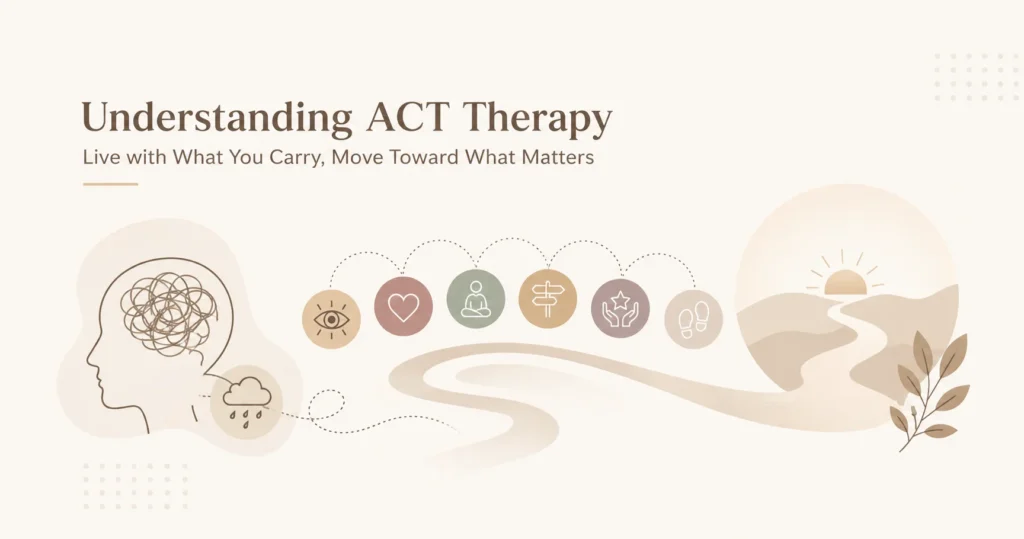
The six principles of acceptance and commitment therapy are acceptance, cognitive defusion, being present, self-as-context, values, and committed action. Together they form the Hexaflex, a model that helps you stop fighting hard thoughts and feelings and start acting on what matters to you, even while the hard stuff is still there.
These acceptance and commitment therapy 6 principles are not dry theory. The ACT therapy core principles are practical skills you can practise in ordinary moments, and they work together rather than one at a time. Here is what each of the principles of acceptance and commitment therapy looks like in real life.

1. Acceptance: Letting It Be
Acceptance does not mean you like the pain or that you are giving up. It means you stop pretending the feeling is not there. Instead of “I should not feel this way,” you try “I am noticing sadness right now.” You make room for the hard thing so it does not have to run your whole day.
2. Cognitive Defusion: Watching Your Thoughts
Cognitive defusion (stepping back so you see a thought as words rather than orders) is one of the most useful ACT therapy defusion techniques. Most of the time we are fused with our thoughts, which means we treat them as facts. If the mind says “I am a failure,” we believe it. ACT therapy cognitive defusion teaches you to add a small phrase: “I am having the thought that I am a failure.” That tiny gap reminds you a thought is a string of words, not a command you have to obey.

3. Being Present: The Now
So much of our suffering lives in the replay of yesterday or the dread of tomorrow. Being present means coming back to your body and the room you are actually in: the warmth of the cup in your hands, your feet on the floor, the sound of rain on the window. Present-moment awareness is a core part of psychological flexibility ACT therapy, because when you are truly here, the “then” and the “later” loosen their grip.
4. Self-as-Context: The Observer
Self-as-context is the part of you that notices your thoughts and feelings without being them. You are not your thoughts. You are not your feelings. You are the one who has them. ACT uses the image of the sky and the weather. Your thoughts and moods are clouds and storms that pass through. You are the sky that holds all of it and stays the same underneath.

5. Values: Knowing What Matters
This is the heart of the commitment in Acceptance and Commitment Therapy. To move forward, you need a direction. Your ACT therapy values are that direction. Values are not goals you tick off, like buying a house. They are how you want to show up: as a patient parent, a loyal friend, an honest worker. They are the compass, not the destination.
6. Committed Action: Doing the Work
Once you know what you value, you take small steps toward it. The steps do not have to be large. If your value is your health, committed action might be a glass of water or a five-minute walk. The point is to do what matters while the beach ball floats beside you, instead of waiting for it to disappear first.

What Is Psychological Flexibility in ACT?
Psychological flexibility is the goal of ACT. It means being able to stay in the present moment, open to difficult thoughts and feelings, and still take action toward what you value. Think of it as a mental muscle that lets you do what matters even when you are hurting.
The six processes above are simply the six ways you build that muscle. You do not need to be calm to live well. You need to be willing.
What Is the Difference Between Acceptance and Control in ACT?
Control means trying to push painful thoughts and feelings away, which often makes them stronger and costs a lot of energy. ACT calls this experiential avoidance. Acceptance means making room for the feeling so you can spend your energy on living, like letting a beach ball float instead of holding it underwater.
That is the whole shift in acceptance vs control ACT. The question stops being “how do I make this feeling stop?” and becomes “what can I do that matters, even with this feeling here?” One of those questions traps you. The other one frees your hands.
Turning Principles Into Practice: ACT Techniques and Exercises
Understanding the 6 principles of ACT therapy is a start. Using them is where the change happens. Therapists blend acceptance and commitment therapy principles and techniques to fit what a person is actually facing. For a full walk-through of the practices themselves, our guide to ACT therapy techniques, interventions, and exercises lays them out one by one. Common ACT therapy techniques and exercises include:
- Defusion phrases: adding “I am having the thought that…” in front of a harsh thought, so it reads as words instead of truth.
- Grounding in the present: slow breathing and noticing five things you can see, hear, or touch, to come back to the now.
- Values clarification: naming what you most want to stand for, so your daily choices point that way.
- Small committed actions: one doable step toward a value, repeated, rather than a single overwhelming change.
- The observer exercise: picturing yourself as the steady sky and your thoughts as passing weather.
Sometimes a therapist will look at the triggers in your environment that pull you into old habits, then help you choose a path that fits your values rather than relying on willpower alone. Defusion is also the skill at the centre of working with looping, intrusive thoughts, which is why our guide to ACT therapy for OCD leans on these same principles. In Ontario, ACT is also used by other regulated health professionals, including occupational therapists who draw on these ideas to help people manage chronic pain or return to work after an injury. It is a way of looking at health that reaches past the physical.
How Is an ACT Values List Used?
In ACT, values are how you want to show up in the world, like being a kind sibling or a steady parent, not goals you tick off. A values list is a simple set of words that helps you name what matters most so your daily choices point in that direction.
Naming your values is harder than it sounds, which is why an ACT values list helps. It offers words like connection, honesty, creativity, courage, or care, and you sort through them to find the few that feel like yours. When you can see your acceptance commitment therapy values list on paper, the hard decisions get a little clearer, because you are no longer just busy. You are pointed somewhere. Living by your values acceptance and commitment therapy direction turns a pile of problems back into a life you are actually choosing.
How Is ACT Different From CBT?
Both are evidence-based talk therapies. CBT often works by testing whether an anxious thought is accurate and then changing it. ACT works by changing your relationship to the thought: accepting it, unhooking from it, and acting on your values anyway. Many therapists draw on both, depending on the person and what they are facing.
Neither is better than the other, and the right fit depends on you. You can read more about CBT and about our ACT page to see which feels closer to what you need, or message a therapist before you book and simply ask.
Why ACT Takes a Different View
Many therapies focus on getting rid of symptoms. ACT starts somewhere else. It treats pain as part of being alive: if you love someone, you will grieve; if you care about your work, you will feel stress. The goal is not a life with no hard feelings. The goal is a life with room for them.
This is why ACT can sit beside the heaviest experiences without flinching. You can feel “not good enough” and still show up for a friend. You can carry anxiety or depression and still be a loving parent in the same hour. If anxiety is the main weight you carry, our guide to ACT therapy for anxiety shows how these principles apply to worry. ACT is one of the most studied contextual behavioural therapies, used for anxiety, depression, chronic pain, stress, and more, according to the Association for Contextual Behavioral Science. It holds up in research because it is built on how people actually work, not on how we are told we should work.
The need for this kind of support is not rare or unusual. The Canadian Mental Health Association reports that in any given year, one in five people in Canada will personally experience a mental health problem or illness. If you are carrying something right now, you are in very ordinary, very human company.
Finding ACT Therapy in Ontario
You do not have to do this alone, and you do not have to decide everything tonight. The first step is often just finding someone who understands what you are going through.
Saalvio offers online therapy in Ontario delivered by registered psychotherapists and registered social workers, including clinicians who work with the core ACT therapy principles to help you build psychological flexibility. Online sessions mean you can do this work from your own couch, whether you are in Burlington, Richmond Hill, or anywhere across Ontario. If you are looking for an ACT therapist Ontario residents can reach without a long wait, online ACT therapy Ontario removes the commute, the waiting room, and a fair bit of the dread of a first visit.
Before you book anything, you can message a therapist before you book and ask whatever you need to ask: whether they have worked with someone like you, whether ACT fits what you are facing, whether they will understand the life you come from. There is no cost and no commitment. Every Canadian’s first therapy session with a Saalvio clinician is free, so deciding to try therapy is not a financial gamble on whether the fit will be right. If you are not sure where to begin, our guide on how to find a therapist can help.
Across the rest of Canada and North America, the Saalvio app offers self-help tools, guided practices, and structured self-assessments you can use any time. It also includes Thrive, the in-app AI companion, which can listen and suggest a practice at the hours when reaching a person is hardest. Thrive is a support tool, not a clinician, and it is not therapy. Therapy with a Saalvio clinician is offered in Ontario today.
Frequently Asked Questions
What is the “acceptance” in ACT actually about?
Acceptance in ACT is not about being a victim or liking your pain. It is about acknowledging that a thought or feeling is present, so you stop pouring all your energy into fighting it. When you accept that anxiety is here, you free up that energy to focus on the life you actually want to live.
How do I know if I am “fused” with my thoughts?
If your thoughts feel like absolute truths you must obey, you are likely fused with them. For example, if the thought “I cannot go to that event” feels like a solid wall, that is fusion. ACT therapy cognitive defusion helps you see that a thought is just a sentence, so you can choose whether to act on it.
Can ACT help with physical health issues?
Yes. ACT is widely used in rehabilitation and chronic pain care. By shifting from control toward acceptance, people learn to live meaningful lives even with physical limits. In Ontario, ACT-based ideas are sometimes part of occupational therapy as well, helping people manage pain and return to the activities that matter to them.
How long does ACT therapy take?
ACT is often described as a brief therapy, and many people feel a shift within 6 to 12 sessions. The exact length depends on what you are working through. The skills themselves, though, are a lifelong practice. The goal is lasting psychological flexibility, not a quick fix, so the tools stay useful long after sessions end.
Is ACT effective?
Yes. According to the Association for Contextual Behavioral Science, ACT is one of the most studied contextual behavioural therapies, with research support across anxiety, depression, chronic pain, and stress. As with any therapy, results vary from person to person, and a registered therapist can help you find the approach that fits you best.
Where can I find an ACT therapist in Ontario?
You can find support through Saalvio, whose clinical team of registered psychotherapists and registered social workers offers online ACT therapy across Ontario. You can message a therapist with your questions before you book, at no cost, and every Canadian’s first session with a Saalvio clinician is free.
Clinically reviewed
Usman Khan, Registered Psychotherapist
Usman Khan is the Clinical Director of Saalvio and a Registered Psychotherapist with the College of Registered Psychotherapists of Ontario (CRPO #13456). He holds an MD, an MPH from Western University, and an MA in Counselling Psychology from Yorkville University. He reviews all clinical content on saalvio.com before publish.
See also across Saalvio
Topics mentioned in this post that have their own page on the site.
Talk to our clinical team
Saalvio offers a free 30-minute consultation with any therapist on the team. There is no card on file. If we are not the right fit, we will say so and help you find one.