
ACT Therapy for OCD: What It Is and How It Helps
Book a Free 30-Minute Consultation
OCD is not fussiness, and it is not a quirk. It is the thought that arrives uninvited, the one you would never choose, and then the long bargaining that follows it. Check the door again. Wash again. Replay the moment one more time to be sure you are not the person the thought says you are. You already know how tiring it is, because you have been doing it quietly, often for years, often without telling anyone what it costs you.
There is something worth knowing inside that exhaustion. Of all the things OCD insists on, the loudest is that you have to win the argument with your own mind before you can live. ACT therapy for OCD starts somewhere else. It does not ask you to prove the thought wrong or to make it leave. It teaches you a different way of carrying it, so the thought can show up and you can still do the thing you actually care about. This guide explains what ACT therapy for OCD is, how it works, what the research says, and how to find support in Ontario.
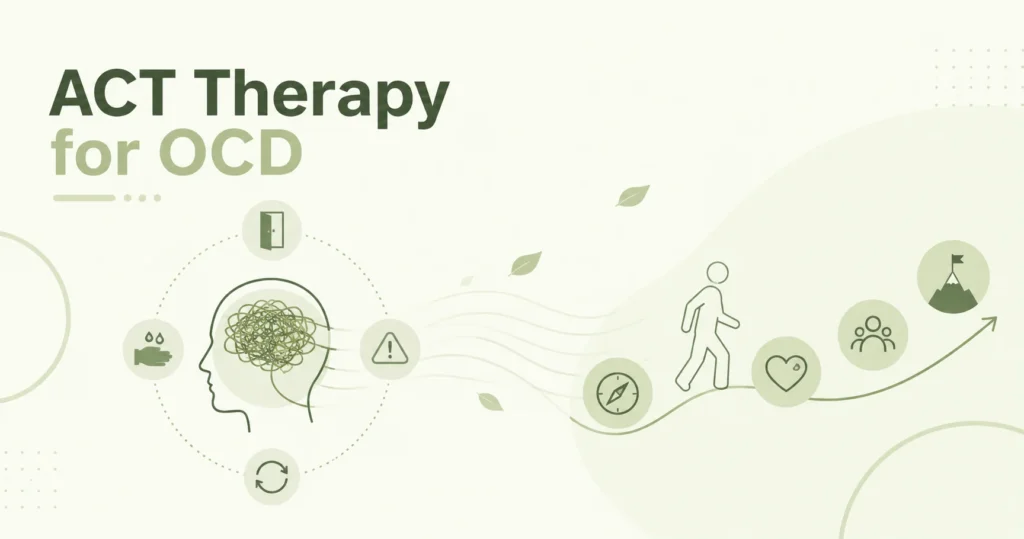
What Is ACT Therapy for OCD?
ACT, or acceptance and commitment therapy, is an evidence-based talk therapy for OCD. Instead of arguing with intrusive thoughts or trying to make them go away, ACT teaches you to change how you relate to them. The aim is not fewer thoughts. The aim is a life that is less and less controlled by them.
This is often a relief to hear. So many people with OCD have spent years trying to settle the same questions: Is this thought true? Will something terrible happen? Am I a good person or a bad one? ACT, sometimes written acceptance and commitment therapy for OCD, gently steps out of that fight. It was developed by psychologist Steven Hayes and is now one of the most researched of the newer behavioural therapies. (Association for Contextual Behavioral Science)
The Six Core Processes of ACT
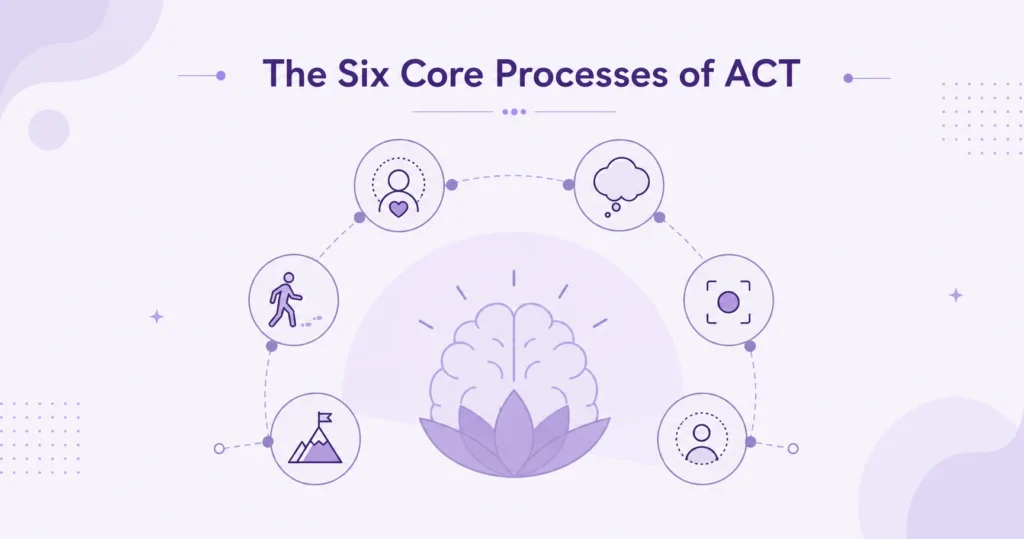
ACT is built on six core processes that work together to build what researchers call psychological flexibility, the ability to act on your values even while uncomfortable thoughts are present. Here is what each one means in plain language. (Association for Contextual Behavioral Science)
- Acceptance: making room for uncomfortable thoughts and feelings instead of fighting to push them away.
- Cognitive defusion: seeing a thought as just a thought, not a fact and not a command.
- Present-moment awareness: staying with the here and now instead of getting pulled into “what if” loops.
- Self-as-context: noticing that you are the one watching the thoughts, not the thoughts themselves.
- Values clarification: getting clear on what actually matters to you in your life.
- Committed action: taking real steps toward those values, even when discomfort comes along for the ride.
Together, these six help people with OCD build a life around what they care about, rather than a life organized around avoiding fear.
How Does ACT Help OCD?
ACT helps OCD by building psychological flexibility, the ability to act on what matters to you even while uncomfortable thoughts are present. You learn to let intrusive thoughts come and go without performing the compulsion. Over time the thoughts lose some of their grip, and you stop organizing your whole day around keeping them away.
The shift is small to describe and large to live. OCD runs on a deal: do the ritual, get a few minutes of relief, and teach your brain that the ritual was necessary. ACT helps you change your side of that deal. With practice, you can notice the thought (“what if I left the stove on”), name it as a thought rather than a warning, and walk out the door toward something you value anyway. Cognitive defusion is the skill at the centre of this, and we will come back to it below.
How Is ACT Different From CBT for OCD?
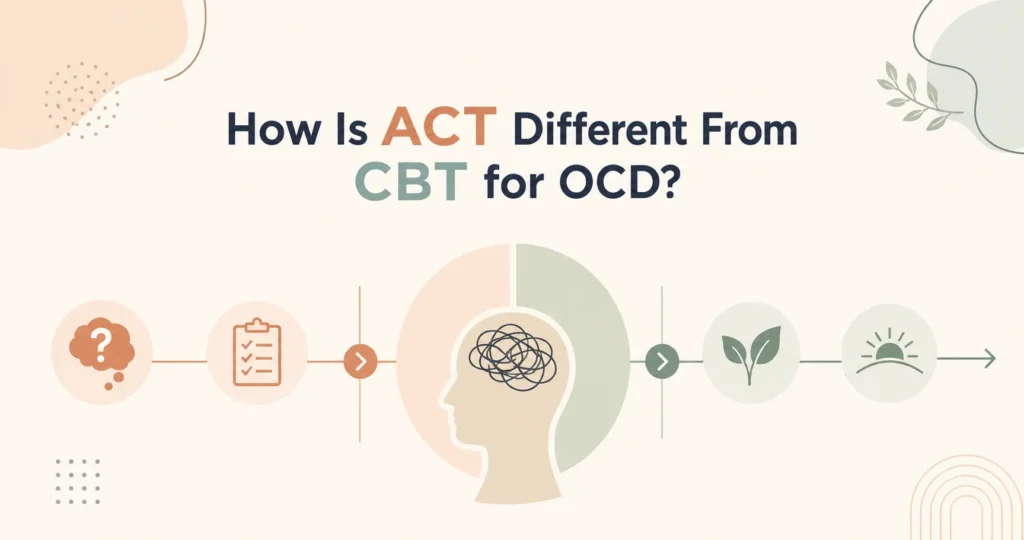
CBT for OCD, especially exposure and response prevention, focuses on facing feared situations and not doing the compulsion. ACT is a third-wave form of CBT that shifts the focus from changing the content of your thoughts to changing your relationship with them. Many therapists in Ontario blend both, depending on what you need.
You may have heard that CBT, and specifically exposure therapy and response prevention (ERP), is the first-line psychological treatment for OCD. That is true, and the International OCD Foundation lists ERP that way. ERP works by helping you face what you fear, on purpose and at a pace you can manage, while not doing the ritual that usually follows. ACT does not replace that. It comes at the same loop from a different angle: less time spent trying to prove the thought false, more time spent learning to hold it lightly and keep living. For people who feel stuck in constant mental warfare with their OCD, that shift can matter a great deal.
Is ACT Effective for OCD?
Yes. A growing body of research suggests ACT can improve OCD symptoms, psychological flexibility, and quality of life. It is best understood as a well-supported complement to exposure-based CBT, which the International OCD Foundation lists as the first-line psychological treatment for OCD.
In a randomized clinical trial of adults with OCD, Twohig and colleagues (2010) found that eight sessions of ACT produced significantly greater improvement in OCD severity than progressive relaxation training, and the gains held at three-month follow-up. A named workbook, Living Beyond OCD Using Acceptance and Commitment Therapy, developed by therapists trained in the ACT model, offers structured exercises for people who want to practise these tools at home. This is not a fringe idea. It is a researched path that many people are already walking.
What Does ACT Therapy for OCD Look Like in Practice?
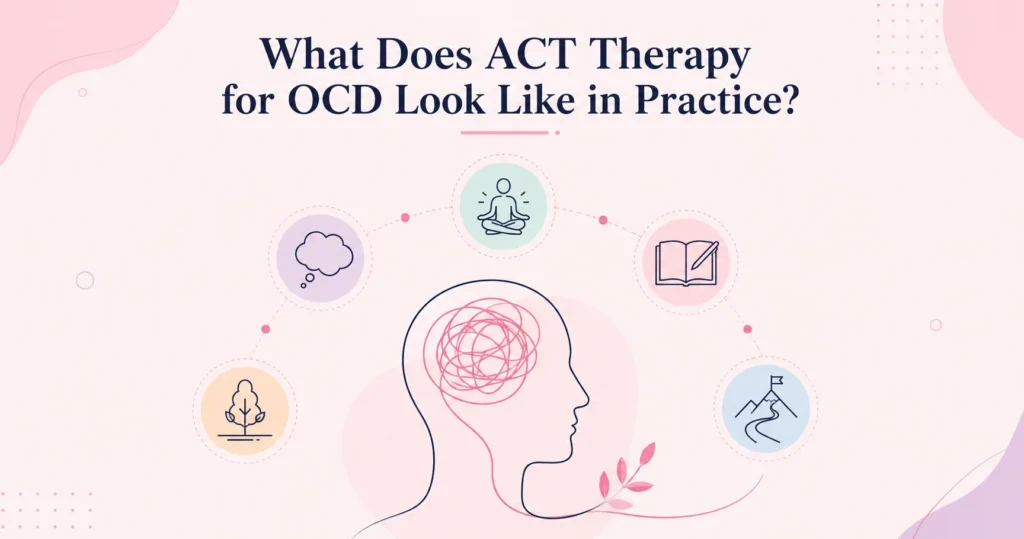
Common ACT exercises for OCD include cognitive defusion (noticing a thought as just a thought, not a command), present-moment grounding, journaling about your core values, mindful body awareness, and gradually doing activities you have been avoiding because of OCD-related fear. The work is steady and practical, and most of it you can carry into your everyday life.
Here is a simplified walk-through of how these ACT therapy exercises for OCD often unfold in session and between sessions.
Step 1: Notice the Thought as a Thought
Your therapist helps you catch an intrusive thought as it arrives and label it for what it is. Not “I am dangerous,” but “I am having the thought that I am dangerous.” That small change in wording is cognitive defusion, and it puts a little air between you and the thought.
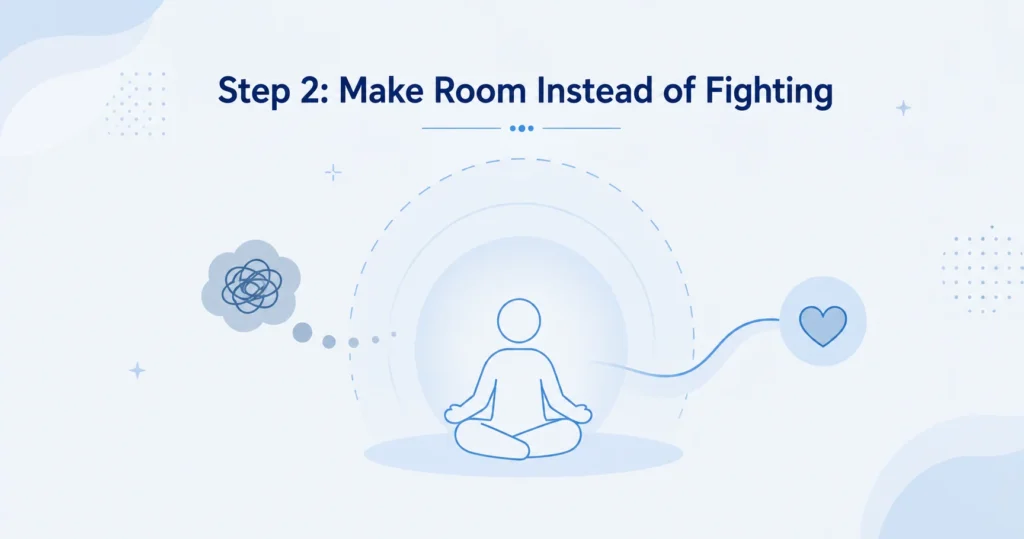
Step 2: Make Room Instead of Fighting
Next comes acceptance: letting the thought and the discomfort be there without rushing to fix, check, or neutralize. This is not giving up and it is not liking the thought. It is choosing not to spend the next hour wrestling something that gets stronger the harder you pull.
Step 3: Move Toward What You Value
Then you take one committed action toward something that matters, with the thought still present. You sit down to dinner with your family before the kitchen feels “right.” You send the message without re-reading it ten times. Over time, this practice loosens the grip that intrusive thoughts have on your behaviour, and the day stops being organized around avoiding them.
ACT for Intrusive Thoughts
Intrusive thoughts are unwanted thoughts, images, or urges that show up against your will and clash with who you are. Almost everyone has them. In OCD, they stick, and the mind treats them as threats that must be answered. ACT for intrusive thoughts works by changing the response, not the thought: you learn to let the thought pass through without performing a ritual, so it stops being treated as an emergency.
Who Can Benefit From ACT Therapy for OCD?
ACT is a flexible approach that can help across many forms of OCD, including:
- Contamination OCD: fear of germs, illness, or contamination, with washing or cleaning compulsions.
- Harm OCD: unwanted intrusive thoughts about hurting yourself or someone else, thoughts that are deeply distressing precisely because they go against your values.
- Relationship OCD (ROCD): persistent doubt and checking about a relationship or a partner.
- Scrupulosity: obsessions focused on morality, religion, or being a good person.
- Pure O: primarily obsessional OCD, where the compulsions are mostly mental and harder for others to see.
- OCD alongside anxiety, depression, or trauma, which often travel together.
The same six ACT skills stretch well beyond OCD, which is one reason the approach is so widely used. If your OCD travels with everyday worry, our guide to ACT therapy for anxiety and our deeper look at acceptance and commitment therapy for generalized anxiety disorder cover that pattern. And when the checking keeps you up at night or strains the people around you, our guide to ACT therapy for sleep, stress, and the people you love looks at those knock-on effects.
A note on harm OCD, because it carries so much shame. Having an intrusive thought about harm is not the same as wanting to cause harm, and it does not make you dangerous. These thoughts are common in OCD, and they are treatable. If they are weighing on you, you do not have to carry them in silence.
ACT is not a replacement for a proper diagnosis or a treatment plan. If you are in real distress, reaching out to a registered therapist is the right next step. Self-assessment tools can help you reflect on your experience and bring structured information to a clinician, but only a qualified clinician can diagnose.
How Common Is OCD?
OCD is more common than most people realize. The International OCD Foundation estimates that about 1 in 40 adults has OCD or will develop it at some point in their lives, and at least 1 in 100 children and teens. Whether you are in a big city or a small Ontario town, you are not the only one carrying this, and you are not carrying something rare. You can learn more about our support for OCD and how it fits into virtual care.
Accessing ACT Therapy for OCD in Ontario
Many people tell us the same thing: the hardest part is not wanting help, it is finding help they can actually reach. Waitlists stretch for months. In-person clinics are not always nearby. Knowing where to start can feel like its own obstacle. This is where online therapy in Ontario has become a real lifeline, and it is one reason people search for online ACT therapy for OCD in Ontario in the first place.
Saalvio offers OCD therapy in Ontario, delivered by registered psychotherapists and registered social workers who use evidence-based approaches, including ACT (acceptance and commitment therapy). You meet from home, on your own schedule, without the commute or the waiting room. Therapy with a Saalvio clinician is offered in Ontario today. Across the rest of Canada and North America, the Saalvio app offers self-help tools, mood tracking, and structured self-assessments you can use any time.
Before you book anything, you can message a registered psychotherapist before you book and ask whatever you need to ask: whether they have worked with OCD like yours, whether their approach fits, whether they will understand the life you come from. There is no cost and no commitment. Messaging is for questions and brief clarifications, not therapy by text, and the therapy itself happens in your booked sessions. Your first session with a Saalvio therapist is free, so deciding to try is not a financial gamble on whether the fit is right.
Online ACT Therapy for OCD in Toronto
Toronto is one of the most diverse cities in Canada, and the people living with OCD here are just as varied. If you are looking for ACT therapy for OCD in Toronto, virtual care removes the cross-city commute and the long clinic waitlist. Through Saalvio, you can connect with a registered psychotherapist or registered social worker who works with OCD and ACT-informed approaches, from wherever you are. See more about therapy in Toronto.
ACT Therapy for OCD in Ottawa and Mississauga
People in Ottawa and Mississauga often tell us that OCD-specific support is hard to find outside of hospital settings, and that local services have not kept pace with demand. Saalvio’s online OCD therapy in Ontario reaches both cities the same way it reaches everywhere else in the province: a private, structured, evidence-based session from home, no referral needed. You can explore online therapy across Ontario and start from where you are.
How Saalvio Supports You
At Saalvio, support is built to feel approachable rather than intimidating, for people first and patients second. Here is how the platform helps:
- Self-guided exercises, mood tracking, journaling, and structured self-assessments through the Saalvio mobile app, available across Canada and North America on the App Store and Google Play.
- Therapy sessions and self-assessments through the web client portal at client.saalvio.com, for clients who prefer a desktop or browser.
- Access to registered psychotherapists and registered social workers across Ontario who are trained in evidence-based approaches, including ACT, with anxiety and OCD among the experiences they work with.
- A stigma-free space where your experience is taken seriously, in the languages our clinical team speaks.
Frequently Asked Questions
Is ACT effective for OCD?
Yes. A growing body of research, including a randomized clinical trial by Twohig and colleagues (2010), suggests ACT can improve OCD symptoms, psychological flexibility, and quality of life. It is best understood as a well-supported complement to exposure and response prevention, which the International OCD Foundation lists as the first-line treatment for OCD.
What is the difference between ACT and ERP or CBT for OCD?
CBT for OCD, especially exposure and response prevention (ERP), focuses on facing fears and not doing the compulsion. ACT is a third-wave form of CBT that shifts the focus from changing the content of your thoughts to changing how you relate to them. Many Ontario therapists blend both approaches depending on what you need.
Can ACT help with intrusive thoughts and Pure O?
Yes. ACT is often a good fit for intrusive thoughts and for Pure O, the form of OCD where compulsions are mostly mental. Rather than trying to make the thought go away, ACT teaches you to notice it as just a thought and keep moving toward what you value, so the thought slowly stops being treated as an emergency.
What are the six core processes of ACT?
The six core processes of ACT are acceptance, cognitive defusion, present-moment awareness, self-as-context, values clarification, and committed action. Together they build psychological flexibility, which is the ability to act on what matters to you even while uncomfortable thoughts are present. They are the foundation of how ACT works for OCD and anxiety.
Can I get ACT therapy for OCD online in Ontario?
Yes. Saalvio offers online OCD therapy in Ontario, delivered by registered psychotherapists and registered social workers trained in evidence-based approaches, including ACT. You meet from home, with no referral needed. Therapy is offered in Ontario today; the Saalvio self-help app is available across Canada and North America.
Is ACT a replacement for diagnosis or treatment?
No. ACT is a treatment approach, not a substitute for a proper diagnosis or treatment plan, and self-help tools are not a substitute for clinical care. Only a qualified clinician can diagnose OCD. If you are in significant distress, reaching out to a registered therapist is the right next step.
A Final Word
Living with OCD can feel isolating, especially when you are not sure where to turn. ACT therapy offers something honest rather than something shiny: not a promise that the thoughts will disappear, but a path toward a life that feels worth living even when they show up. You deserve support that meets you where you are. When you are ready, you can start with the Saalvio app, or message a therapist with your questions first. We will be here.
Clinically reviewed
Usman Khan, Registered Psychotherapist
Usman Khan is the Clinical Director of Saalvio and a Registered Psychotherapist with the College of Registered Psychotherapists of Ontario (CRPO #13456). He holds an MD, an MPH from Western University, and an MA in Counselling Psychology from Yorkville University. He reviews all clinical content on saalvio.com before publish.
See also across Saalvio
Topics mentioned in this post that have their own page on the site.
Talk to our clinical team
Saalvio offers a free 30-minute consultation with any therapist on the team. There is no card on file. If we are not the right fit, we will say so and help you find one.