
Complete Guide To Anxiety: Symptoms, Causes & Treatment in Ontario
Book a Free 30-Minute Consultation
You know the 3 a.m. version of it. The chest that will not loosen. The mind that will not stop running the same loop. The quiet certainty that if you let your guard down for one second, something will go wrong. Anxiety does not always announce itself. Sometimes it just becomes the background hum of a life, and you forget it was ever quieter.
If that is you, you are not broken, and you are not alone. Anxiety is one of the most common mental health challenges Canadians face, and according to Anxiety Canada statistics, millions of our neighbours carry some version of it. It ranges from a low, nagging worry to a sudden, overwhelming panic. This guide walks through what anxiety is, what it feels like, what causes it, and the real options for help in Ontario. We will go step by step.
| Anxiety disorders affect about 20% of Canadian youth (under 25), with high rates among women. |
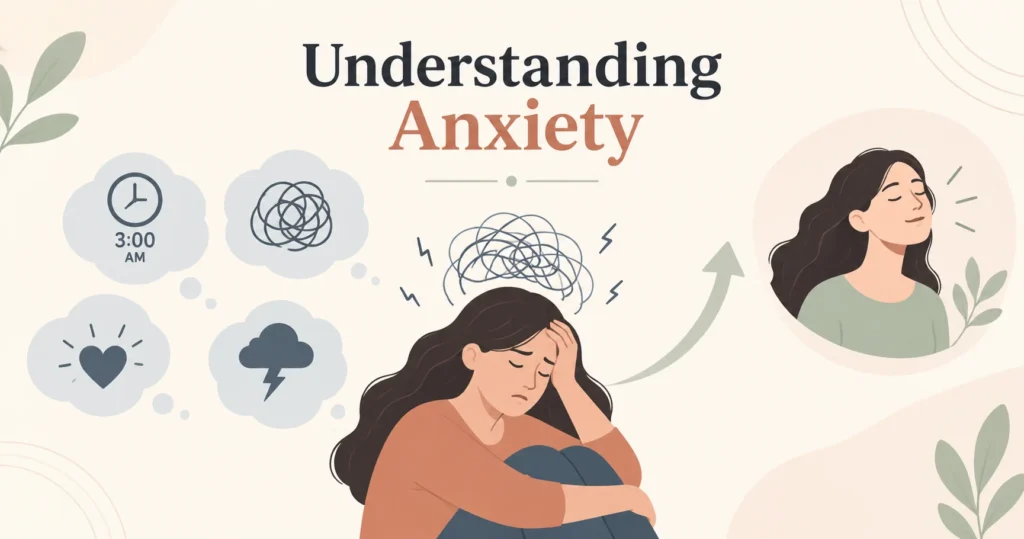
What is anxiety?
Anxiety is your body’s natural alarm response to stress or perceived danger. Occasional anxiety is normal and even protective, the “fight or flight” reflex doing its job. It becomes a disorder when the alarm gets stuck on and starts interfering with daily life, sleep, work, or relationships. Anxiety disorders are recognized, treatable mental health conditions, not a personal weakness.
So what is anxiety, in plain terms? It is a feeling of fear, worry, or unease about something uncertain. While a bit of occasional anxiety is normal, like before a job interview or a big move, it becomes a real problem when that internal alarm will not switch off and starts taking pieces of your life with it.
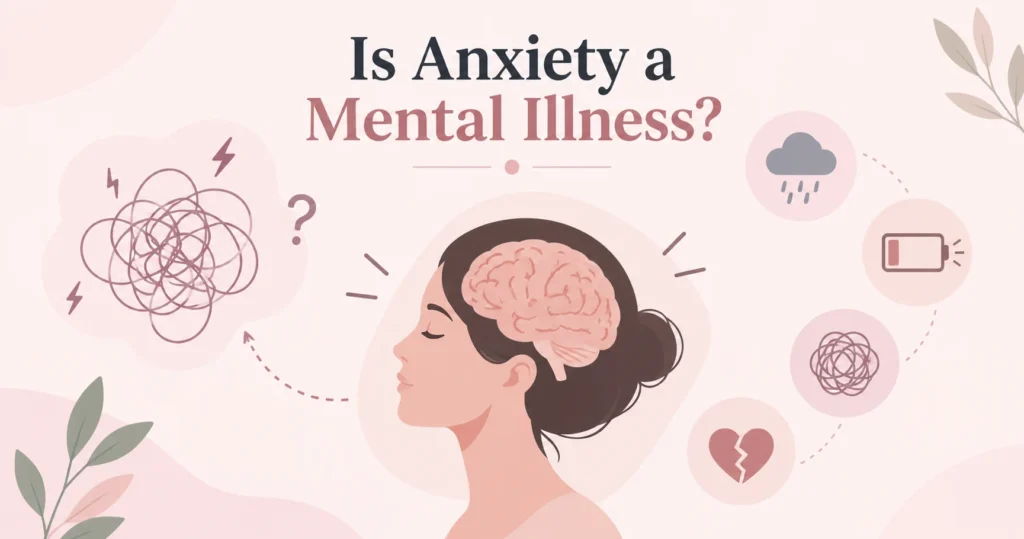
Is anxiety a mental illness?
Yes. When anxiety is persistent, out of proportion to the situation, and interfering with your daily life, it is recognized as a mental health condition, not a character flaw or something you should be able to “just get over.” The good news in that fact is simple: because it is a recognized condition, it is also a treatable one.
What does anxiety feel like?
Anxiety shows up in both the body and the mind. Common physical signs are a racing heart, a tight chest, shortness of breath, sweating, dizziness, and muscle tension. Mental signs include constant worry, racing thoughts, a sense of dread, and trouble concentrating. What does anxiety feel like day to day? Different for everyone, but rarely only “in your head.”
Many people ask us what anxiety feels like because they are trying to name something they have carried for a long time. It often shows up as:
- Constant worry or racing thoughts that you can’t seem to “catch.”
- A tight chest or that scary feeling of difficulty breathing.
- Restlessness, or just feeling constantly “on edge” for no clear reason.
- Trouble focusing on the task at hand because your mind is elsewhere.
Understanding these early signs is so important. It’s the first step in learning How to Deal with Anxiety? Before the weight of it starts to feel too heavy to carry.
Anxiety symptoms you should never ignore
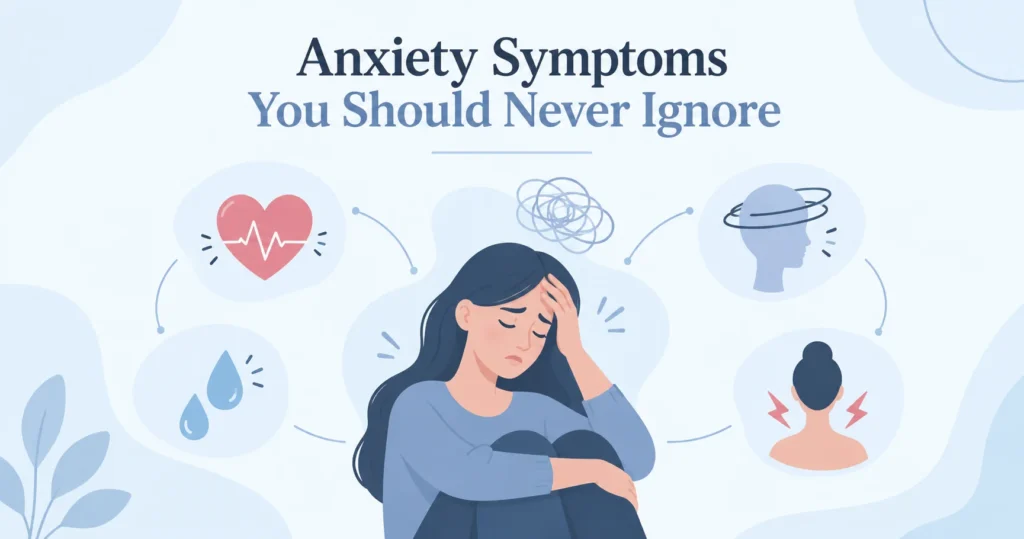
Recognizing anxiety symptoms early can make a real difference. We often brush them off as “just a bad day,” but the body is usually trying to tell you something.
Common physical symptoms
These are the physical symptoms of anxiety people most often describe:
- An increased heart rate that feels like your chest is fluttering.
- Sudden sweating or shaking, even when you aren’t cold or active.
- Dizziness or a lightheaded feeling that makes the world feel unsteady.
- Muscle tension, especially in your jaw, neck, or shoulders.
If you have ever thought of what anxiety feels like physically, this list is the short answer: anxiety lives in the body as much as the mind.
Emotional & mental symptoms
- Excessive worry about things that haven’t happened yet.
- A sense of fear without any clear, logical reason.
- Difficulty concentrating, often described as “brain fog.”
When these feelings intensify, they may be anxiety disorders signs, which can include avoidance behaviours, like skipping social plans or missing work, or even panic attacks. If you aren’t sure whether what you feel matches up, reading more about the specific symptoms of anxiety can help you find the words for your experience.
Anxiety symptoms in women
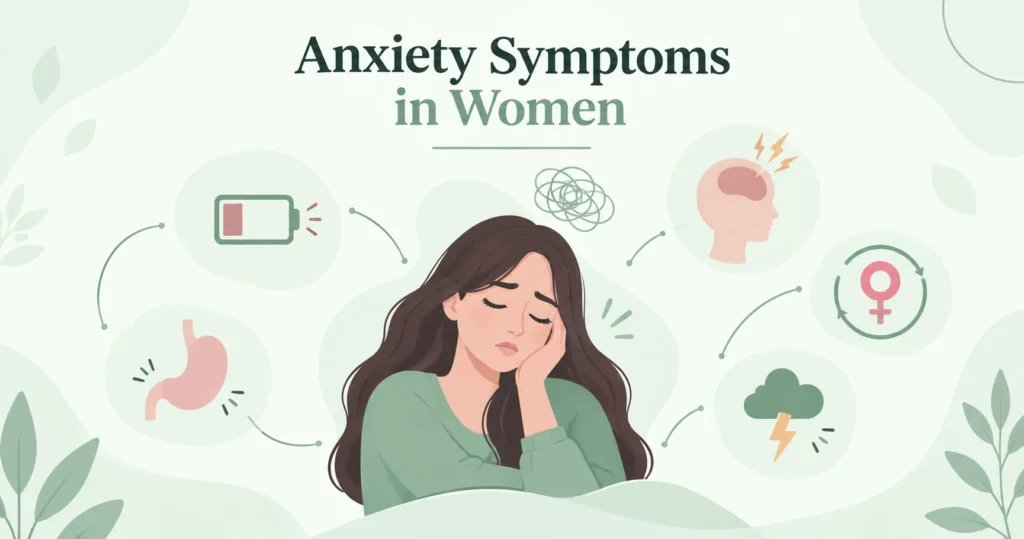
Anxiety can look a little different from person to person, and many women report symptoms that are easy to dismiss: ongoing fatigue, irritability, tension headaches, stomach trouble, and a constant sense of being “on” while managing work, caregiving, and everyone else’s needs. Hormonal shifts across the menstrual cycle, pregnancy, postpartum, and perimenopause can also affect anxiety. None of it means you are doing life wrong. It means your body is carrying a real load.
Symptoms of anxiety attack
The symptoms of an anxiety attack can feel intensely physical. They often include:
- A sudden, intense fear that something bad is about to happen.
- Chest pain that can sometimes be mistaken for a heart issue.
- Shortness of breath, like you can’t get enough air.
- A frightening feeling of being out of control.
These episodes are frightening. They are also manageable once you have the right tools.
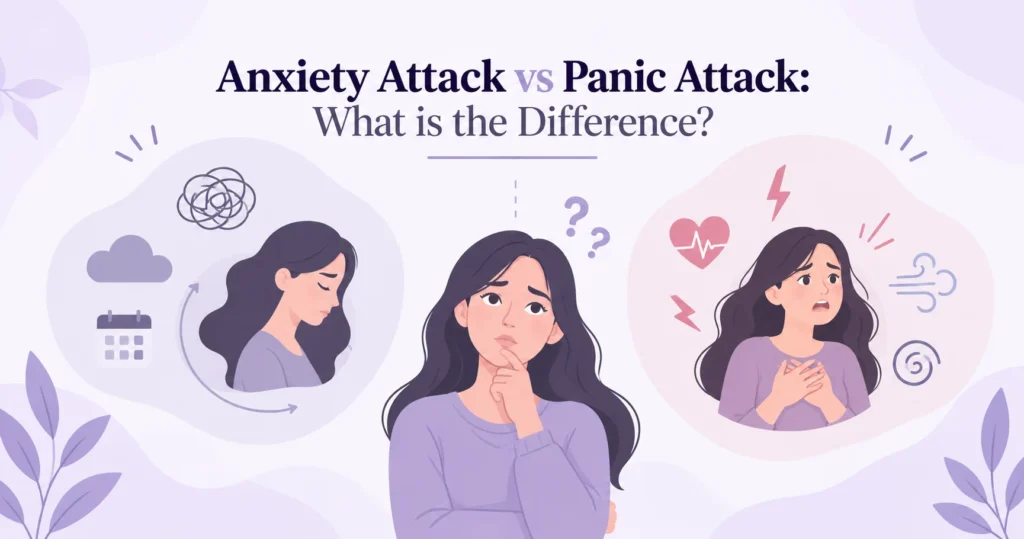
Anxiety attack vs panic attack: What is the difference?
An anxiety attack usually builds gradually and is tied to a specific stressor. A panic attack hits suddenly, often without a clear trigger, and the symptoms are more intense and physical: racing heart, shortness of breath, dizziness, and a fear of losing control. Both pass, and both are manageable. Knowing which one you are having helps you respond.
That is the heart of the anxiety attack vs panic attack question. Anxiety attacks simmer, often linked to money worries or a relationship strain, and build before they peak. Panic attacks arrive like a lightning bolt, sometimes out of nowhere. Understanding anxiety vs panic attack helps you reach for the right technique, which takes some of the fear out of the moment itself.
What to do during a panic attack
In the moment, you are not in danger even though your body insists you are. A few things help: slow your breathing (in for 4, out for 6 or 8), name five things you can see and four you can touch to pull yourself back into the room, and remind yourself that a panic attack always peaks and passes, usually within minutes. You do not have to fight it. You have to ride it out.
The scale of the struggle: Canadian statistics
According to the Centre for Addiction and Mental Health (CAMH), 1 in 5 Canadians experience a mental illness or substance use issue in any given year, and in Ontario the disease burden of mental illness and addiction is 1.5 times higher than all cancers put together. If you are struggling, you are part of a very large community of people looking for the same answers.
Types of anxiety disorders
Anxiety is an umbrella term covering several different experiences:
- Generalized Anxiety Disorder (GAD). Generalized anxiety disorder is a persistent, “free-floating” worry about everyday things. It is the feeling of waiting for the other shoe to drop, even when life is going well.
- Social Anxiety and Social Phobia. Social anxiety makes ordinary interactions feel like an interrogation. Social anxiety disorder is the more intense, long-term version, while social phobia anxiety often leads people to avoid public situations entirely because the fear of being judged is too loud.
- Separation Anxiety. We think of separation anxiety as a child’s first day of school, but it affects adults too, especially during big transitions or in close relationships.
- Performance Anxiety. This is the “stage fright” that arrives before a presentation, an exam, or a major life event.
Anxiety vs Stress: Are they the same thing?
Not quite. Stress is a response to a specific pressure, a deadline, a bill, a hard week, and it usually eases once the pressure lifts. Anxiety can linger after the trigger is gone, or show up with no clear trigger at all. Anxiety vs stress is really a question of duration and proportion: stress fades, anxiety tends to stay and to spread.
High functioning anxiety
High functioning anxiety is not an official diagnosis, but it describes something real: people who look successful, organised, and dependable on the outside while running on worry underneath. They hit deadlines, answer every message, and rarely say no, partly because slowing down feels dangerous. If you are praised for how much you handle and exhausted by how much you handle, this may be familiar. It still counts. You do not have to be falling apart to deserve support.
What causes anxiety?
It is rarely one thing. Anxiety usually comes from a mix:
- Stressful life events: a breakup, a job loss, or even the general grind of life in a city like Toronto.
- Genetics: if anxiety runs in your family, you may be more prone to it.
- Brain chemistry: the systems that manage mood can fall out of balance.
Medical conditions: physical and mental health are closely linked. Some health conditions and medications can bring anxiety-like symptoms, so if you are worried something physical is affecting how you feel, talk it over with your family doctor. Saalvio offers talk therapy, not medical assessment or diagnosis, so a doctor is the right person to check the physical side.
If you are curious about the deeper “why,” exploring what causes anxiety can be an eye-opening part of understanding yourself.
Can blood pressure cause anxiety?
Physical health and anxiety are linked, and changes in the body, including blood pressure, can come with anxiety symptoms. If you have physical signs like a racing heart or chest tightness, see a doctor first to rule out a physical cause, then address the anxiety itself. The two often travel together, so caring for one usually helps the other.
Anxiety management: Practical ways to cope
Learning how to navigate these feelings is a skill, and like any skill, it takes practice. Often, using a digital mental health platform can provide the structure you need to make these habits stick. Here are some proven anxiety management techniques:
- Breathing exercises. One of the fastest ways to settle your nervous system. Try the 4-7-8 method: breathe in for 4, hold for 7, exhale slowly for 8. Breathing exercises for anxiety work because they tell your body the danger has passed.
- Stay active. You don’t have to run a marathon. A 20-minute walk releases tension the body is holding.
- Build a routine. Anxiety loves uncertainty. A simple daily rhythm gives your brain a sense of safety.
- Limit triggers. Too much caffeine or scrolling bad news at midnight does not help. Set a few gentle boundaries for yourself.
If you are wondering how you cope with anxiety day to day, these small habits are the foundation of feeling better.
How to calm anxiety instantly
To calm anxiety quickly, slow your breathing (in for 4, out for 6 or 8), try 5-4-3-2-1 grounding (name what you can see, hear, touch, smell, and taste), or splash cold water on your face. These steps calm the nervous system fast. For lasting change, therapy works on the patterns underneath. This is also the short answer to how to stop anxiety from spiralling in the moment.
When the walls feel like they are closing in, here is how to calm anxiety right where you are:
- Grounding (5-4-3-2-1). Name 5 things you see, 4 you can touch, 3 you can hear, 2 you can smell, 1 you can taste. This pulls your brain out of the future and back into the room.
- Cold water. Splash cold water on your face. It triggers a reflex that slows your heart rate.
- Step away. If a situation is overwhelming, give yourself permission to walk away for five minutes.
These are also reliable tips for anxiety attacks and how to stop them before they spiral.
Anxiety test: How to know if you need help
If anxiety is louder than you want for more than a few weeks, is changing your behaviour (avoiding things, broken sleep, constant checking), or is affecting work and relationships, that is a reasonable time to talk to someone. You do not need to be in crisis to benefit from support. This is the honest version of an anxiety test, and it is how to know if you have anxiety that has outgrown everyday worry.
Ask yourself:
- Do I feel anxious or worried most days of the week?
- Is my sleep suffering because I can’t turn off my brain?
- Does my anxiety stop me from doing things I used to love?
If you answered yes, it is not a sign of weakness. It is a sign you might need some extra support. According to the Mental Health Commission of Canada, early intervention is one of the most effective ways to support long-term recovery.
Anxiety treatment options in Ontario
You do not have to white-knuckle this alone. There are real anxiety treatment options, and anxiety help in Ontario is more accessible than it has ever been.
Anxiety therapy is about more than “talking.” It is about understanding your triggers and building a toolkit of coping strategies that actually fit your life.
- Cognitive Behavioural Therapy (CBT). CBT is a leading, well-researched treatment for anxiety. It focuses on the link between thoughts, feelings, and actions, helping you change the loops that keep worry going.
- Medication. For some people, medication is a helpful bridge that makes therapy more effective. This is always a conversation with a physician.
If you are looking for anxiety treatment in Ontario specifically, both publicly funded programs and private virtual care are available, and you can start without a referral.
Therapy for anxiety: When to seek help
Consider therapy for anxiety if self-help is not quite enough anymore, or if you are having frequent panic attacks. Professional support gives you a structure that is hard to build on your own, and you do not have to wait until things are unbearable to ask for it.
Living with Anxiety in Canada
In anxiety Canada conversations, we are getting better at this. We are moving away from stigma and toward real solutions. Ontario offers a range of services:
- Local community counselling centres.
- Mental health programs through your workplace or school.
- Digital platforms that bring the therapist to you.
- Getting help is easier than it has ever been, especially with the rise of virtual care.
Saalvio: Your partner in anxiety recovery
No one in Ontario should have to face anxiety alone. Saalvio helps people across the province access support from the comfort of their own homes. Whether you are looking for online therapy in Toronto or you need virtual counselling in Barrie, our platform is available 24/7 and our clinical team of registered psychotherapists and registered social workers is here when you are ready.
Through online therapy in Ontario, we connect you with registered psychotherapists and registered social workers who truly get it. With Saalvio, you can:
- Book sessions easily from your phone or laptop.
- Get personalized support that fits your actual life.
- Access quality care whether you are in a big city or a small town.
Not ready to book? You can message any of our therapists with your questions first. There is no cost, no commitment, and no awkward sales call, just a conversation about whether the fit is right. And every Canadian’s first therapy session with a Saalvio clinician is free, so the decision to start is never a financial gamble.
Start Where You Are
If you are looking for a natural remedy for anxiety? or structured support, we will meet you where you are. Try therapy for anxiety with Saalvio’s digital therapy Ontario.
- Private, secure, and compassionate.
- Available across Ontario.
- Designed for real people, in real life.
For a full breakdown of what sessions cost, what insurance covers, and how to submit a receipt, see our resource on how much therapy costs in Ontario and our insurance reimbursement guide.
| Good News: Before you commit to anything, you can book a free 30-minute consultation to meet a clinician, share what brought you here, and ask any questions you have. |
Beyond therapy: Saalvio’s digital toolkit
Anxiety does not only happen during a therapy session. It happens in the grocery aisle, on a late-night shift, or while you are trying to fall asleep. That is why the Saalvio app offers self-help tools that live in your pocket, ready when you are. (The full self-help library lives on the Saalvio mobile therapy app.)
- Mood Tracker. Log how you are feeling throughout the day. Maybe a dip at 4 p.m., a spike at 8 p.m. Over time, the Daily Mood Chart helps you see patterns and, with your permission, share them with your therapist to find your triggers and notice the days you feel more like yourself.
- Anger Diary. Anxiety can show up as restless, frustrated energy. The Anger Diary is a private space to put those heavy feelings into words, notice what sets them off, and build a calmer response.
- Science-backed self-help tools. Whether you need a quick grounding activity or an anxiety check-in, these are built for daily use. The Saalvio app also includes:
- Thrive AI: an AI companion for the moments between sessions. Thrive is not a clinician and not therapy, and it is not a crisis service.
- Talk to Experts: connect with a member of our clinical team when you want a professional perspective.
- Goal-setting templates: small steps, one at a time.
- Mental health podcasts: guided exercises and honest conversations about burnout and healing.
These app tools are available any time, so you can practise anxiety management at your own pace. The app is available across Canada and North America; therapy with a Saalvio clinician is offered in Ontario.
Frequently Asked Questions
What is anxiety and how does it feel?
Anxiety is a persistent feeling of worry or fear about something uncertain. It often shows up as a racing heart, a mind that won’t slow down, tight chest, and a physical sense of restlessness. It lives in the body as much as the mind, and it feels different for everyone.
Is anxiety a mental illness?
When anxiety is persistent, out of proportion to the situation, and interferes with daily life, sleep, work, or relationships, it is recognised as a mental health condition. That is not a weakness or a character flaw. It also means it is treatable, with therapy, sometimes medication, and practical coping skills.
How do you cope with anxiety?
Good day-to-day coping includes slow breathing, regular movement, a steady routine, limiting caffeine and late-night doomscrolling, and grounding techniques in hard moments. These help many people. When self-help is not enough, working with a registered therapist through anxiety therapy adds structure and support you cannot easily build alone.
What are the symptoms of an anxiety attack?
The symptoms of an anxiety attack often include chest tightness, a racing heart, shortness of breath, and a sudden sense of overwhelming dread. They can feel intensely physical, and chest pain is sometimes mistaken for a heart problem. They are frightening but manageable, and they pass.
How to calm anxiety quickly?
Slow your breathing (in for 4, out for 6 or 8), use 5-4-3-2-1 grounding, or splash cold water on your face to settle your nervous system fast. Stepping away from an overwhelming situation for five minutes also helps. For lasting change, therapy works on the patterns underneath the moments.
What is the difference between an anxiety attack and a panic attack?
An anxiety attack usually builds gradually and is tied to a stressor. A panic attack hits suddenly, often without a clear trigger, with more intense physical symptoms like a racing heart, shortness of breath, and a fear of losing control. Both pass, and both are manageable.
Can blood pressure cause anxiety?
Physical health and anxiety are linked, and changes in the body, including blood pressure, can come with anxiety symptoms. If you have physical signs like a racing heart or chest tightness, see a doctor first to rule out a physical cause, then address the anxiety. Caring for one often helps the other.
When should I seek anxiety treatment?
If your worries are starting to control your life, your sleep, or your relationships, or if self-help is not enough after a few weeks, it is a good time to ask for support. You do not need to be in crisis to benefit. Anxiety treatment in Ontario is available without a referral.
Final Thoughts
Understanding your anxiety is the first step toward getting your life back. From noticing the early symptoms to exploring your treatment options, every small step counts.
Whether you are carrying a little extra stress or living with severe panic, support is available right here in Ontario, and you do not have to reach for it perfectly. You can reach for it tired, unsure, and one step at a time. We will be here.
Clinically reviewed
Usman Khan, Registered Psychotherapist
Usman Khan is the Clinical Director of Saalvio and a Registered Psychotherapist with the College of Registered Psychotherapists of Ontario (CRPO #13456). He holds an MD, an MPH from Western University, and an MA in Counselling Psychology from Yorkville University. He reviews all clinical content on saalvio.com before publish.
See also across Saalvio
Topics mentioned in this post that have their own page on the site.
Talk to our clinical team
Saalvio offers a free 30-minute consultation with any therapist on the team. There is no card on file. If we are not the right fit, we will say so and help you find one.