
REBT for Irrational Beliefs and Negative Thinking: A Complete Guide
Have you ever felt like your own mind is working against you? It is a heavy thing to carry. Maybe you replay a short conversation for hours, certain you got it wrong. Maybe you wait for the bad news you are sure is coming. Maybe there is a flat, unkind voice in your head that has been with you so long you stopped noticing it was there.
If any of that sounds familiar, you are not alone, and you are not broken. There is a way to make sense of the thoughts that weigh you down, and to loosen their grip slowly, at your own pace. This guide explains what REBT for irrational beliefs is, what those beliefs are, how REBT helps with negative thinking, and how to find this kind of support in Ontario. We will go in plain language, one step at a time.

What Is Rational Emotive Behaviour Therapy?
REBT, or rational emotive behaviour therapy, is a structured talk therapy that helps you spot the harsh, unrealistic thoughts behind painful feelings, question whether they are true, and replace them with more balanced ones. It looks at how your beliefs shape your emotions, and how changing that inner dialogue can change how you feel day to day.
Rational emotive behavior therapy was one of the first approaches built on a simple idea: it is rarely the event itself that hurts most, but the belief we hold about it. Two people can lose the same job. One thinks, this is hard and I will get through it. The other thinks, I am a failure and always will be. Same event, very different pain. REBT is sometimes called irrational beliefs therapy because its main work is gently challenging those loud, unfair thoughts that are not actually true.
What Are Irrational Beliefs in REBT?
Irrational beliefs are extreme, all-or-nothing thoughts that are unrealistic and unfairly self-critical. In REBT they usually show up as rigid musts and shoulds, such as I must be perfect, everyone must like me, or if I fail once I am worthless. REBT helps you trade these for fairer, more realistic thoughts that match what is actually happening.
All-or-nothing thinking, sometimes called black-and-white thinking, is the habit of seeing things as total success or total failure, with nothing in between. It is one of the most common irrational thinking patterns, and it leaves no room to be a human being who is simply doing their best.
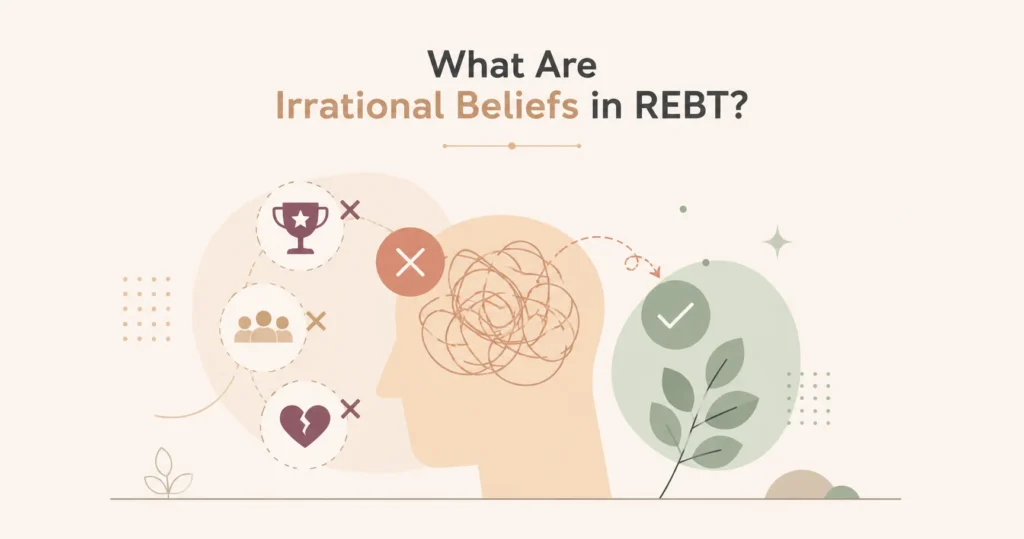
Common Examples of Irrational Beliefs in REBT
Here are common examples of irrational beliefs in REBT, and the more balanced thought that can sit beside each one:
- The must. “I must do this perfectly or it does not count.” A fairer thought: “Doing my best is enough, and most things do not need to be perfect.”
- The should. “Everyone should approve of me.” A fairer thought: “I would like people to approve of me, but I can be okay even when some do not.”
- Catastrophizing. “If this goes wrong, it will be the end of everything.” A fairer thought: “This would be hard, and I have gotten through hard things before.”
- Self-condemnation. “If I fail at one thing, I am worthless.” A fairer thought: “Failing at something does not make me a failure as a person.”
These patterns might look like small habits. They are not small. They stack up over years, and they shape how you show up for yourself and for the people you love.
What Are Self-Defeating Beliefs?
Self-defeating beliefs are the quiet stories we tell ourselves that hold us back from the life we want. Common self-defeating beliefs examples include “I always mess things up,” “there is no point in trying,” and “people like me do not get better.” They feel like facts. They are not facts. They are old thoughts that have been repeated so often they started to sound true.

How Negative Thinking Patterns Affect Your Mental Health
When harsh beliefs play on a loop, they harden into negative thinking patterns therapy is designed to unravel. You might notice yourself overthinking every choice, feeling worn out by the middle of the day, pulling back from things you used to enjoy, or quietly losing trust in yourself.
These patterns do not stay only in your head. The Canadian Mental Health Association reports that, in any given year, 1 in 5 people in Canada will personally experience a mental health problem or illness, with anxiety disorders affecting about 4.6 percent of the population and major depression about 5.4 percent. Negative thinking is not the whole story behind these numbers, but it is one of the threads, and it is a thread that can be worked with.
The good news worth holding onto is that these patterns are learned, which means they are not permanent.
How Does REBT Help with Negative Thinking?
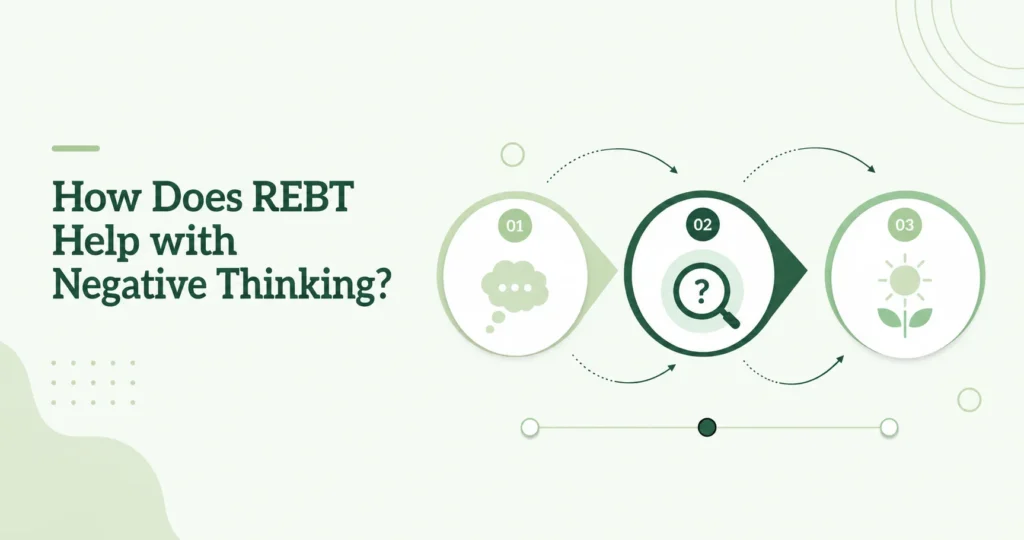
REBT works in three steps. First you notice the thought you are actually telling yourself when things get hard. Then you challenge it by asking whether it is true, or just a fear-based guess. Then you replace it with a thought that is realistic and kinder. This process is called cognitive restructuring, which simply means looking at a thought and checking how true and how helpful it really is.
These are the cognitive restructuring techniques at the heart of REBT, and they are also a practical answer to how to challenge irrational thoughts in your own daily life. If you want the specific tools laid out, our guide to REBT techniques walks through each one:
- Identify the thought. Catch what you are saying to yourself in the moment. Anxious and self-critical thoughts are fast and feel like facts, so naming them out loud or on paper is the first real foothold.
- Challenge the belief. Ask plain questions. Is this completely true? What would I say to a friend who said this about themselves? What is the most realistic outcome here?
- Replace it with a balanced thought. Trade the harsh thought for one that is both honest and fair. Not fake cheer, just a truer sentence you can actually believe.
You do not have to do these steps perfectly, and you do not have to do them alone. A trained therapist helps you spot the patterns you are too close to see, which is often the part that is hardest to do by yourself. The steadiest change tends to come from doing this a little each day, which is why the daily practice benefits of REBT are worth a read once the basics feel familiar.
REBT in Real Life: What Does It Feel Like?
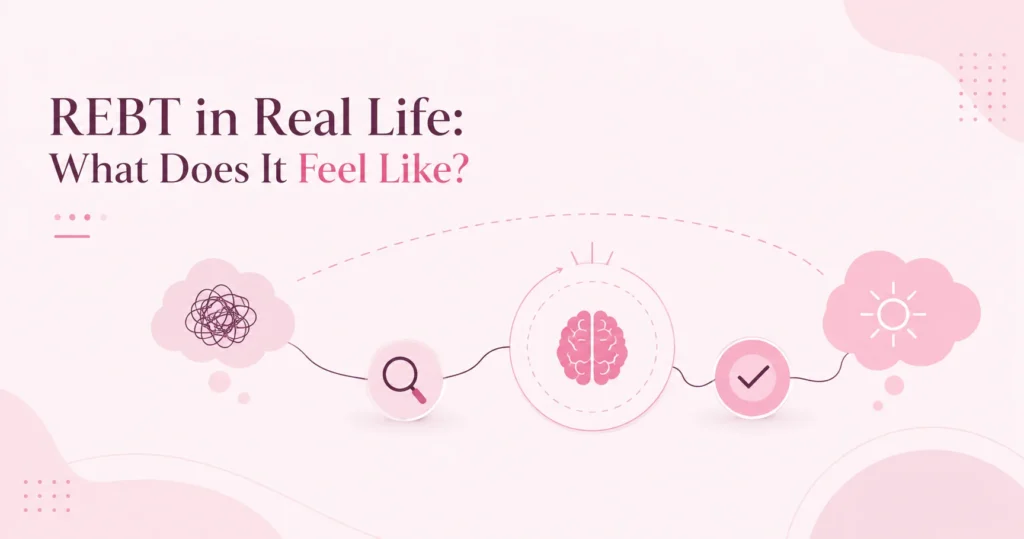
Picture yourself at your kitchen table, logged into a session for online therapy in Ontario, maybe with a cup of tea going cold beside you. Instead of only venting about a rough week, your therapist helps you slow down and pull one automatic thought apart, then set a steadier one in its place.
Maybe you are at home in Waterloo, and you realize partway through that your stress is not really coming from your inbox. It is coming from the impossible standard you have been holding yourself to for years. Maybe you are in Barrie, noticing for the first time how often the word “should” runs through your day. That quiet moment of recognition is REBT doing its work.
Why REBT Is Used for Anxiety and Depression
REBT is widely used for anxiety and low mood because it works on the thought patterns that keep distress going, rather than only on the surface feeling. It is often applied to anxiety and panic, depression and low mood, ongoing stress, and struggles with self-esteem.
If you are curious how it fits with related approaches, it can help to look at the difference between CBT and REBT, which the next section covers.
What Is the Difference Between CBT and REBT?
REBT is part of the cognitive behavioural family and shares its core idea, that thoughts shape feelings. REBT puts extra focus on the rigid musts and shoulds underneath distress, and on accepting yourself without conditions. CBT, or cognitive behavioural therapy, covers a wider set of techniques. Many therapists blend both. If you want the two set side by side, we cover the difference between CBT and REBT in plain terms.
In practice, the line between rebt vs cbt is softer than it looks. REBT helped lay the groundwork for modern CBT, and a lot of what they teach overlaps: notice the thought, test it, choose a steadier response, practise between sessions. If you want to understand the broader family, our CBT page walks through how cognitive behavioural therapy works and who it tends to fit.
Is REBT Effective for Anxiety and Depression?
REBT has good support as a way to ease anxiety and low mood, because it works on the thought patterns that keep distress going. It is not a guaranteed cure, and results vary from person to person. For many people, regular practice of its techniques leads to steadier, calmer thinking over time, especially when the work is consistent.
Honesty matters here more than a sales pitch. No therapy works the same way for everyone, and no honest clinician will promise that it will. What REBT offers is a clear, repeatable method, and a method you can repeat is one you can lean on when the harder days come.
Natural Ways to Support REBT Therapy
Therapy is a big part of the picture, but small daily habits help the work hold between sessions:
- Journaling. Get the thoughts out of your head and onto paper, where you can finally see them for what they are.
- Mindfulness. Practise staying in the present instead of drifting into the “what ifs” of tomorrow.
- Breathing. Slow your breath to settle your nervous system, so your thinking mind has room to work.
You can also lean on trusted Canadian resources. The Canadian Mental Health Association offers free, plain-language information and evidence-based self-help for managing anxiety and low mood, and the Centre for Addiction and Mental Health provides clear guides on common mental health concerns and the talk therapies used to address them.
How to Find an REBT Therapist in Ontario
If you have been searching for an REBT therapist in Ontario, you have plenty of company. Across the province, from Toronto to Ottawa and the smaller towns in between, more people are choosing flexible online sessions, virtual counselling that fits a real schedule, and app-based tools to keep the practice going between appointments. If you are not sure where to begin, our guide on how to find a therapist can help you take the first step.
How Saalvio Supports Your REBT Work
Saalvio offers online REBT therapy in Ontario, delivered by registered psychotherapists and registered social workers. Our clinical team uses evidence-based approaches, including the cognitive restructuring at the heart of REBT, to help you notice harsh thoughts, question them, and build fairer ones. REBT therapy in Ontario through Saalvio meets you where you actually are, in the room where you feel safe, by video.
Before you book anything, you can message a registered psychotherapist before you book and ask whatever you need to ask: whether their approach fits what you are going through, whether they have worked with someone like you, whether they will understand the life you come from. There is no cost and no commitment, and it is not therapy by text. It is simply a conversation, so you can feel safe choosing. Every Canadian’s first therapy session with a Saalvio clinician is free, so deciding to try therapy is not a financial gamble on whether the fit will be right.
Across the rest of Canada and North America, the Saalvio app offers self-help tools you can use any time, including cognitive exercises, journaling, and mood tracking to help you notice and reshape your thinking on your own schedule. The app also includes Thrive, the in-app AI companion, which can listen and prompt gentle reflection when no one else is awake. The app is built for self-help and is not a replacement for therapy. Therapy with a Saalvio clinician is offered in Ontario today.
A note for parents and caregivers: Saalvio’s therapy is for adults in Ontario. If you are looking for support for a child or teen, your family doctor or your child’s school can connect you with clinicians who specialize in young people. Kids Help Phone is also there any time at 1-800-668-6868, or by texting CONNECT to 686868.
Frequently Asked Questions
What are irrational beliefs in REBT?
Irrational beliefs are extreme, all-or-nothing thoughts that are unrealistic and unfairly self-critical. In REBT they usually appear as rigid musts and shoulds, such as I must be perfect or everyone must like me. REBT helps you notice them and trade them for fairer, more realistic thoughts that match what is actually happening.
How does REBT help with negative thinking?
REBT uses cognitive restructuring, a three-step process. You notice the thought you are telling yourself, challenge it by asking whether it is true or just a fear-based guess, then replace it with a balanced, kinder thought. Over time this helps you respond to life’s ups and downs in a steadier way.
What are examples of irrational beliefs?
Common examples include the must (“I must be perfect”), the should (“everyone should approve of me”), catastrophizing (“if this goes wrong it ends everything”), and self-condemnation (“if I fail once, I am worthless”). These also overlap with self-defeating beliefs, the quiet stories that hold us back from the life we want.
What is the difference between CBT and REBT?
REBT is part of the cognitive behavioural family and shares its core idea, that thoughts shape feelings. REBT puts extra focus on rigid musts and shoulds, and on accepting yourself without conditions. CBT covers a wider set of techniques, and many therapists blend both. To learn more, see our CBT page.
Can REBT help with anxiety and depression?
REBT is widely used to support people with anxiety and low mood, because it works on the thought patterns that keep distress going. It is not a guaranteed cure, and results vary from person to person. For many people, regular practice of its techniques is associated with steadier, calmer thinking over time.
How do I find an REBT therapist in Ontario?
You can search Ontario-based therapy directories, ask your family doctor for a referral, or use a platform like Saalvio to access online REBT therapy across Ontario. Before you book, you can message a registered psychotherapist with your questions, and every Canadian’s first session with a Saalvio clinician is free.
Final Thoughts
The way you talk to yourself when no one is listening matters more than it seems. The thought after a mistake, the belief you carry into a hard day, the quiet “should” that follows you around, they all add up. REBT for irrational beliefs gives you a way to take some of that weight back, gently and at your own pace.
You do not have to do this perfectly, and you do not have to do it alone. You can reach for help tired and unsure. We will be here.
Clinically reviewed
Usman Khan, Registered Psychotherapist
Usman Khan is the Clinical Director of Saalvio and a Registered Psychotherapist with the College of Registered Psychotherapists of Ontario (CRPO #13456). He holds an MD, an MPH from Western University, and an MA in Counselling Psychology from Yorkville University. He reviews all clinical content on saalvio.com before publish.
See also across Saalvio
Topics mentioned in this post that have their own page on the site.
Talk to our clinical team
Saalvio offers a free 30-minute consultation with any therapist on the team. There is no card on file. If we are not the right fit, we will say so and help you find one.