
What is ERP therapy?
Book a Free 30-Minute Consultation
If OCD has been running your mornings, your commute, or the last thing you check before you leave the house, you have probably already tried to reason your way out of it. Reasoning rarely works on its own, because OCD does not usually respond to logic. It responds to a different kind of practice, one built around facing the fear directly instead of arguing with it.
ERP therapy stands for exposure and response prevention, a structured, evidence-based form of CBT (cognitive behavioural therapy) used mainly to treat OCD (obsessive-compulsive disorder). A therapist helps you face a feared thought or situation on purpose, then supports you in resisting the urge to perform the usual ritual, so the fear has room to fade on its own.
If you are ready to book a therapy session in Canada, this approach can help you start working on the cycle with professional support.

What does ERP therapy stand for?
Each letter describes a step. Exposure means facing a thought, image, or situation that triggers anxiety, on purpose and with support. Response prevention means choosing not to perform the ritual or checking behaviour that usually follows. Put together, the two steps teach the nervous system that the feared outcome does not need a ritual attached to it in order to pass.
What is ERP therapy, exactly?
A simple ERP therapy definition is this: it is a specific type of CBT that pairs planned exposure with the practice of resisting compulsions. The ERP therapy meaning becomes clearer with an example. Someone who fears contamination might be asked to touch a doorknob and then wait, without washing their hands right away, while a therapist stays with them through the anxiety.
According to the Centre for Addiction and Mental Health, this approach is usually combined with cognitive strategies that help a person notice and adjust the thoughts that keep the cycle going.
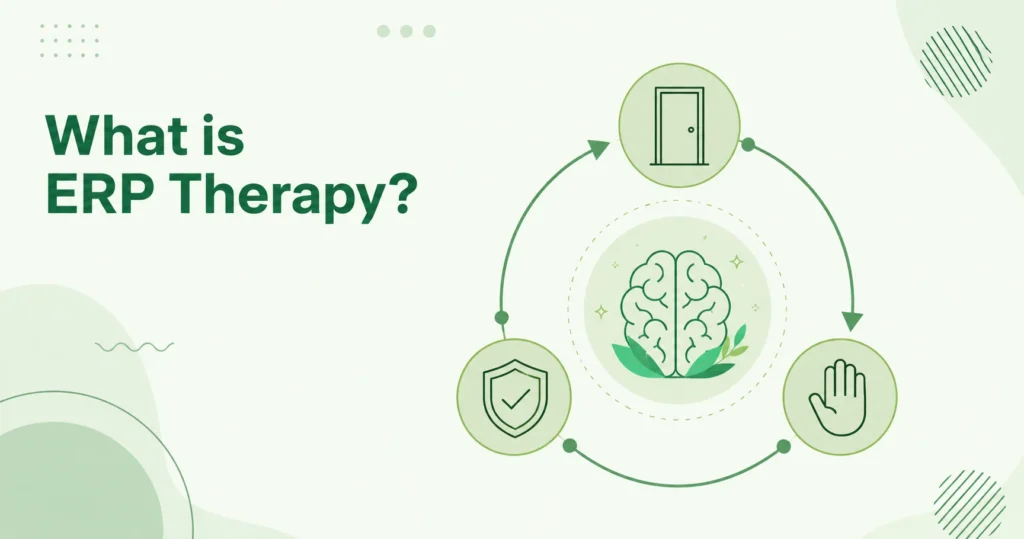
What is ERP therapy in OCD?
OCD involves two connected parts: obsessions, which are intrusive and unwanted thoughts, and compulsions, the rituals a person performs to relieve the distress those thoughts cause. According to CAMH, OCD affects roughly one adult in forty. The cycle works like this: an obsession causes distress, a compulsion briefly reduces the distress, and that relief teaches the brain to repeat the compulsion next time. ERP interrupts the cycle by keeping the exposure and removing the compulsion, so the anxiety is allowed to rise and fall on its own, without a ritual attached.
Many people find the fear loses some of its grip with repeated practice, not because the thought disappears, but because it stops requiring a response every time it shows up.
If you recognize this pattern, the checking, the washing, the mental reviewing, the reassurance you keep asking for, that recognition is worth bringing to a clinician. It is not a diagnosis, and only a qualified clinician can determine what you are experiencing. Self-recognition is simply the starting point, the thing you bring into the room, not the answer itself.
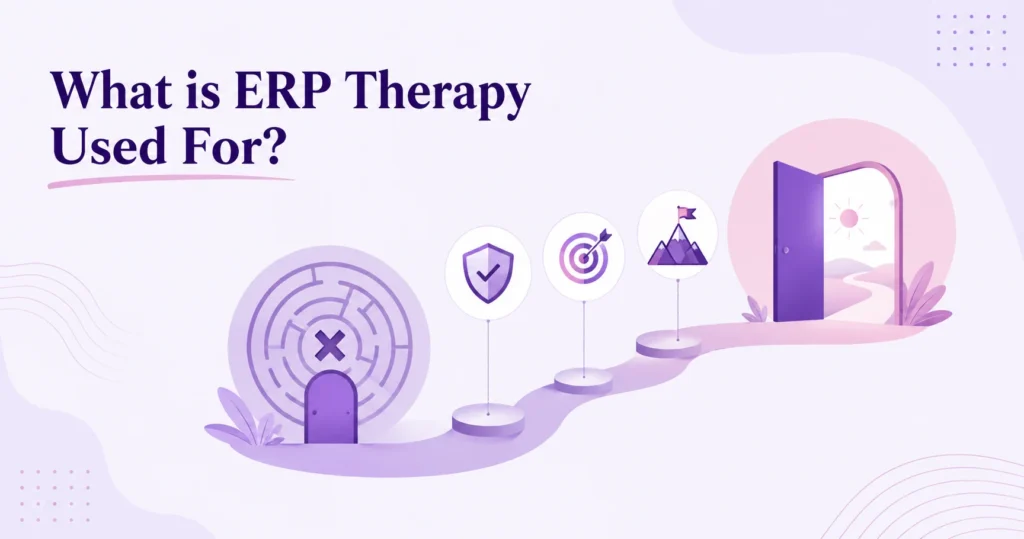
What is ERP therapy used for?
ERP was developed specifically for OCD and remains most closely associated with it, but many clinicians also draw on the same exposure principles for related anxiety patterns, including specific phobias and some forms of health anxiety, where avoidance and reassurance seeking play a similar role. What connects these presentations is a pattern of avoidance that keeps the anxiety intact, even though avoiding the feared thing feels like relief in the moment.
If you are exploring therapy for anxiety more broadly, ask your therapist directly whether exposure-based work fits what you are experiencing. Not every anxiety presentation calls for it, and a therapist trained in CBT can help you figure out what does, and whether a different evidence-based approach might serve you better.
What does an ERP therapy session actually look like?
Sessions usually start with building a list of feared situations, ranked from mildly uncomfortable to very difficult, sometimes called a hierarchy. Early sessions tend to start near the bottom of that list, so the work feels manageable rather than overwhelming, and the pace is set together, not imposed.
Within a session, the therapist typically stays with you while you sit with an exposure, tracking how the anxiety rises, peaks, and then starts to fall on its own once the compulsion is withheld. That waiting, uncomfortable as it is, is the part doing the work. Over repeated sessions, the same exposure that once felt unbearable usually starts to feel more ordinary, and the hierarchy moves upward. Between sessions, a therapist may ask you to practice specific exposures as homework, always at a pace you have agreed to together, with a plan for what to do if a practice goes harder than expected.
For a fuller walkthrough of how a course of treatment tends to unfold, see how ERP therapy works.
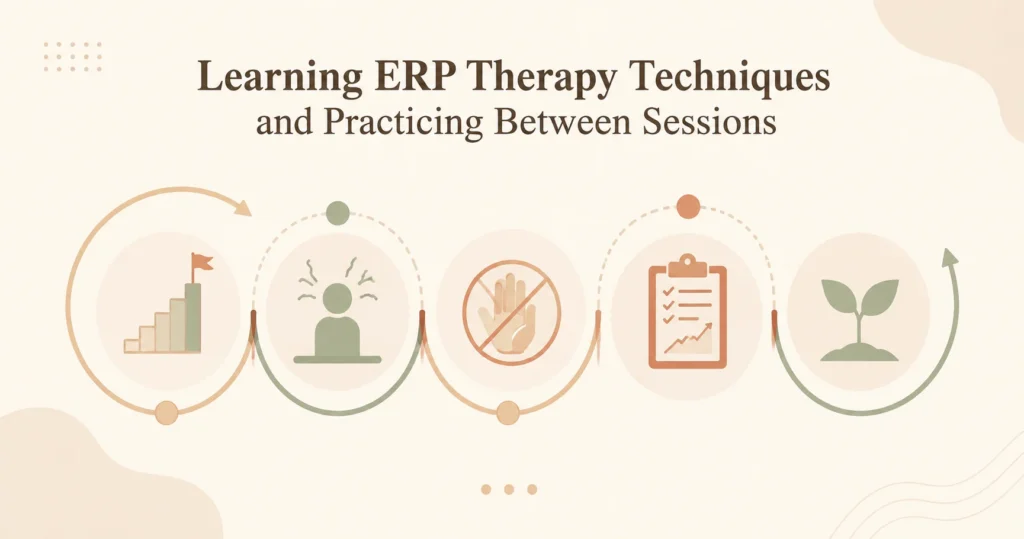
Learning ERP therapy techniques and practicing between sessions
A therapist trained in this approach can teach a small set of core ERP therapy techniques, including how to build a hierarchy, how to sit with discomfort without reaching for a ritual, and how to track progress so the work stays visible over weeks and months. Many people also want to know what ERP therapy at home can look like between appointments. Self-directed practice can support the work, but OCD is a condition where exposure done incorrectly, too fast, or without the response prevention piece done properly, can sometimes reinforce the very cycle it is meant to interrupt.
That is part of why a trained therapist’s guidance matters, especially early on, and why the two ideas, structured technique and safe practice, tend to travel together in a real course of treatment.
How Saalvio supports OCD and ERP-informed care
Saalvio’s highly experienced clinical team of registered psychotherapists and registered social workers includes clinicians trained in CBT, who can incorporate exposure and response prevention techniques into therapy for OCD. Therapy is currently offered in Ontario, with expansion across Canada underway. Sessions are typically reimbursable under most extended health benefit plans, and every client receives a detailed receipt for submission to their insurer.
If you are not sure whether a therapist’s approach or experience with OCD is the right fit, you can message any of our therapists with your questions before you book anything. There is no cost and no commitment. Our clinical team includes therapists who work in English, Urdu, Hindi, Punjabi, and Arabic, so language does not have to be another barrier on top of everything else OCD already makes harder.
When to reach out for support
OCD symptoms that take up more than an hour a day, or that get in the way of work, school, or relationships, are worth bringing to a clinician.
A real first step
If OCD has been quietly shaping your days, you do not have to figure out where to start on your own. A conversation with a therapist, even a brief message before you book, can be the whole first step.
Frequently Asked Questions
Is ERP therapy the same as CBT?
ERP is a specific form of CBT. CBT is the broader category, covering a range of approaches that connect thoughts, feelings, and behaviour, and exposure and response prevention is the part of it built specifically around facing fears and resisting compulsions rather than analyzing them.
How long does ERP therapy take to work?
This varies by person and by how long OCD has been present, how many areas of life it touches, and how consistently the practice happens between sessions. Many people notice gradual changes over weeks of consistent practice, though the exact pace is something to discuss with your therapist rather than something a general article can promise.
Can I do ERP therapy on my own?
Some people use self-help resources to understand the approach and build familiarity with it before starting therapy. But OCD often benefits from a trained therapist’s guidance, particularly around how to sequence exposures safely, how much distress is reasonable to sit with, and how to handle a setback without concluding that the approach is not working.
Does Saalvio diagnose OCD?
No. Saalvio’s clinicians can help you reflect on symptoms you bring to a session, but a diagnosis is made by a qualified clinician within their scope of practice, not by an app or a self-assessment tool on its own.
Clinically reviewed
Usman Khan, Registered Psychotherapist
Usman Khan is the Clinical Director of Saalvio and a Registered Psychotherapist with the College of Registered Psychotherapists of Ontario (CRPO #13456). He holds an MD, an MPH from Western University, and an MA in Counselling Psychology from Yorkville University. He reviews all clinical content on saalvio.com before publish.
See also across Saalvio
Topics mentioned in this post that have their own page on the site.
Talk to our clinical team
Saalvio offers a free 30-minute consultation with any therapist on the team. There is no card on file. If we are not the right fit, we will say so and help you find one.