
How does ERP therapy work?
Book a Free 30-Minute Consultation
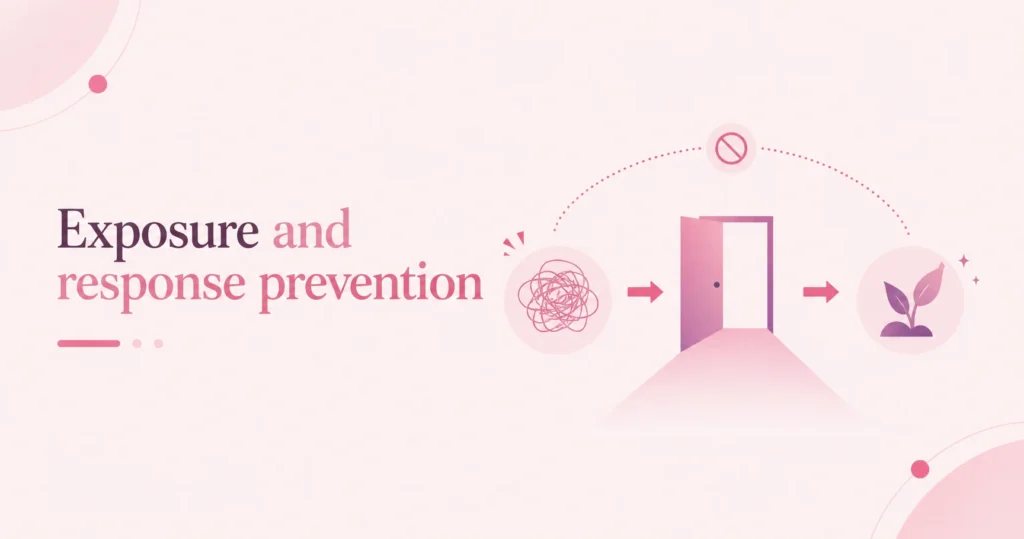
Exposure and response prevention works on a simple mechanism, even though living with OCD rarely feels simple. A therapist helps you deliberately approach a thought, image, or situation that triggers your obsession, and then helps you sit with the urge to perform the usual ritual without acting on it. Held together long enough, that pairing- exposure without the ritual- teaches your brain something new about the thing it has been afraid of.
For people looking for mental health support in Canada, ERP can be one way to work on these patterns with professional guidance.
How ERP therapy works
The mechanism has two moving parts, and both have to be present for the approach to do anything. The first part is exposure: deliberately bringing on the trigger instead of avoiding it. The second part is response prevention: choosing not to perform the compulsion that usually follows. Neither part alone accomplishes much.
Exposure without response prevention just repeats the same relief-seeking cycle that maintains OCD in the first place. Response prevention without exposure asks you to resist an urge that was never triggered on purpose, which is a much harder and less structured way to practice. Together, the two parts create a specific kind of learning experience: your nervous system registers the fear, waits it out without a ritual, and discovers that the feared outcome did not require one.
According to the Centre for Addiction and Mental Health, behaviour in cognitive-behavioural therapy can be changed using techniques including exposure and response prevention, alongside other strategies such as self-monitoring. It sits inside a broader model where thoughts and behaviour influence each other, and changing the behaviour side of that loop is often the fastest way to interrupt a pattern that has been running on autopilot for years.
What is ERP therapy and how does it work
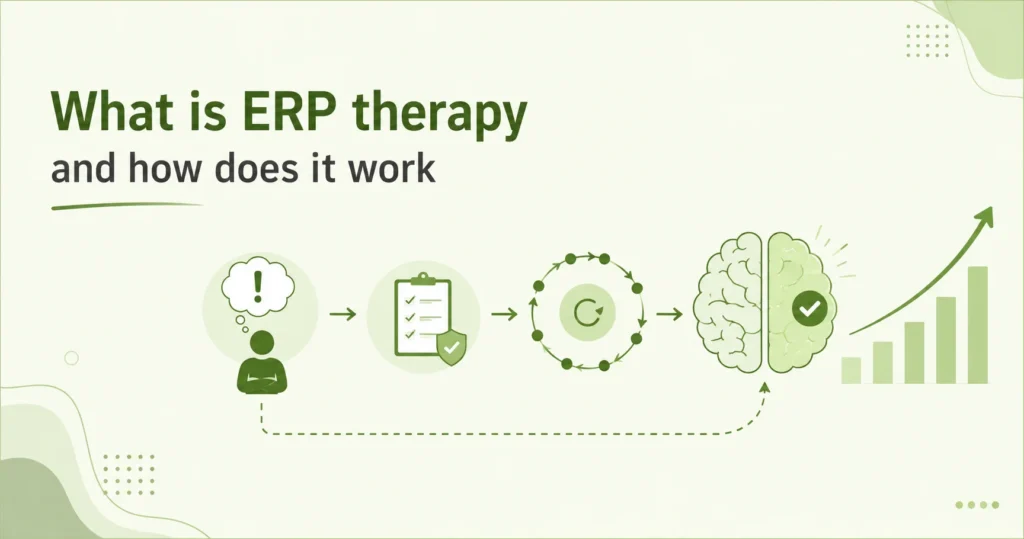
If you are still working out the basics, what is ERP therapy covers the fuller picture of what the approach is and where it came from. In short, it is not about willpower, and it is not about proving you can tolerate the anxiety once. It is about repetition. A single exposure teaches your brain very little.
A pattern of exposures, spaced out and gradually increasing in difficulty, teaches your brain to update a prediction it has been making for a long time, usually something close to “if I do not perform this ritual, something terrible will happen.” Each round of exposure without the ritual is evidence against that prediction. Over enough rounds, the prediction itself starts to change, not because anyone argued you out of it, but because your own experience contradicted it directly.
How does ERP work for OCD
For OCD specifically, the trigger and the ritual are usually easy to name, even if they are hard to sit with. Someone with contamination fears might be exposed to a doorknob, a public surface, or an unwashed hand, then asked to delay or skip the handwashing that usually follows. Someone with checking compulsions might be asked to leave the house without going back to check the stove, even once.
Someone with intrusive, unwanted thoughts might be asked to write the thought down and read it back, rather than mentally arguing with it or seeking reassurance that it is not true. Each of these is a version of the same underlying move: bring on the discomfort on purpose, then withhold the response that has been keeping the discomfort in charge.
How ERP works for ocd is easiest to see in the shape of the anxiety itself during a single exposure. Distress tends to rise quickly once the trigger is introduced, plateau for a period that can feel much longer than it actually is, and then fall on its own once the compulsion is withheld.
That fall is not something a therapist manufactures. It happens because sustained anxiety is metabolically expensive, and the body cannot maintain a peak fear response indefinitely without a threat that actually escalates. What the compulsion normally does is cut that curve short, which feels like relief but actually prevents you from ever learning that the curve comes down on its own. ERP simply lets the curve run its full course.
How does ERP therapy work between sessions
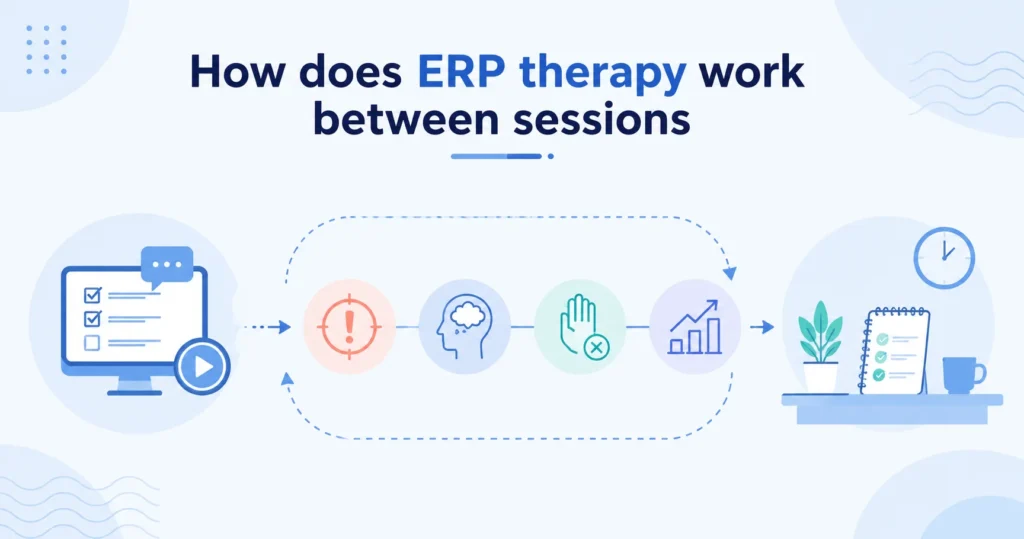
The mechanism does not pause when the appointment ends. Practice outside of sessions is where a lot of the real change happens, because a single exposure inside a fifty-minute session is not enough repetition to shift a pattern that has been reinforced daily for months or years.
Many people want to know what ERP therapy at home can look like once they understand the basic mechanism, since the same principle, exposure paired with withheld compulsion, applies whether the practice happens in a therapist’s office or in your own kitchen. What changes between the two settings is supervision and pacing, not the underlying process.
Consistency matters more than intensity. A short, deliberately chosen exposure practiced several times a week tends to produce more durable change than one long, difficult exposure attempted once and then avoided out of exhaustion. This is part of why a structured set of ERP therapy techniques, rather than an improvised approach, tends to work better. Structure keeps the difficulty level appropriate, keeps the response prevention piece consistent, and gives you a way to notice progress instead of guessing at it.
How does ERP therapy help with OCD?
The help shows up gradually and in layers. The first layer is usually a shorter distress curve: the same trigger stops producing as sharp or as long a spike in anxiety. The second layer is a shrinking ritual: checking once instead of five times, or not at all. The third layer, and often the one that matters most day to day, is time and attention returning to the rest of a person’s life. Hours that used to disappear into washing, checking, reviewing, or seeking reassurance become available again, for work, for relationships, for rest.
According to the Centre for Addiction and Mental Health, exposure and response prevention is a behavioural approach that is typically paired with cognitive strategies, helping a person notice and adjust the thinking patterns that kept the ritual feeling necessary in the first place. That combination, behaviour change plus a shift in how the underlying thoughts are held, is part of why the change tends to generalize beyond the specific triggers practiced in session, into situations that were never directly rehearsed.
How does ERP therapy work over the longer term?
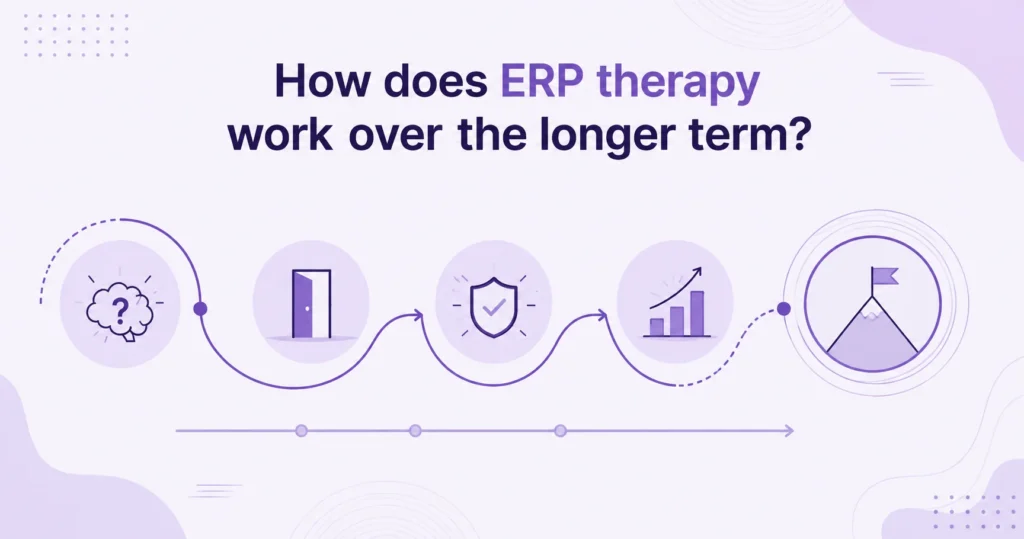
Change built through repeated exposure tends to hold up because it was earned through direct experience rather than reassurance from someone else. That said, OCD can find new triggers, especially during periods of stress, so many courses of treatment end with a maintenance phase: identifying early warning signs, agreeing on what to do if a new obsession appears, and keeping a small number of exposure practices going even after the main course of therapy has finished.
The goal is not to eliminate every uncomfortable thought forever. Intrusive thoughts are a normal part of how minds work. The goal is for those thoughts to stop requiring a ritual in order to pass.
If you are unsure whether this approach fits what you are experiencing, you can message any of our therapists with your questions before you book anything. There is no cost and no commitment, and a short conversation is often enough to tell whether the fit feels right.
So, how does ERP therapy work, from the first exposure to the last check-in with your therapist? One trigger faced on purpose, one ritual withheld, repeated often enough for the brain to trust its own experience over its old prediction.
When to reach out for support
OCD symptoms that take up significant time each day, or that interfere with work, school, or relationships, are worth bringing to a clinician.
Frequently Asked Questions
Does ERP therapy work quickly or slowly?
Both, in different ways. The distress curve within a single exposure often starts to fall within minutes. The broader shift, less time spent on rituals and less daily interference from OCD, tends to build over weeks of consistent practice rather than happening in one session.
Why does response prevention matter as much as exposure?
Because exposure without response prevention repeats the same cycle that keeps OCD going. Facing a fear and then performing the ritual anyway teaches the brain that the ritual was necessary. Withholding the ritual is what allows the brain to learn otherwise.
Can the mechanism stop working over time?
For most people, it does not, because the learning is based on direct experience rather than a technique that can be forgotten. New triggers can appear, particularly under stress, which is why a maintenance plan and occasional practice tend to be part of a full course of treatment.
Clinically reviewed
Usman Khan, Registered Psychotherapist
Usman Khan is the Clinical Director of Saalvio and a Registered Psychotherapist with the College of Registered Psychotherapists of Ontario (CRPO #13456). He holds an MD, an MPH from Western University, and an MA in Counselling Psychology from Yorkville University. He reviews all clinical content on saalvio.com before publish.
See also across Saalvio
Topics mentioned in this post that have their own page on the site.
Talk to our clinical team
Saalvio offers a free 30-minute consultation with any therapist on the team. There is no card on file. If we are not the right fit, we will say so and help you find one.