
How to Overcome Depression: A Plain Guide for Ontario
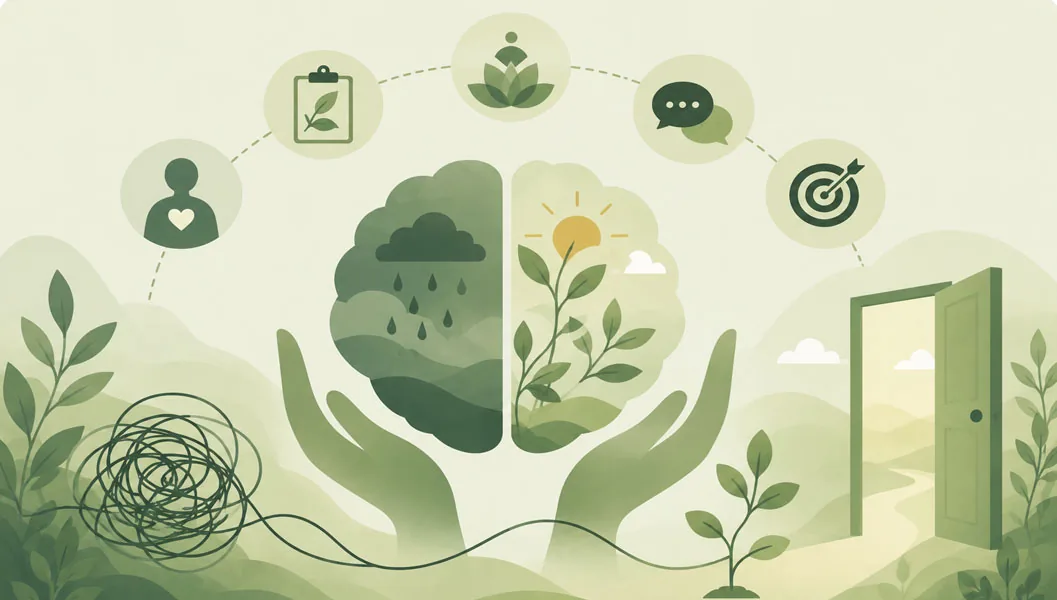
Depression is not a mood you can argue yourself out of. It is the coffee that tastes like nothing. It is the message you mean to answer for three days and cannot. It is your own voice gone flat and unkind, telling you that this is just who you are now. If you have been quietly asking how to overcome depression, you are already doing the hard part. You are still looking for a way through, on a day when looking takes everything you have.
This guide goes in small steps, because small steps are the honest answer. It covers what depression does, the natural things that help, what professional care looks like, and how to find support across Ontario when you are ready. There is no rush built into any of it. You can read it tired. You can read it unsure. If you are not sure whether what you are feeling is depression or a hard stretch of low mood, our post on the difference between sadness and depression can help you tell them apart.
How Do You Overcome Depression?
Start small and stay consistent. Anchor each day with a simple routine, get some daylight and gentle movement, practise mindfulness and slow breathing, stay connected to one person you trust, and break big tasks into tiny steps. These build traction over time. When self-help is not enough, structured therapy gives the kind of guidance that is hard to reach on your own.
That is the short version of how do you overcome depression, and it is also the answer to how can i overcome depression when the whole thing feels too heavy to lift. You do not lift the whole thing. You lift the next small piece of it. The best way to overcome depression is rarely one big change. It is a handful of small ones, repeated on the days you do not feel like it. Depression and how to overcome it is a question people often carry alone for years before saying it out loud, so the fact that you are asking matters.
Understanding the Psychology of Depression
Depression is layered, and it is rarely just one thing that sets it off. It usually comes from a mix of biology, the way we think, and what we are living through. It can grow out of old conflicts that never got resolved, hard chapters in our relationships, the harsh inner critic most of us carry, or emotional reserves worn thin by long stretches of stress. People sometimes call this mental depression, and how to overcome mental depression is, at root, the same patient work as any other low mood: understanding what is feeding it, then easing it one piece at a time. If you want to check what you are noticing in yourself, our guide to the signs of depression lays them out plainly.
There is something worth naming here. Depression is closely tied to physical health, not separate from it. According to CAMH (the Centre for Addiction and Mental Health), people with depression are two times more likely to have a stroke and 1.5 times more likely to develop cancer, and between 17 and 27 percent of people with heart disease go on to develop depression. The link runs both ways. That is why whole-person care, the kind that looks after your body and your mind together, matters so much. Our depression support page goes deeper into what depression is and how it is treated. Asking how do you overcome depression is not a small question. It is you deciding to look at the whole picture.
What Are Natural Ways to Overcome Depression?
Helpful natural steps include daily mindfulness, slow deep breathing, regular gentle movement, protecting your sleep, limiting social media comparison, and staying socially connected instead of isolating. Breaking tasks into small, doable steps builds momentum. These work best with consistency and patience, and alongside professional guidance when symptoms are heavy.
Before any formal therapy, there are natural ways to overcome depression that have helped a lot of people steady themselves. None of these are a cure, and none of them ask you to feel better on command. They just give you something to hold while you begin to overcome from depression at your own pace.
Practise Mindfulness
Mindfulness simply means paying attention to right now, on purpose, without judging it. Sit quietly for a few minutes, breathe, and notice what is actually around you. It can slow the spiral before it takes the whole day.
Learn Slow, Deep Breathing
Depression can keep your body braced, as if something bad is always about to happen. A slow inhale, a brief hold, and an even slower exhale tells your nervous system it is safe to let some of that tension go.
Connect With One Person You Trust
When we are low, the instinct is to hide. But isolation is fuel for depression. You do not have to tell anyone everything. One honest conversation with one person who will not flinch can remind you that you are not on an island. If reaching out in person feels like too much, this is also where online care across Ontario can help, a safe space to say the thing out loud.
Limit Social Media Comparison
It is easy to scroll into the trap of measuring your insides against everyone else’s outsides. If a feed leaves you feeling “less than,” step back from it. Unfollow what flattens you. Make room for what keeps you grounded in your real life.
Break Tasks Into Small Steps
When you are depressed, washing the dishes can feel like climbing a mountain. So do not look at the mountain. Look at your feet. Pick one small thing. Checking off even a tiny task gives you a real, earned sense of “I did that,” and on a hard day, that is not nothing.
What Are Coping Skills for Depression?
Five well-supported coping skills are mindfulness to stay grounded, behavioural activation (doing small tasks even when you do not feel like it), deep breathing to calm the nervous system, journaling to release heavy thoughts, and short bouts of physical activity to lift mood. Using several together helps both the physical and the emotional sides of depression.
Of these, behavioural activation is worth knowing by name. It is the practical heart of CBT for depression, which is cognitive behavioural therapy, a structured way of learning to notice and shift the unhelpful thoughts and habits that keep low mood going. Behavioural activation flips the usual logic. Instead of waiting to feel motivated before you act, you take a small action first, and let the motivation catch up. It is one of the most studied tools we have for depression, and you can start practising it before you ever see a therapist. Our closer look at how CBT works for depression walks through what those sessions actually involve.
How Do You Overcome Anxiety and Depression Together?
Anxiety and depression often travel together, and so does burnout. The same tools help all three: slow breathing to settle the nervous system, mindfulness to slow racing thoughts, small daily routines to hold onto, and focusing only on what you can control. Therapy that treats them together, such as CBT, is often more effective than treating each one on its own.
If you are trying to figure out how to overcome anxiety and depression at the same time, or how to overcome burnout and depression after months of running on empty, the overlap is good news. You are not fighting separate battles. You can read more about anxiety and how it interacts with low mood, and the same gentle, consistent approach tends to ease the whole knot at once.
How Do You Overcome Depression After a Breakup?
Grief after a breakup is real, and low mood or apathy (a flat, do-not-care feeling) is common. Keep a gentle routine, lean on supportive people, limit social media comparison, and let yourself feel without rushing it. If the heaviness lasts more than a few weeks, or stops you from functioning, talking to a therapist helps.
How to overcome breakup depression is partly about giving yourself permission to grieve a future you thought you had. That ache is not weakness. And how to overcome apathy depression, that numb stretch where nothing seems worth doing, often starts with behavioural activation: one small action, taken before the feeling returns, repeated until the colour slowly comes back.
How Do You Overcome Severe or Clinical Depression?
For severe, clinical, or chronic depression, professional support is essential, not optional. Structured therapy, ongoing support, and sometimes medication under a licensed healthcare provider help you manage intense episodes safely. Self-help alone is rarely enough at this level. If you are in crisis, please use the crisis resources at the bottom of this page.
Sometimes depression goes deeper than the natural steps can reach. If you are living with severe depression, clinical depression, or what feels like a deep depression that does not lift, that is not a personal failure. It is a health condition that has gone past the point where willpower is the answer. Learning how to overcome severe depression, how to overcome clinical depression, how to overcome deep depression, or how to overcome chronic depression almost always means letting someone trained walk it with you. There is no medal for doing the hardest version alone.
Bipolar depression is its own situation, because it sits inside bipolar disorder and the lows alternate with high-energy periods. How to overcome bipolar depression is not a self-help question; it needs assessment and ongoing care from a physician or psychiatrist, since the right plan usually involves medical management Saalvio does not provide. If this sounds like you, please start with your family doctor.
This is also where the question “is depression a disability” sometimes comes up. The plain answer is that depression is a recognized, treatable health condition, and how it is classified for work or benefits depends on its severity and impact in your specific situation. What matters most here is that it is treatable, and that you do not have to wait until it is unbearable to ask for help.
Exploring More Specialized Therapy Options
When low mood is tangled up with intense emotions or hard memories, a few specialized approaches can help. These are options a therapist might suggest, not a menu you have to choose from alone.
- DBT for intense emotions: dialectical behaviour therapy teaches skills for managing intense emotions and softening the “all-or-nothing” thinking depression often brings.
- EMDR: eye movement desensitization and reprocessing helps the brain reprocess stuck memories so they stop feeling so heavy in the present. (EMDR is offered by some clinicians; ask whether it fits your situation.)
- IPT: interpersonal therapy focuses on working through relationships, since healing how we connect with others often lifts mood directly.
How Can You Overcome Depression in Ontario?
Support across Ontario is closer than ever. Many programs blend in-person and virtual care, so you can meet a registered psychotherapist or registered social worker from home. Saalvio’s clinical team offers online therapy in Ontario for depression, including therapy in Toronto, therapy in Ottawa, and therapy in Mississauga, with a free first session as a no-pressure way to start.
If you have been searching for depression help Ontario Canada, or for mental health support in Toronto Ontario, the options are broader than they used to be. From the busy streets of Toronto to the quieter corners of the province, depression therapy Ontario and online therapy for depression Ontario are within reach without a referral. How to overcome depression in Ontario does not have to mean a six-month wait and a long commute. It can mean opening a screen at the hour you actually feel it.
How Saalvio Can Support You
If you are looking for depression therapy Toronto or anywhere across Ontario, Saalvio offers support that fits into your real life. Our clinical team of registered psychotherapists and registered social workers provides:
- Personalized therapy sessions with people who take the time to understand your context.
- CBT-based work to help shift the thought patterns that keep low mood going.
- Mood tracking and journaling tools in the Saalvio mobile app, so you can notice change over time.
- Easy access through the Saalvio mobile app on iPhone and Android.
Not ready to book? You can message a therapist before you book, with no cost and no commitment. Ask whatever you need to ask: whether they have worked with someone like you, whether their approach fits, whether they will understand the life you come from. Messaging is a conversation, not therapy by text, and not crisis support. Every Canadian’s first therapy session with a Saalvio clinician is free, so deciding to try is not a financial gamble on whether the fit will be right.
Saalvio’s virtual therapy is offered in Ontario today, delivered by registered psychotherapists and registered social workers. The Saalvio self-help app is available across Canada and the rest of North America. If you are not sure where to begin, how to find a therapist walks through it slowly.
Saalvio does not bill insurers directly. Sessions with registered psychotherapists and registered social workers are typically reimbursable under most Canadian extended health benefit plans, and you receive a detailed receipt to submit to your insurer. Coverage varies by plan, so it is worth checking yours.
How to Support Someone Overcoming Depression
If someone you love is depressed, listen without trying to fix it, ask how you can help rather than assuming, encourage small steps, and stay in touch even when they pull away. Gently encourage professional help and offer to help them find it. Look after your own wellbeing too. Supporting someone is easier when you are not running on empty.
Knowing how to support someone overcoming depression is its own kind of care, and it matters more than getting the words perfect. You do not need the right thing to say. You need to keep showing up. Often the most useful thing you can offer is not advice, but the steady fact of not leaving.
Can Depression Be Overcome Without Medication?
Often, yes, especially when symptoms are mild to moderate. Many people improve through therapy, lifestyle changes, and strong support. Medication is sometimes needed for more severe depression, decided with a licensed healthcare provider. Combining professional help with natural strategies tends to give the most lasting results. This is general information, not medical advice.
So can depression be overcome without medication, and is depression treatable at all? According to CMHA (the Canadian Mental Health Association), major depression affects about 5.4 percent of people in Canada, and the symptoms of mental illnesses can be treated and very often managed effectively, so that with the right supports people can thrive. Depression is a treatable health condition. Medication is one tool among several, not the only door in.
How Long Does It Take to Overcome Depression?
There is no fixed timeline. Recovery depends on severity, support, and treatment. Some people feel a lift in a few weeks; for others it takes months. Consistent, gentle progress matters more than speed. If symptoms are severe or include thoughts of self-harm, please seek help right away.
The honest answer to how long does it take to overcome depression is this: usually longer than you want, often shorter than it feels in the worst hours, and rarely a straight line. There will be days that feel like backsliding. Those days are part of the path, not proof you are failing.
Frequently Asked Questions
How do I get out of my depression?
Getting out of depression usually starts with small, manageable actions rather than one big change. Re-establish a simple daily routine, reach out to at least one trusted person, and seek professional guidance when self-help is not enough. Knowing how to get out of depression is less about a single leap and more about steady, repeated small steps.
What are 5 coping skills for depression?
Five well-supported coping skills for depression are mindfulness to stay grounded, behavioural activation (doing small tasks even when you do not feel like it), deep breathing to calm your nervous system, journaling to release heavy thoughts, and short bouts of physical activity to lift mood. Using several together helps both the physical and emotional sides.
Can depression be overcome without medication?
Often, yes, especially for mild to moderate depression. Many people improve through therapy, lifestyle changes, and a strong support network. Medication is sometimes needed for more severe cases and is decided with a licensed healthcare provider. Combining professional help with natural strategies tends to give the most lasting results. This is general information, not medical advice.
How long does it take to overcome depression?
There is no fixed timeline. Recovery depends on severity, support, and treatment. Some people feel a lift within a few weeks; for others it takes months. Consistent, gentle progress matters more than speed. If symptoms are severe or include thoughts of self-harm, please seek help right away.
How do I enjoy life again after depression?
Rediscovering joy is gradual. Revisit old hobbies without pressure to be good at them, practise gratitude for small moments, and keep up with CBT to hold a balanced perspective. Learning how to enjoy life again after depression is about patience as your capacity for happiness slowly returns, not forcing yourself to feel something on schedule.
How do I support someone overcoming depression?
Listen without trying to fix it, ask how you can help rather than assuming, encourage small steps, and stay in touch even when they withdraw. Gently encourage professional help and offer to help them find it. Look after your own wellbeing too; you cannot pour from an empty cup.
Can you recover from depression?
Yes. Depression is a treatable health condition. According to CMHA, the symptoms of mental illnesses can be treated and very often managed effectively, so that with the right supports people can thrive. With professional support, lifestyle changes, and a support network, most people are able to manage their symptoms and rebuild a full life. It can feel permanent in the moment; it usually is not.
Saalvio is not a crisis service. If you are in immediate danger, please call 911. If you are in mental health crisis, please call 988 (the Suicide Crisis Helpline of Canada) or visit your nearest emergency department.
Clinically reviewed by Usman Khan, RP (CRPO #13456)
Clinically reviewed
Usman Khan, Registered Psychotherapist
Usman Khan is the Clinical Director of Saalvio and a Registered Psychotherapist with the College of Registered Psychotherapists of Ontario (CRPO #13456). He holds an MD, an MPH from Western University, and an MA in Counselling Psychology from Yorkville University. He reviews all clinical content on saalvio.com before publish.
See also across Saalvio
Topics mentioned in this post that have their own page on the site.
Talk to our clinical team
Saalvio offers a free first session with any therapist on the team. There is no card on file. If we are not the right fit, we will say so and help you find one.